
Short Answer
Short Answer / Definition
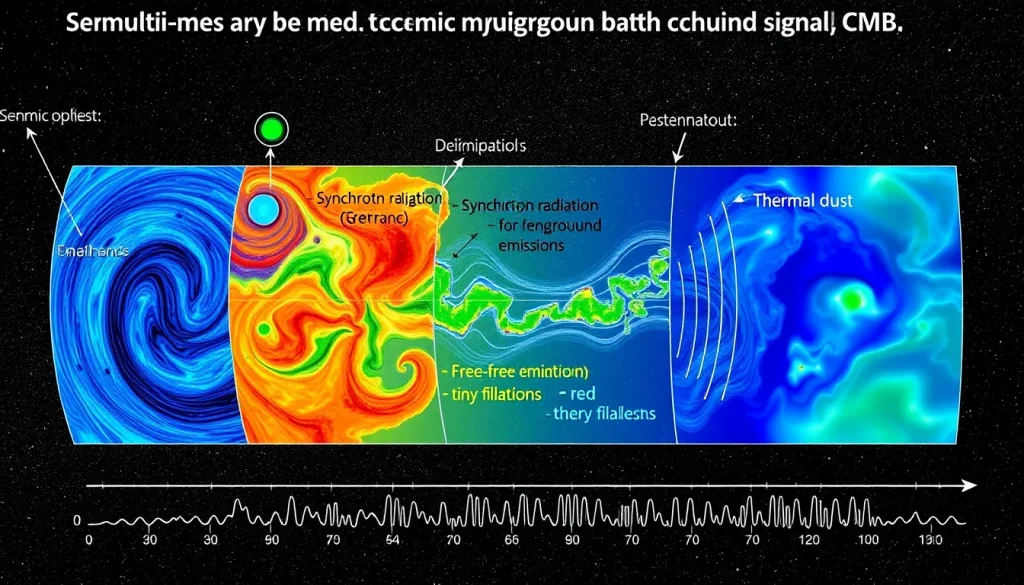
Foreground removal in cosmic microwave background (CMB) observations refers to the suite of techniques used to separate the primordial CMB signal from emissions originating in our Milky Way (synchrotron radiation, free-free emission, and thermal dust) and from extragalactic sources (such as radio galaxies and infrared galaxies). Because these foregrounds contaminate CMB maps at various frequencies, astronomers must model and subtract them to recover the faint, uniform radiation left over from the Big Bang. This process is essential for measuring CMB temperature and polarization anisotropies, which encode information about the universe’s composition, geometry, and evolution.
Main Explanation
The cosmic microwave background is a relic of the hot, dense early universe. About 380,000 years after the Big Bang, the universe had cooled enough for protons and electrons to combine into neutral hydrogen, allowing photons to travel freely. These photons, now stretched by cosmic expansion, form the CMB we observe today. However, the CMB is not the only thing emitting light at microwave and sub-millimeter wavelengths. Our galaxy produces foregrounds through synchrotron radiation (from relativistic electrons in magnetic fields), free-free emission (from ionized gas), and thermal radiation from interstellar dust. Additionally, extragalactic objects like radio galaxies, infrared galaxies, and the Sunyaev-Zel’dovich effect from galaxy clusters contaminate the signal.
To extract cosmological information, astronomers must remove these foregrounds with high precision. The challenge is that the CMB has a blackbody spectrum, while foregrounds have different spectral shapes. By observing at multiple frequencies, one can exploit these spectral differences to separate components. Modern algorithms such as SMICA (Spectral Matching Independent Component Analysis), SEVEM (Spectral Estimation via Expectation Maximization), and NILC (Needlet Internal Linear Combination) are used by the Planck collaboration to produce cleaned CMB maps (Planck 2013, Planck 2015). These methods combine frequency maps, weighted to minimize variance and residual foregrounds.
Foreground removal is not just a technical nuisance—it is the gateway to understanding the universe’s evolution. The CMB anisotropies, once cleaned, reveal the seeds of large-scale structure. They allow us to measure the Hubble constant, the curvature of space, and the abundances of dark matter and dark energy. Moreover, the CMB is a snapshot of the recombination epoch, but the story of the cosmos spans far longer. The following table outlines the major epochs from the Planck epoch to the present day, showing how the universe evolved from a quantum foam to the structured cosmos we inhabit.
Cosmic Epochs Timeline
| Epoch | Time After Big Bang | Temperature | Redshift | Key Events |
|---|---|---|---|---|
| Planck Epoch | < 10⁻⁴³ s | > 10³² K | ? | Quantum gravity effects dominate; no known physics |
| Grand Unification Epoch | 10⁻⁴³ – 10⁻³⁶ s | 10²⁷ – 10³² K | ? | Unification of strong, weak, and electromagnetic forces |
| Inflationary Epoch | 10⁻³⁶ – 10⁻³² s | ~10²⁷ K | ? | Exponential expansion; quantum fluctuations become seeds of structure |
| Electroweak Epoch | 10⁻³² – 10⁻¹² s | 10¹⁵ – 10²⁷ K | ? | Electromagnetic and weak forces separate; particles acquire mass |
| Quark Epoch | 10⁻¹² – 10⁻⁶ s | 10¹² – 10¹⁵ K | ? | Quarks and gluons form quark-gluon plasma |
| Hadron Epoch | 10⁻⁶ – 1 s | 10¹⁰ – 10¹² K | ? | Quarks combine into hadrons (protons, neutrons); matter-antimatter asymmetry emerges |
| Lepton Epoch | 1 – 10 s | 10⁹ – 10¹⁰ K | ? | Leptons dominate; neutrinos decouple |
| Photon Epoch | 10 s – 380,000 yr | 3,000 – 10⁹ K | ~3400 – 1100 | Nucleosynthesis (BBN) forms light elements; photons couple to matter |
| Recombination | ~380,000 yr | ~3,000 K | ~1100 | Electrons and protons form neutral hydrogen; CMB released |
| Dark Ages | 380,000 yr – ~150 million yr | ~3,000 – 60 K | ~1100 – 20 | No stars yet; universe filled with neutral gas |
| Reionization | ~150 million – 1 billion yr | ~60 – 15 K | ~20 – 6 | First stars and galaxies ionize hydrogen |
| Structure Formation | 1 billion yr – present | < 15 K | < 6 | Galaxies, clusters, and large-scale structure form; dark energy accelerates expansion |
The CMB is the most direct evidence for the early universe, and its study has been revolutionized by space missions. COBE (1989) confirmed the CMB’s blackbody spectrum and discovered tiny temperature fluctuations. WMAP (2001–2010) measured the power spectrum with high precision, pinning down cosmological parameters. Planck (2009–2013) provided even sharper maps, testing inflation and constraining the number of neutrino species. The James Webb Space Telescope (JWST) is now probing the era of reionization and first galaxies, complementing CMB studies.
Concept: Foreground Removal Techniques
Definition
Foreground removal is the process of isolating the CMB signal from contaminating astrophysical emissions in multi-frequency sky maps. It is a critical step in CMB data analysis, as foregrounds can mimic or distort the primordial anisotropies.
How It Works
Foregrounds have distinct spectral energy distributions (SEDs) that differ from the CMB’s blackbody spectrum. By observing the sky at multiple frequencies, one can model each component’s contribution using its known or fitted SED. Techniques like Internal Linear Combination (ILC) assume the CMB is constant across frequencies after scaling, and find weights that minimize total variance while preserving the CMB. More advanced methods like SMICA use spectral covariance matrices to separate components in harmonic space. These methods produce cleaned CMB maps and also foreground maps that are useful for studying our galaxy.
Example
The Planck mission observed the sky in nine frequency bands (30–857 GHz). Using SMICA, SEVEM, and NILC, the Planck team produced several cleaned CMB maps. These maps were used to measure the temperature power spectrum to cosmic-variance-limited accuracy, confirming the six-parameter ΛCDM model (Planck 2015). For example, the SMICA map combines all nine frequencies with weights that suppress foregrounds while retaining CMB signal.
Observable Consequences
Successful foreground removal allows astronomers to measure the CMB power spectrum, which exhibits acoustic peaks and damping tail. These features constrain the baryon density, dark matter density, and the curvature of space. Foreground removal also enables the detection of B-mode polarization from primordial gravitational waves—a key test of inflation. Without cleaning, these signals would be swamped by galactic dust and synchrotron emission.
Common Misconceptions
One misconception is that foregrounds are simply ‘noise’ that can be averaged away. In reality, they are structured signals that require careful modeling. Another is that a single frequency is enough; in fact, multi-frequency observations are essential. Finally, some think that cleaned CMB maps are free of all contamination, but residuals remain, especially near the galactic plane, and must be accounted for with masks and error estimates.
Why It Matters
The ability to remove foregrounds is not just a technical achievement—it is the foundation of precision cosmology. The CMB is our earliest direct probe of the universe, and its anisotropies encode the initial conditions that led to galaxies and clusters. By cleaning the CMB, we can test the inflationary paradigm, measure the geometry of space, and constrain the nature of dark matter and dark energy. Moreover, the same component-separation techniques are applied to other datasets, such as the Atacama Cosmology Telescope (ACT) and the Simons Observatory, ensuring that future experiments continue to push the boundaries of our knowledge.
Evidence / Sources
The Planck 2013 results (Ade et al., 2014) and Planck 2015 results (Adam et al., 2015) provide detailed descriptions of component separation methods and the resulting CMB maps. The review by Paykari & Starck (2011) outlines the data analysis pipeline, including map-making and component separation. Petroff et al. (2020) demonstrate a machine-learning approach to full-sky foreground cleaning. These sources are authoritative and peer-reviewed.
Related Registry Entries
This article is related to entries on the Cosmic Microwave Background, the Planck Mission, Recombination, Inflation, and Large-Scale Structure. It also connects to techniques like Component Separation and the measurement of cosmological parameters.
FAQ
Why is foreground removal necessary for CMB observations?
Foregrounds from our galaxy and extragalactic sources emit at the same frequencies as the CMB and can mask or distort the primordial signal. Without removal, precise measurements of CMB anisotropies would be impossible.
What are the main types of foregrounds?
The main foregrounds are synchrotron radiation from relativistic electrons, free-free emission from ionized gas, thermal dust emission, and extragalactic sources such as radio galaxies and infrared galaxies.
How do component separation methods like SMICA work?
SMICA (Spectral Matching Independent Component Analysis) models the sky as a mixture of CMB and foregrounds with different spectral shapes. It fits the spectral covariance matrix in harmonic space to estimate each component's contribution, producing a cleaned CMB map.

Leave a Reply