
Short Answer
Main Explanation
CMB-S4 (Cosmic Microwave Background Stage 4) was a proposed next-generation ground-based observatory designed to probe the earliest moments of the universe by studying the cosmic microwave background (CMB)—the relic radiation left over from the Big Bang. Although the project was canceled on July 9, 2025, by the U.S. Department of Energy and the National Science Foundation, its scientific goals and technical designs continue to shape the field of cosmology. This article explains what CMB-S4 would have done, why the CMB is so important, and how the universe evolved from the Planck epoch to the present day.
The CMB is a faint glow of microwaves that fills the entire sky, a snapshot of the universe when it was just 380,000 years old. At that moment, protons and electrons combined to form neutral hydrogen, and photons decoupled from matter, traveling freely ever since. The CMB carries imprints of the initial conditions that led to the formation of galaxies, clusters, and the large-scale structure we observe today. By measuring the CMB with extraordinary precision, cosmologists can test theories of inflation, measure the number and masses of neutrinos, constrain dark energy, and search for new light particles.
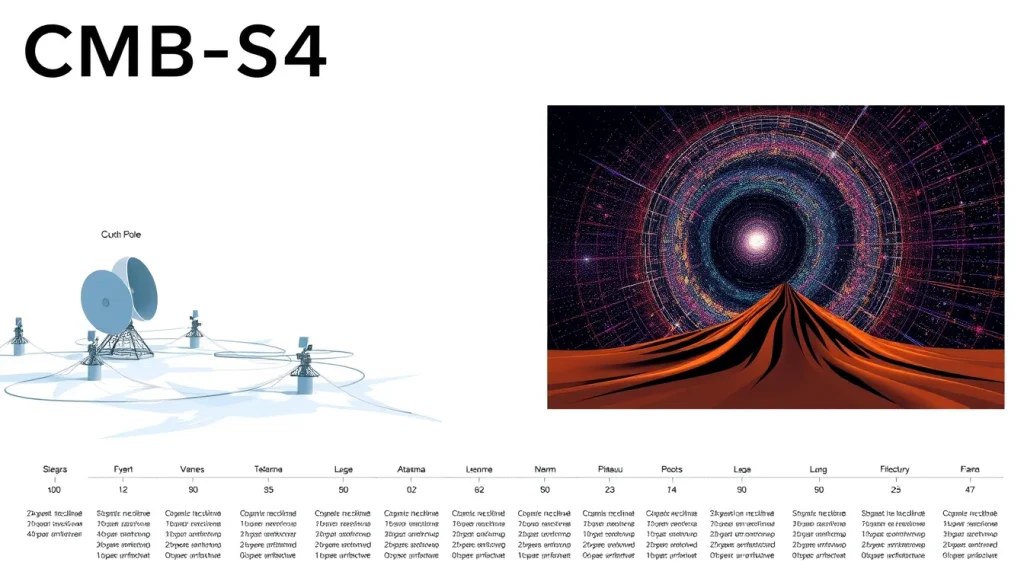
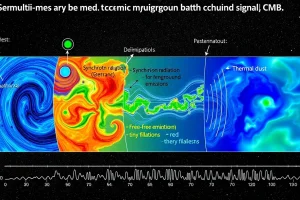
CMB-S4 was designed to be the ultimate ground-based CMB experiment, building on the legacy of COBE, WMAP, and Planck. It would have deployed about 500,000 superconducting detectors—an order of magnitude more than any previous experiment—across two sites: the South Pole and the Atacama Plateau in Chile. These detectors would have observed the sky in 11 frequency bands spanning 20 to 300 GHz, allowing astronomers to separate the faint CMB signal from galactic foregrounds such as dust and synchrotron radiation. The project was endorsed as the highest-priority new initiative by the 2023 Particle Physics Project Prioritization Panel (P5) and as a high-priority recommendation by the Astro2020 decadal survey.
To understand why CMB-S4 mattered, it helps to revisit the cosmic timeline. The universe began in an incredibly hot, dense state known as the Planck epoch, lasting from t=0 to about 10⁻⁴³ seconds. During this period, all four fundamental forces were unified, and quantum gravitational effects dominated. As the universe expanded and cooled, the forces separated one by one. The Grand Unification epoch (10⁻⁴³ to 10⁻³⁶ s) saw the strong and electroweak forces unify, while the inflationary epoch (10⁻³⁶ to 10⁻³² s) witnessed a dramatic exponential expansion that stretched quantum fluctuations to cosmic scales. These fluctuations later seeded the large-scale structure of the universe.
After inflation, the universe entered the electroweak epoch (10⁻³² to 10⁻¹² s), when the electromagnetic and weak forces separated. Then came the quark epoch (10⁻¹² to 10⁻⁶ s), where quarks and gluons existed in a quark-gluon plasma. As the universe cooled further, hadrons formed during the hadron epoch (10⁻⁶ s to 1 s), followed by the lepton epoch (1 s to 10 s) when leptons dominated. Around 10 seconds after the Big Bang, the photon epoch began, with photons and baryons tightly coupled. At about 380,000 years, recombination occurred—electrons and protons combined to form neutral hydrogen—and the universe became transparent. The photons released at this moment are the CMB we observe today.
Following recombination, the universe entered the Dark Ages, a period with no stars or galaxies. Gravity slowly amplified tiny density fluctuations, and around 100–200 million years after the Big Bang, the first stars and galaxies formed, initiating reionization. This epoch ended when ultraviolet radiation from these first objects ionized the intergalactic medium. Over billions of years, structure formation led to the galaxies, clusters, and superclusters we see today, all while dark energy accelerated cosmic expansion.
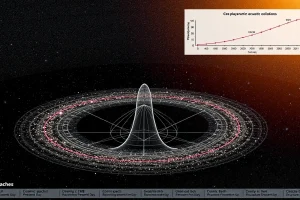
The CMB provides a direct window into the earliest observable moments. By measuring its temperature anisotropies—variations of a few parts in 100,000—and its polarization patterns, scientists can extract a wealth of information. The temperature power spectrum reveals the acoustic peaks: oscillations in the photon-baryon fluid that encode the composition and geometry of the universe. The polarization, particularly the B-mode signal, is a unique signature of primordial gravitational waves predicted by inflation. CMB-S4 was designed to detect these B-modes with unprecedented sensitivity, potentially confirming or ruling out whole classes of inflationary models.
The table below summarizes the major cosmic epochs and their key characteristics.
| Epoch | Time After Big Bang | Temperature | Key Events |
|---|---|---|---|
| Planck | 0 – 10⁻⁴³ s | >10³² K | All forces unified; quantum gravity dominates |
| Grand Unification | 10⁻⁴³ – 10⁻³⁶ s | 10²⁷ – 10³² K | Strong and electroweak forces separate |
| Inflation | 10⁻³⁶ – 10⁻³² s | ~10²⁷ K | Exponential expansion; quantum fluctuations stretched |
| Electroweak | 10⁻³² – 10⁻¹² s | 10¹⁵ – 10²⁷ K | Electromagnetic and weak forces separate |
| Quark | 10⁻¹² – 10⁻⁶ s | 10¹² – 10¹⁵ K | Quark-gluon plasma; quarks not yet confined |
| Hadron | 10⁻⁶ – 1 s | 10¹⁰ – 10¹² K | Protons and neutrons form; baryon–antibaryon annihilation |
| Lepton | 1 – 10 s | 10⁹ – 10¹⁰ K | Leptons dominate; neutrinos decouple |
| Photon | 10 s – 380,000 yr | 3,000 – 10⁹ K | Photons coupled to matter; primordial nucleosynthesis |
| Recombination | ~380,000 yr | ~3,000 K | Neutral atoms form; CMB released |
| Dark Ages | 380,000 – ~100 Myr | ~3,000 – 50 K | No light sources; neutral hydrogen |
| Reionization | ~100 – 500 Myr | ~50 – 10 K | First stars and galaxies ionize intergalactic medium |
| Structure Formation | ~500 Myr – present | ~10 K – 2.7 K | Galaxies, clusters, and large-scale structure form; dark energy dominates |
Mission
Mission Facts
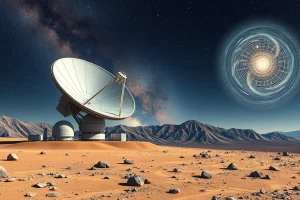
CMB-S4 was a proposed ground-based observatory, not a space mission. It would have consisted of multiple telescopes at the South Pole and in the Atacama Plateau in Chile. The project was a joint effort of the U.S. Department of Energy (DOE) and the National Science Foundation (NSF), with contributions from international partners.
Launch
No launch was planned; CMB-S4 was designed for ground-based operation. The project was in its design and development phase when it was canceled on July 9, 2025.
Telescope/Instrument
CMB-S4 would have employed both large-aperture and small-aperture telescopes to probe a wide range of angular scales. The detectors would have been superconducting transition-edge sensors (TES) and microwave kinetic inductance detectors (MKIDs), totaling approximately 500,000—an order of magnitude more than any previous experiment.
Wavelength
The observatory would have observed in 11 frequency bands spanning 20 to 300 GHz, corresponding to wavelengths from about 1 cm to 1 mm. This broad coverage was essential for separating the CMB from galactic foregrounds.
Objective
The primary objectives were to detect or constrain the primordial B-mode polarization of the CMB (a signature of inflation), measure the sum of neutrino masses, determine the number of relativistic species, probe dark energy and dark matter models, and map the gravitational lensing of the CMB to trace the distribution of matter throughout cosmic history.
Major Results
Because the project was canceled before construction, no scientific results were produced. However, the design and simulation work yielded significant technical advances and a comprehensive science book that will guide future experiments.
Dataset
No observational dataset was generated. The project’s legacy includes extensive survey simulations, instrumentation designs, and a detailed document archive maintained by the CMB-S4 collaboration.
Legacy
Although canceled, CMB-S4’s technical innovations—such as large-format detector arrays, advanced readout systems, and foreground removal techniques—will inform future CMB experiments. The science collaboration continues to develop plans to support the community, and the scientific priorities identified by CMB-S4 remain central to cosmology.
Why It Matters
The cancellation of CMB-S4 is a significant setback for cosmology, but the questions it aimed to answer remain pressing. The CMB is our most direct probe of the early universe, and the search for inflationary B-modes is one of the highest-priority goals in astrophysics. The measurements of neutrino masses and the nature of dark energy are crucial for understanding the fundamental physics of the universe. While CMB-S4 will not be built as originally envisioned, its legacy lives on in the technical developments and the scientific community’s continued commitment to these questions. Future experiments—both ground-based and space-based—will build on the groundwork laid by CMB-S4.
Evidence / Sources
The information in this article is based on the official CMB-S4 project website and related resources. The cancellation announcement is documented at cmb-s4.org. The experiment’s design and science goals are described in the project’s overview and science book. Additional details are available from the Lawrence Berkeley National Laboratory’s CMB-S4 page.
Related Registry Entries
Related topics include the cosmic microwave background itself, cosmic inflation, the Big Bang model, and the missions that preceded CMB-S4, such as COBE, WMAP, and Planck. See the links below for deeper dives.
Last Reviewed: September 5, 2026
FAQ
Why was CMB-S4 canceled?
On July 9, 2025, the U.S. Department of Energy and the National Science Foundation issued a joint statement saying they could no longer support the project. The reasons were not detailed in the statement, but it marked the end of the design and development phase.
What would CMB-S4 have measured?
CMB-S4 would have measured the cosmic microwave background with unprecedented sensitivity, focusing on the B-mode polarization (a signature of inflation), the lensing of the CMB, and the temperature and polarization anisotropies to constrain neutrino masses and dark energy.
How does the CMB reveal the history of the universe?
The CMB is a relic of the moment when the universe became transparent, about 380,000 years after the Big Bang. Its tiny temperature fluctuations encode the initial density perturbations that grew into galaxies and clusters. The CMB's polarization and power spectrum also carry information about inflation, neutrinos, and the geometry of space.
Leave a Reply