
Short Answer
Main Explanation
The universe began in an extremely hot, dense state and has been expanding and cooling ever since. The standard cosmological model, Lambda-CDM, describes a sequence of epochs from the Planck epoch (t < 10⁻⁴³ s) through inflation, the formation of elementary particles, nucleosynthesis, recombination, and the emergence of stars and galaxies. Each epoch is defined by the dominant physics and particle content of the cosmos.
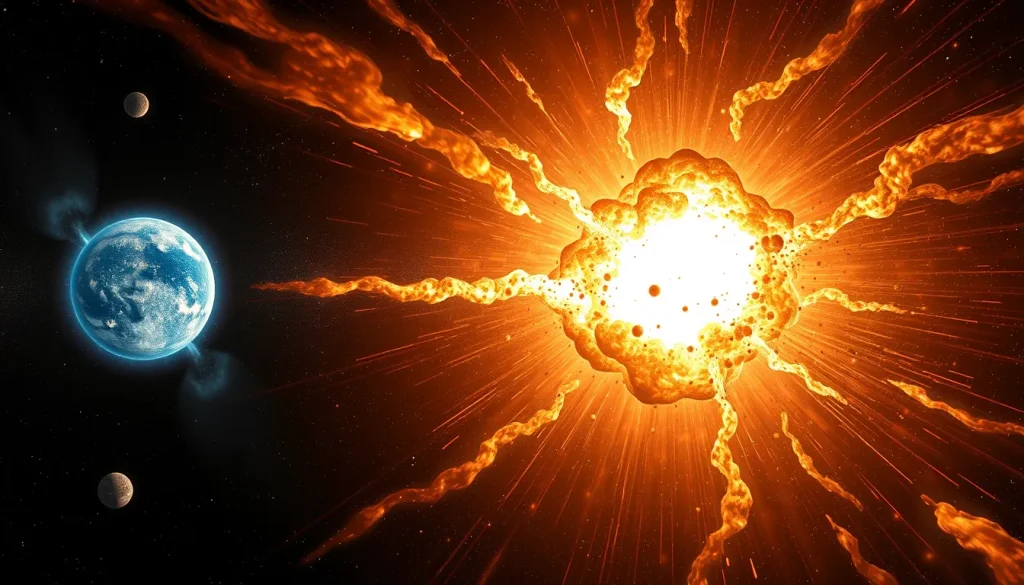
Among the most dramatic events in this cosmic history are pair-instability supernovae (PISNe). These are predicted to have exploded from the first massive stars, known as Population III stars, which formed out of pristine hydrogen and helium gas in the early universe. With masses between roughly 130 and 250 times that of the Sun, these stars would have died in a runaway thermonuclear explosion that completely obliterated them, leaving no black hole or neutron star behind.
A Brief Cosmic Timeline
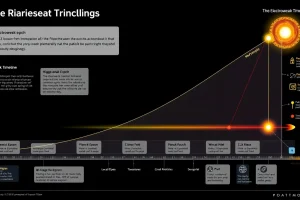
The table below summarizes the major epochs of the universe, from the Planck epoch to the present day, highlighting where PISNe fit in.
| Epoch | Time After Big Bang | Key Events |
|---|---|---|
| Planck Epoch | < 10⁻⁴³ s | Quantum gravity dominates; no current theory fully describes it. |
| Grand Unification Epoch | 10⁻⁴³ – 10⁻³⁶ s | Strong and electroweak forces unify; inflation begins. |
| Inflationary Epoch | 10⁻³⁶ – 10⁻³² s | Exponential expansion; seeds of large-scale structure form. |
| Electroweak Epoch | 10⁻³² – 10⁻¹² s | Electromagnetic and weak forces separate; quarks and leptons exist. |
| Quark Epoch | 10⁻¹² – 10⁻⁶ s | Quarks and gluons form a quark-gluon plasma. |
| Hadron Epoch | 10⁻⁶ – 1 s | Protons and neutrons form; matter-antimatter asymmetry emerges. |
| Lepton Epoch | 1 – 10 s | Leptons dominate; neutrinos decouple. |
| Photon Epoch | 10 s – 380,000 yr | Photons dominate; nucleosynthesis creates light elements. |
| Recombination | ~380,000 yr | Electrons combine with nuclei; CMB is released. |
| Dark Ages | 380,000 yr – ~100 million yr | No luminous sources; neutral hydrogen fills the universe. |
| Reionization | ~100 million – 1 billion yr | First stars and galaxies ionize neutral hydrogen; PISNe may contribute. |
| Structure Formation | 1 billion yr – present | Galaxies, clusters, and large-scale structure form. |
The Role of Pair-Instability Supernovae
Population III stars are the first stars, formed from gas that had not yet been enriched with elements heavier than helium. Because they were so massive, they burned hot and fast, and many are expected to have ended their lives as PISNe. These explosions are unique: they completely disrupt the star, ejecting all of its material into the surrounding medium. This process enriches the intergalactic medium with heavy elements, including carbon, oxygen, and silicon, which are essential for later star formation and planet formation.
Moreover, PISNe are extremely luminous, potentially outshining an entire galaxy for a short time. Their light curves and spectra have distinctive features that could be detected by telescopes such as the James Webb Space Telescope (JWST). Observations of high-redshift supernovae could provide direct evidence of Population III stars and help map the timeline of reionization.
Concept: Pair-Instability Supernovae
Definition
A pair-instability supernova is a type of supernova that occurs in very massive stars (roughly 130–250 solar masses) with low metallicity. In the core, extremely energetic gamma rays produce electron-positron pairs, reducing the radiation pressure that supports the star against gravity. This leads to a partial collapse and then a runaway thermonuclear explosion that completely destroys the star, leaving no remnant.
How It Works
In the core of a massive star, gamma rays are produced by nuclear fusion. When the temperature exceeds about 10⁹ K, the energy of these gamma rays is high enough to convert into electron-positron pairs (pair production). This process removes energy from the radiation field, lowering the pressure that counteracts gravity. The core contracts, heating further and triggering an explosive oxygen-burning phase. The energy released exceeds the gravitational binding energy, and the entire star is blown apart.
Equation
The threshold for pair production occurs when the photon energy (E = hν) exceeds twice the rest-mass energy of an electron (2mₑc² ≈ 1.022 MeV). The efficiency of pair production depends on the temperature and density of the core, and the resulting instability is modelled by the Chandrasekhar-like condition for the core’s pressure support.
Example
A 200 solar-mass Population III star with zero metallicity would evolve to a core temperature of about 10⁹ K, triggering pair instability. The resulting supernova would have a peak luminosity exceeding 10⁴⁶ erg/s and a light curve that lasts for months. The explosion would completely disperse the star, seeding the surrounding gas with heavy elements.
Observable Consequences
PISNe are expected to be visible at high redshifts, possibly out to z ≈ 10–20. Their distinctive light curves (long-duration, with a plateau or multiple peaks) and spectra (strong helium and oxygen lines) distinguish them from ordinary core-collapse supernovae. Surveys with JWST or the upcoming Nancy Grace Roman Space Telescope could detect them, providing a direct probe of Population III stars and the reionization epoch.
Common Misconceptions
One misconception is that PISNe leave behind black holes. In reality, the explosion is so energetic that the star is completely disrupted, leaving no compact remnant. Another is that PISNe are rare; while they are rare in the local universe, they may have been common among the first stars. Finally, some think PISNe are the same as hypernovae or gamma-ray bursts, but they are a distinct class with different physical mechanisms.
Why It Matters
Pair-instability supernovae are a key piece in our understanding of the early universe. They are likely the first source of heavy elements, enriching the gas that later formed lower-mass stars and planets. They may also contribute to the ionizing radiation that drove reionization. Detecting them would confirm the existence of Population III stars and test models of star formation in the early universe. Moreover, their absence in the local universe sets constraints on the maximum mass of stars today, linking cosmic history to present-day stellar populations.
Evidence / Sources
Current evidence for PISNe is indirect, based on theoretical models and the observed chemical abundance patterns in ancient stars. The first stars are too faint to be observed directly, but their supernovae could be detected. Recent studies have predicted the rates and signatures of PISNe and their detectability with JWST. The sources below provide detailed analyses.
- Venditti et al. (2023) – “The first fireworks: A roadmap to Population III stars during the epoch of reionization through pair-instability supernovae” doi:10.1093/mnras/stad3513
- Whalen et al. (2013) – “Finding the First Cosmic Explosions. I. Pair-Instability Supernovae” doi:10.1088/0004-637X/777/2/110
- Pan et al. (2012) – “Pair-instability supernovae at the epoch of reionization” doi:10.1111/j.1365-2966.2012.20837.x
- Wikipedia – “Pair-instability supernova” https://en.wikipedia.org/wiki/Pair-instability_supernovae
Related Registry Entries
Explore other entries in this interactive reference:
Last Reviewed / Updated: September 5, 2026
FAQ
What is the difference between a pair-instability supernova and a core-collapse supernova?
Core-collapse supernovae occur in stars with masses roughly 8–100 solar masses and leave behind a neutron star or black hole. Pair-instability supernovae occur in very massive stars (130–250 solar masses) with low metallicity, and the explosion completely disrupts the star, leaving no remnant.
Could a pair-instability supernova be observed today?
They are expected to be extremely rare in the local universe because such massive stars do not form in metal-rich environments. However, telescopes like JWST are designed to detect them at high redshifts, possibly out to z ≈ 20.
How do pair-instability supernovae contribute to reionization?
The explosion itself does not directly reionize much hydrogen, but the massive Population III stars that produce them are strong sources of ionizing radiation. The supernovae also enrich the gas, which can affect subsequent star formation and the escape of ionizing photons.
What evidence do we have for pair-instability supernovae?
Currently, evidence is indirect: theoretical models predict their existence, and chemical abundance patterns in ancient stars suggest enrichment by PISNe. Direct detection is a major goal of JWST and future surveys.
Leave a Reply