
Short Answer
Main Explanation
The Friedmann equations, also known as the Friedmann–Lemaître (FL) equations, are the central mathematical framework of modern cosmology. They describe how the universe expands or contracts over time under the assumptions of spatial homogeneity and isotropy — the cosmological principle. First derived by Alexander Friedmann in 1922 from Einstein’s field equations of general relativity, these equations govern the evolution of the cosmic scale factor a(t), which quantifies how distances between freely moving objects change as the universe expands.
Definition
The Friedmann equations are a set of two independent differential equations that relate the expansion rate (parameterized by the Hubble parameter H) to the energy density ρ, pressure p, spatial curvature k, and the cosmological constant Λ. They assume a perfect fluid source and the Friedmann–Lemaître–Robertson–Walker (FLRW) metric, which is the most general metric satisfying homogeneity and isotropy.
How It Works
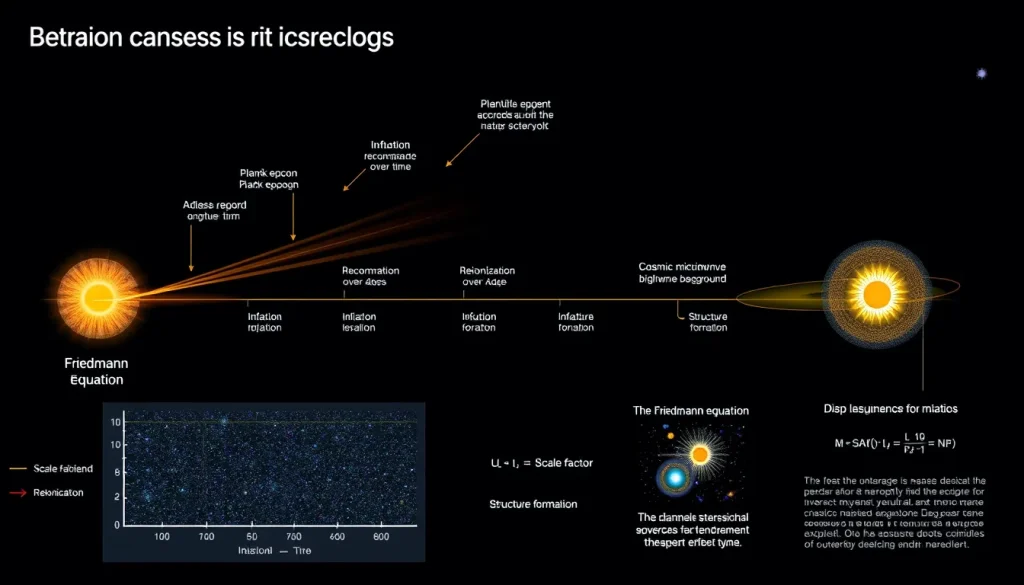
In essence, the Friedmann equation is the gravitational field equation applied to the whole universe. It states that the expansion rate squared is proportional to the energy density minus the curvature term plus a cosmological constant term. The second Friedmann equation (acceleration equation) describes how the expansion rate changes with time, driven by the sum of density and pressure. Together, they determine the entire dynamical history of the cosmos, from the Planck epoch to the present day.
The Equation
The first Friedmann equation is often written as:
H² = (ȧ/a)² = (8πG/3)ρ – kc²/a² + Λc²/3
where H is the Hubble parameter, a is the scale factor, G is Newton’s gravitational constant, ρ is the total energy density, k is the spatial curvature parameter (0 for flat, +1 for closed, -1 for open), Λ is the cosmological constant, and c is the speed of light. The second Friedmann equation (acceleration) is:
ä/a = – (4πG/3)(ρ + 3p/c²) + Λc²/3
These equations are complemented by the fluid equation, which expresses energy conservation in an expanding universe.
Example
Consider a flat, matter-dominated universe (k=0, Λ=0). The Friedmann equation simplifies to H² = (8πG/3)ρ. For pressureless matter, ρ ∝ a⁻³, leading to a(t) ∝ t^(2/3). This gives the familiar decelerating expansion for a matter-only universe. Adding a cosmological constant (Λ) can produce accelerated expansion, as observed in the late universe.
Observable Consequences
The Friedmann equations predict the expansion of the universe, the cosmic microwave background (CMB) as a relic of the hot early phase, the primordial abundances of light elements via Big Bang nucleosynthesis, and the large-scale structure formation. They also underlie the concept of critical density, the density required for a flat universe. The equations are the backbone of the ΛCDM model, which includes dark energy (Λ) and cold dark matter.
To visualize the cosmic history, the following table summarizes the major epochs from the Planck epoch to the present, based on the standard ΛCDM model:
| Epoch | Time After Big Bang | Temperature | Key Events |
|---|---|---|---|
| Planck Epoch | 0 to ~10⁻⁴³ s | ~10³² K | Quantum gravity era; no current theory |
| Grand Unification Epoch | 10⁻⁴³ to 10⁻³⁶ s | ~10²⁸ K | Fundamental forces unify except gravity |
| Inflationary Epoch | 10⁻³⁶ to 10⁻³² s | ~10²⁷ K | Exponential expansion; seeds for structure |
| Electroweak Epoch | 10⁻³² to 10⁻¹² s | ~10¹⁵ K | Electromagnetic and weak forces separate |
| Quark Epoch | 10⁻¹² to 10⁻⁶ s | ~10¹² K | Quarks and gluons form quark-gluon plasma |
| Hadron Epoch | 10⁻⁶ to 1 s | ~10¹⁰ K | Protons and neutrons form; matter-antimatter annihilation |
| Lepton Epoch | 1 to 10 s | ~10⁹ K | Leptons dominate; neutrinos decouple |
| Photon Epoch | 10 s to 380,000 years | ~10⁹ to 3000 K | Photons coupled to matter; nucleosynthesis |
| Recombination | ~380,000 years | ~3000 K | Electrons combine with nuclei; CMB released |
| Dark Ages | 380,000 to ~150 million years | ~3000 to 30 K | No stars yet; neutral hydrogen |
| Reionization | ~150 million to 1 billion years | ~30 to 10 K | First stars and galaxies ionize hydrogen |
| Structure Formation | 1 billion years to present | ~10 K to 2.7 K | Galaxies, clusters, and large-scale structure form |
The cosmic microwave background (CMB) is a direct relic of the recombination epoch. Missions like COBE, WMAP, and Planck have mapped its temperature anisotropies, confirming the predictions of the Friedmann equations and the ΛCDM model. The James Webb Space Telescope (JWST) is now probing the epoch of reionization and the first galaxies.
Common Misconceptions
One common misconception is that the Friedmann equation describes the expansion of objects within space; rather, it describes the expansion of space itself. Another is that the cosmological constant is a separate energy component with negative pressure, but in the equation it appears as a geometric term. Also, the Friedmann equations do not specify the nature of the density or pressure; they must be supplemented by an equation of state for the cosmic fluid.
Why It Matters
The Friedmann equation is not just a mathematical curiosity; it is the foundation of our understanding of the universe’s origin, evolution, and fate. It allows cosmologists to calculate the age of the universe, the distances to faraway galaxies, the abundance of light elements, and the growth of cosmic structure. It also provides the framework for interpreting observations of distant supernovae, the CMB, and baryon acoustic oscillations. Without the Friedmann equation, the Big Bang model and the ΛCDM paradigm would not exist. It is the key that unlocks the history of the cosmos from the Planck epoch to the present.
Evidence / Sources
The Friedmann equations are validated by a broad range of observations. The Hubble–Lemaître law, which shows that galaxies recede at velocities proportional to their distances, directly reflects the expansion described by the equations. The cosmic microwave background, with its near-perfect blackbody spectrum and tiny anisotropies, matches predictions from the equations and the ΛCDM model. Big Bang nucleosynthesis correctly predicts the primordial abundances of hydrogen, helium, and lithium. The accelerated expansion of the universe, discovered through Type Ia supernovae, is explained by the cosmological constant term in the equations. The Planck satellite’s measurements of CMB anisotropies provide precise constraints on the parameters in the Friedmann equation, confirming the flat geometry and the composition of the universe (about 5% ordinary matter, 27% dark matter, 68% dark energy).
Related Registry Entries
This article is part of a series on cosmic expansion and the early universe. Related entries include the Big Bang model, cosmic inflation, the cosmic microwave background, and the ΛCDM model. Explore these to deepen your understanding of how the Friedmann equation connects to the broader narrative of cosmology.
FAQ
What does the Friedmann equation describe?
It describes the expansion or contraction of the universe over time, relating the expansion rate to energy density, pressure, curvature, and the cosmological constant.
How is the Friedmann equation derived?
It is derived from Einstein's field equations of general relativity applied to the FLRW metric, which assumes a homogeneous and isotropic universe filled with a perfect fluid.
What is the critical density?
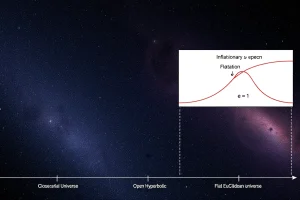
The critical density is the density that makes the spatial curvature k=0, yielding a flat universe. It is given by ρ_c = 3H²/(8πG).
Why is the cosmological constant important?
The cosmological constant Λ accounts for dark energy and explains the observed accelerated expansion of the universe. In the Friedmann equation, it acts as a repulsive force.

Leave a Reply