What Are the Biggest Misconceptions About the Big Bang?
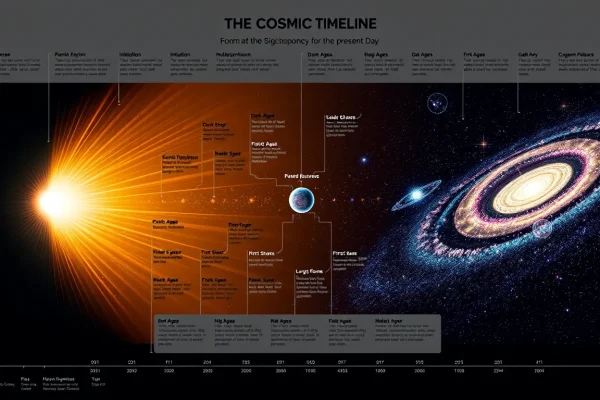
The Big Bang theory is often misunderstood. This guide debunks common myths and explains the true origin and evolution of the universe, from the Planck epoch to the present day.

The interactive reference to the beginning and evolution of the universe.
The Big Bang theory is often misunderstood. This guide debunks common myths and explains the true origin and evolution of the universe, from the Planck epoch to the present day.
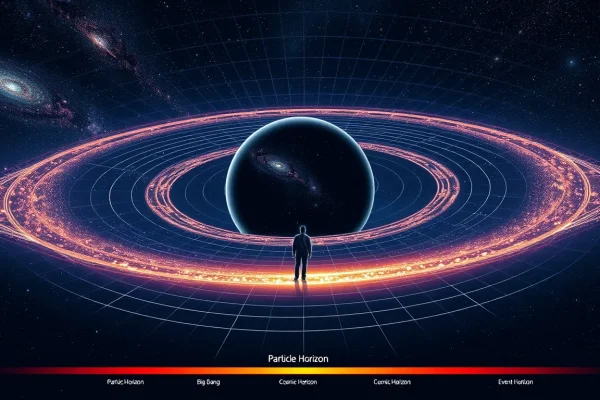
A cosmic horizon marks the boundary of what we can observe in an expanding universe. The particle horizon defines the edge of the observable universe, while the event horizon sets the limit of future observations. This guide explains the concept and traces the cosmic epochs from the Planck era to structure formation.
Recombination marks the moment about 378,000 years after the Big Bang when free electrons and protons combined to form neutral hydrogen, allowing photons to travel freely and making the universe transparent. This epoch gave birth to the cosmic microwave background and set the stage for the formation of stars and galaxies.
A comprehensive guide to the cosmic dark ages, the period when the universe was shrouded in neutral hydrogen, and how the first stars and galaxies emerged to end the darkness. This article covers the full cosmic timeline, key missions, and the evidence that shapes our understanding of this pivotal era.
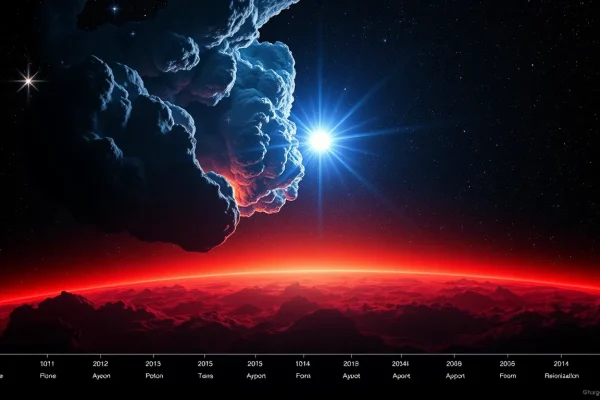
The first stars emerged roughly 100–200 million years after the Big Bang, ending the cosmic dark ages. This article traces the full evolution of the universe—from the Planck epoch through inflation, recombination, and reionization—and explains how the first atoms, stars, and galaxies formed, with key evidence from COBE, WMAP, Planck, and JWST.
Population III stars are the hypothetical first generation of stars, formed from primordial hydrogen and helium. They were likely massive, hot, and short-lived, and their radiation reionized the early universe. This article explores their formation, properties, and cosmic significance.
The photon epoch was a period in the early universe, from about 10 seconds to 380,000 years after the Big Bang, when photons dominated the energy density. During this time, atomic nuclei formed via nucleosynthesis, and the universe remained a hot, dense plasma until recombination produced the cosmic microwave background.
The Grand Unification Epoch was a fleeting period in the early universe, from about 10⁻⁴³ to 10⁻³⁵ seconds after the Big Bang, when three of the four fundamental forces were unified. This article explores that epoch, its place in cosmic history, and the full timeline from Planck time to the present day.
Before recombination, the universe was an opaque plasma of free electrons and photons. When electrons and protons combined to form neutral hydrogen, light finally decoupled, creating the cosmic microwave background. This article explains the physics behind this cosmic milestone and why no telescope can see earlier with light.
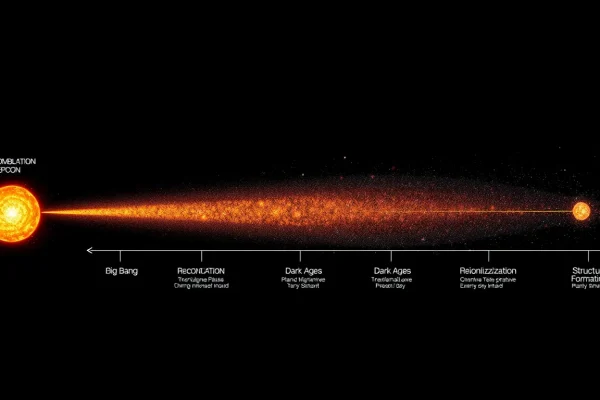
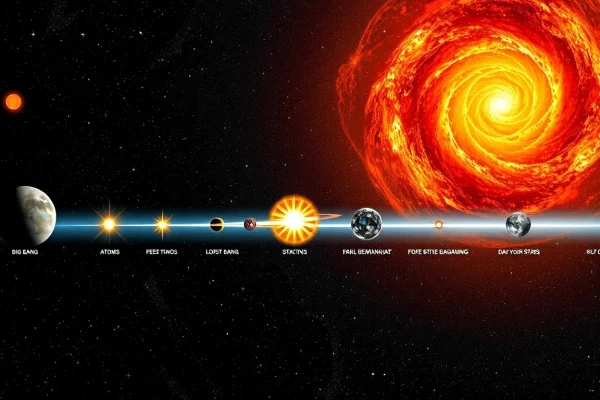
The Big Bang is the leading scientific explanation for the origin of the universe, describing how it expanded from an extremely hot, dense state about 13.8 billion years ago. This comprehensive guide walks through the sequence of cosmic epochs—from the Planck epoch to the present day—covering the formation of particles, atoms, stars, and galaxies, and the evidence that supports this model.