Short Answer
Main Explanation
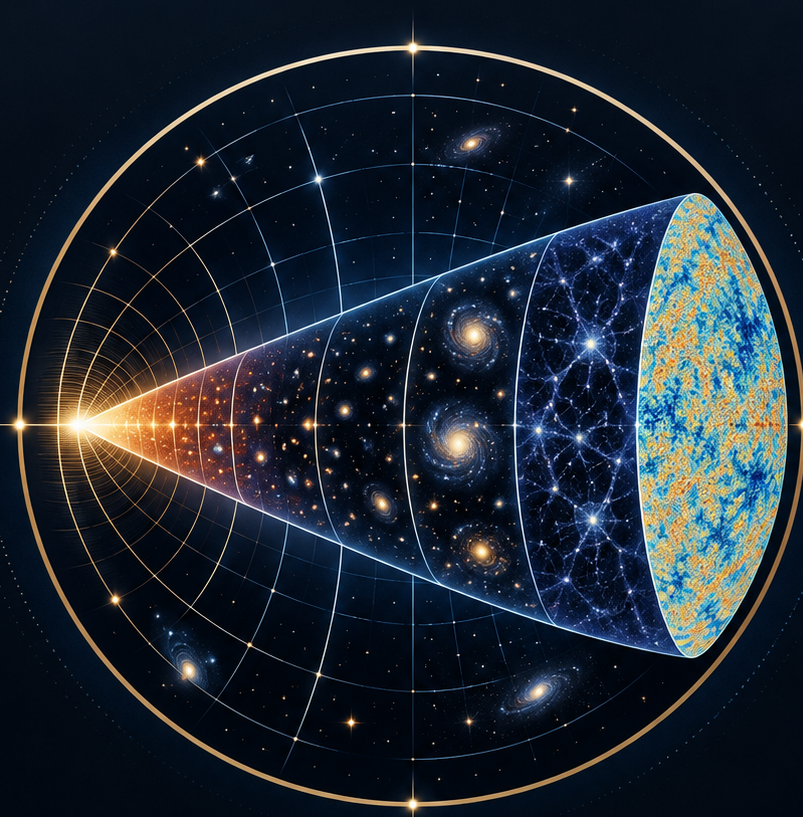
Recombination is a pivotal epoch in the history of the universe. It occurred approximately 378,000 years after the Big Bang, at a redshift of about 1100, when the universe had cooled to roughly 3000 K. At this point, free electrons and protons combined to form neutral hydrogen atoms, and photons—previously trapped in an opaque plasma—were released to travel freely. This event marks the moment the universe became transparent, and the relic radiation from this time is observed today as the cosmic microwave background (CMB).
The term “recombination” is historically misleading, as the Big Bang model does not posit that protons and electrons had been combined before; the name predates the modern theory. Nevertheless, it is the standard term used in cosmology.
When It Happened
Recombination took place about 378,000 years after the Big Bang. This is a well-established figure derived from observations of the CMB and the standard Lambda-CDM model of cosmology. The exact timing depends on the baryon density and the expansion rate, but the consensus value is around 378,000 years.
Temperature
At recombination, the universe had cooled to approximately 3000 K. This temperature is low enough that the average photon energy could no longer ionize hydrogen atoms. The transition from an ionized plasma to a neutral gas occurred rapidly in cosmic terms, over a relatively short period.
Approximate Redshift
The redshift of recombination is z ≈ 1100. This means that light emitted at that time has been stretched by a factor of 1100 due to the expansion of space. The CMB we observe today has a redshifted temperature of about 2.725 K, corresponding to this epoch.
Dominant Particles/Physics
Before recombination, the universe was a hot, dense plasma of protons, electrons, and photons, along with small amounts of helium and trace amounts of other light nuclei. The physics governing this era is primarily quantum electrodynamics and the Saha equation, which describes the ionization equilibrium. As the temperature dropped, the balance shifted toward neutral hydrogen formation.
What Happened
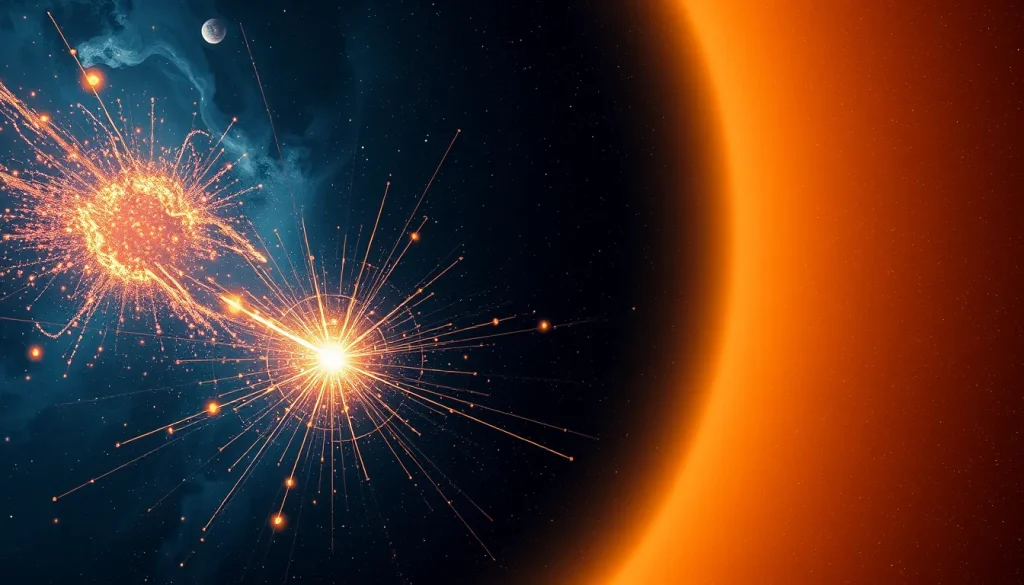
As the universe expanded and cooled, the rate of recombination (electron + proton → hydrogen + photon) began to exceed the rate of photoionization. Once the temperature fell below about 3000 K, the photons no longer had enough energy to ionize hydrogen efficiently. Neutral hydrogen atoms formed, and the universe transitioned from an opaque plasma to a transparent gas. The photons that were previously scattering off free electrons were released, creating the cosmic microwave background. This process is also known as photon decoupling, as the photons ceased to interact with matter and began to travel freely.
What Came Before
Before recombination, the universe was in the photon epoch, dominated by radiation and a hot plasma of baryons and electrons. The universe was opaque because photons constantly scattered off free electrons via Thomson scattering. This era followed the lepton epoch, when electrons and positrons annihilated, leaving a small excess of matter.
What Came Next
After recombination, the universe entered the Dark Ages—a period with no luminous sources. The neutral hydrogen gas was mostly transparent to radiation, but no stars or galaxies had yet formed. Over the next few hundred million years, gravity amplified tiny density fluctuations, leading to the formation of the first stars and galaxies. This triggered reionization, when ultraviolet radiation from these first objects ionized the intergalactic medium again. Eventually, structure formation led to the large-scale cosmic web we observe today.
Evidence
The primary evidence for recombination comes from the cosmic microwave background. The CMB is a nearly perfect blackbody spectrum with a temperature of 2.725 K, matching predictions. The anisotropies in the CMB, measured by missions like COBE, WMAP, and Planck, provide detailed information about the conditions at recombination. The acoustic peaks in the CMB power spectrum are consistent with the standard model and confirm the timing and physics of recombination. Additionally, the observed abundance of light elements (primordial nucleosynthesis) supports the baryon density that determines the recombination epoch.
Why It Matters
Recombination is a cornerstone of modern cosmology. It marks the transition from an opaque, radiation-dominated universe to a transparent, matter-dominated one. The CMB released at recombination is the oldest light we can observe, providing a snapshot of the universe when it was only 378,000 years old. This relic radiation encodes information about the initial conditions for structure formation, the geometry of the universe, and the composition of matter and energy. Without recombination, the universe would remain opaque, and we would not be able to observe the distant cosmos. The study of recombination also tests fundamental physics, including atomic physics and the standard model of particle physics, under extreme conditions.
Evidence / Sources
The evidence for recombination is overwhelming and comes from multiple independent observations:
- The cosmic microwave background, discovered in 1965, has a blackbody spectrum that matches the predicted relic radiation from recombination.
- Precise measurements of CMB anisotropies by COBE, WMAP, and Planck confirm the acoustic oscillations and the geometry of the universe.
- The temperature of the CMB (2.725 K) corresponds to a redshift of about 1100, consistent with the recombination epoch.
- The observed large-scale structure of the universe, including galaxy clusters and the cosmic web, matches simulations that start from the initial conditions imprinted at recombination.
Key sources include the Wikipedia article on recombination, the Astronoo article on cosmological recombination, and the Cambridge University Press chapter on the recombination of the primeval plasma.
Related Registry Entries
This article is part of a series on cosmic epochs and the evolution of the universe. Related entries include:
- The Big Bang and the Planck Epoch
- Inflation and the Early Universe
- The Cosmic Microwave Background
- The Dark Ages and Reionization
- Structure Formation and the Large-Scale Structure
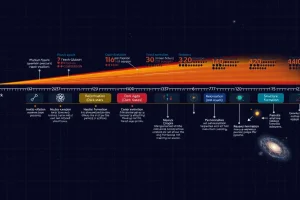
For a complete timeline, see the table below:
| Epoch | Time After Big Bang | Redshift | Temperature | Key Events |
|---|---|---|---|---|
| Planck Epoch | < 10⁻⁴³ s | > 10³² | > 10³² K | Quantum gravity effects dominate |
| Grand Unification Epoch | 10⁻⁴³ – 10⁻³⁶ s | ~10²⁸ | ~10²⁸ K | Fundamental forces unify |
| Inflationary Epoch | 10⁻³⁶ – 10⁻³² s | ~10²⁷ | ~10²⁷ K | Exponential expansion, seeds of structure |
| Electroweak Epoch | 10⁻³² – 10⁻¹² s | ~10²⁵ | ~10²⁵ K | Electromagnetic and weak forces separate |
| Quark Epoch | 10⁻¹² – 10⁻⁶ s | ~10¹⁵ | ~10¹⁵ K | Quarks and gluons form plasma |
| Hadron Epoch | 10⁻⁶ – 1 s | ~10¹³ | ~10¹³ K | Protons and neutrons form |
| Lepton Epoch | 1 – 10 s | ~10¹⁰ | ~10¹⁰ K | Leptons dominate, electron-positron annihilation |
| Photon Epoch | 10 s – 378,000 yr | ~10⁹ – 1100 | ~10⁹ – 3000 K | Photons dominate, nucleosynthesis |
| Recombination | ~378,000 yr | ~1100 | ~3000 K | Neutral hydrogen forms, universe becomes transparent |
| Dark Ages | 378,000 – ~150 million yr | 1100 – ~20 | 3000 – ~60 K | No luminous sources, structure seeds grow |
| Reionization | ~150 million – ~1 billion yr | ~20 – ~6 | ~60 – ~20 K | First stars and galaxies ionize intergalactic medium |
| Structure Formation | ~1 billion yr – present | < 6 | < 20 K | Galaxies, clusters, and large-scale structure form |
FAQ
Why is it called 'recombination' if it was the first time electrons and protons combined?
The term is historical. It was coined before the Big Bang theory became the standard model, when it was thought that atoms had existed earlier. The name stuck, even though it is technically a misnomer.
What exactly happened during recombination?
As the universe cooled to about 3000 K, free electrons and protons combined to form neutral hydrogen atoms. This reduced the number of free electrons, allowing photons to travel without scattering, making the universe transparent.
How do we know recombination happened?
The cosmic microwave background is the direct evidence. Its blackbody spectrum, temperature, and anisotropies match predictions from the standard model. Missions like COBE, WMAP, and Planck have measured these properties with high precision.
What came after recombination?
After recombination, the universe entered the Dark Ages, followed by the formation of the first stars and galaxies, reionization, and eventually the large-scale structure we see today.
Leave a Reply