Short Answer
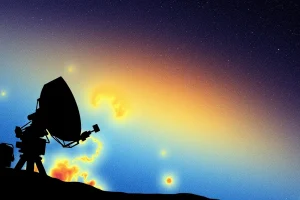
The European Space Agency’s Planck mission, launched in 2009, spent 4.5 years scanning the sky to measure the cosmic microwave background (CMB) — the relic radiation from the Big Bang. Its observations provided the most precise portrait of the early universe, refining our understanding of cosmic history from the first fractions of a second to the present day. This article explains what Planck discovered and how those discoveries fit into the broader narrative of cosmic evolution.
Main Explanation
Planck and the Cosmic Microwave Background
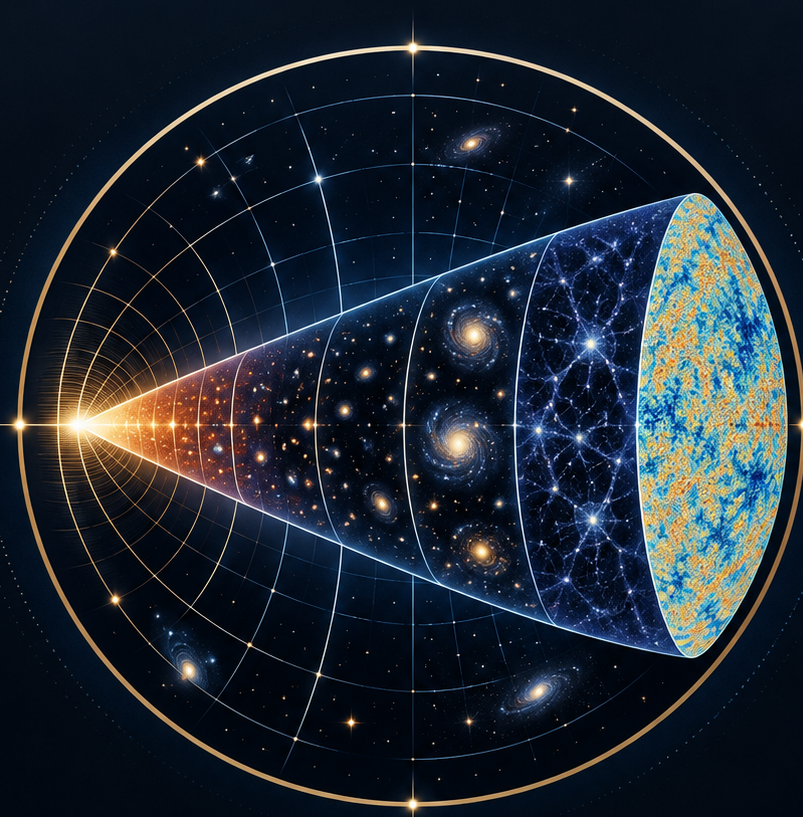
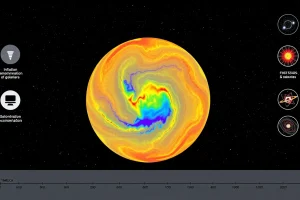
The CMB is a faint glow of microwave radiation that fills the entire sky, a snapshot of the universe when it was just 380,000 years old. At that time, the universe had cooled enough for protons and electrons to combine into neutral hydrogen, allowing photons to travel freely for the first time. Planck’s detectors were so sensitive they could distinguish temperature variations of a few millionths of a degree, producing the most accurate CMB maps ever made (ESA, Planck science highlights). These temperature fluctuations are the seeds of all cosmic structure — galaxies, clusters, and superclusters that formed later.
The Cosmic Epochs
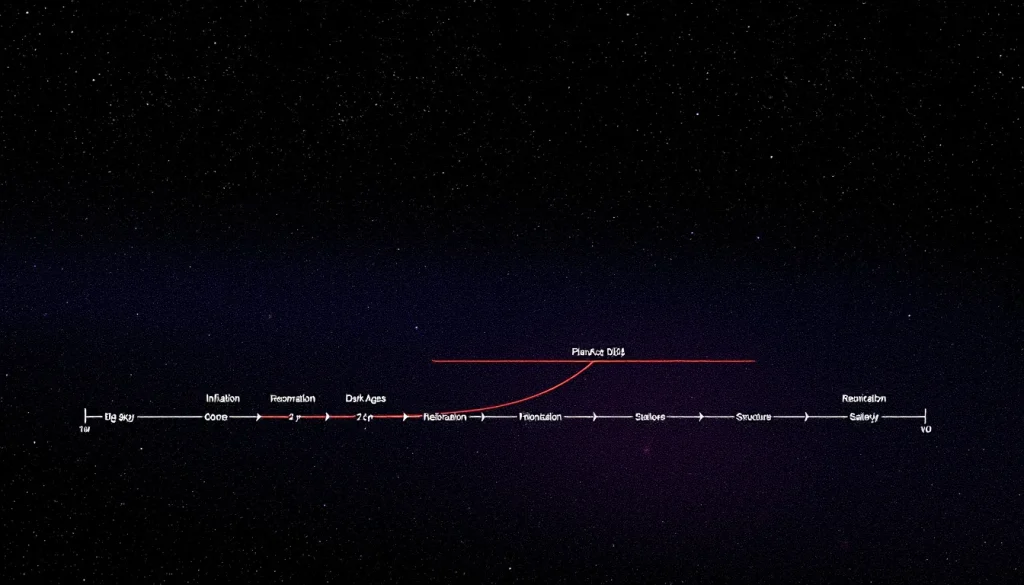
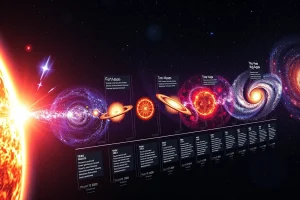
The universe’s history is divided into distinct epochs, each characterized by different physical processes and particle content. Planck’s data, combined with other observations, allows us to trace this evolution in detail. The table below summarizes the major epochs from the Planck epoch to the present.
| Epoch | Time After Big Bang | Temperature | Key Events |
|---|---|---|---|
| Planck epoch | 0 to 10⁻⁴³ s | >10³² K | Quantum gravity effects dominate; unified forces. |
| Grand Unification epoch | 10⁻⁴³ to 10⁻³⁶ s | 10²⁷–10³² K | Strong, weak, and electromagnetic forces unify. |
| Inflationary epoch | 10⁻³⁶ to 10⁻³² s | Dropping rapidly | Exponential expansion; quantum fluctuations stretched to cosmic scales. |
| Electroweak epoch | 10⁻³² to 10⁻¹² s | 10¹⁵–10²⁷ K | Electromagnetic and weak forces separate; particles acquire mass. |
| Quark epoch | 10⁻¹² to 10⁻⁶ s | 10¹²–10¹⁵ K | Quarks and gluons form a quark-gluon plasma. |
| Hadron epoch | 10⁻⁶ to 1 s | 10¹⁰–10¹² K | Protons and neutrons form; matter-antimatter annihilation. |
| Lepton epoch | 1 to 10 s | 10⁹–10¹⁰ K | Leptons dominate; neutrinos decouple. |
| Photon epoch | 10 s to 380,000 yr | 3,000–10⁹ K | Photons dominate; light elements form via Big Bang nucleosynthesis. |
| Recombination | 380,000 yr | ~3,000 K | Electrons combine with protons; CMB released. |
| Dark Ages | 380,000 yr to ~150 million yr | ~3,000 K to ~60 K | No stars yet; universe is dark and neutral. |
| Reionization | ~150 million yr to ~1 billion yr | ~60 K to ~20 K | First stars and galaxies ionize neutral hydrogen. |
| Structure Formation | ~1 billion yr to present | ~20 K to 2.7 K | Galaxies, clusters, and large-scale structure assemble. |
Planck’s measurements of the CMB provide direct evidence for the conditions at recombination and indirectly constrain earlier epochs, including inflation. The temperature fluctuations seen by Planck match predictions from inflation, supporting the idea that quantum fluctuations seeded cosmic structure.
Planck Mission Details
Planck was a European Space Agency mission with significant NASA contributions. It was launched in May 2009 and operated until October 2013, scanning the sky in nine frequency bands from 30 to 857 GHz (ESA, Planck overview). Its telescope had a large, smooth primary mirror and cryogenically cooled detectors to achieve the required sensitivity. The mission’s primary objective was to measure the CMB anisotropies with precision set by fundamental astrophysical limits (ESA, Planck science highlights).
Major Results
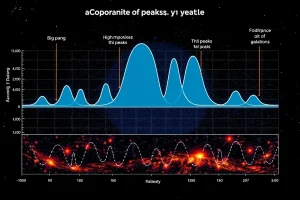
- Precise measurements of the CMB power spectrum, yielding cosmological parameters with unprecedented accuracy.
- Determination of the universe’s age as 13.8 billion years.
- Composition: ~4.9% ordinary matter, ~26.8% dark matter, ~68.3% dark energy (based on Planck 2018 results, Planck 2018 results).
- Measurement of the Hubble constant (H₀) to ~67.4 km/s/Mpc, with implications for cosmic expansion.
- Confirmation of the near-flat geometry of the universe.
- Constraints on inflation, showing that the primordial spectrum is nearly scale-invariant.
From Recombination to the Present
After recombination, the universe entered the Dark Ages — a period with no luminous sources. Eventually, gravity amplified the small density fluctuations seen in the CMB, leading to the formation of the first stars and galaxies. These objects reionized the neutral hydrogen during the epoch of reionization, making the universe transparent to ultraviolet light. Over billions of years, structure formation assembled galaxies, clusters, and the large-scale cosmic web we observe today. Planck’s data, combined with other missions like COBE and WMAP, have established the Lambda-CDM model as the standard cosmological framework, where dark energy drives accelerated expansion and cold dark matter shapes structure.
Why It Matters
Planck’s discoveries transformed cosmology from a field of rough estimates into a precision science. By measuring the CMB to fundamental limits, Planck provided a direct window into the early universe, testing theories of inflation, nucleosynthesis, and structure formation. Its results underpin our current understanding of the universe’s composition, age, and geometry, and they guide future missions and experiments seeking to probe the first moments of existence.
Evidence / Sources
The primary evidence comes from Planck’s full-sky CMB maps and the derived power spectrum. The Planck 2018 results paper (Aghanim et al., 2019) presents the final cosmological parameters. Additional context is provided by ESA’s official summaries:
- ESA – Planck science highlights
- ESA – Planck overview
- Planck 2018 results (Astronomy & Astrophysics)
Related Registry Entries
For further exploration, see the registry entries on the Cosmic Microwave Background, Inflation, Recombination, Dark Ages, Reionization, and the Planck Mission.
Last reviewed: September 4, 2026
FAQ
What did Planck discover about the universe?
Planck produced the most precise maps of the cosmic microwave background, revealing temperature fluctuations that encode the universe's initial conditions. It determined the universe's age (13.8 billion years), its composition (about 5% ordinary matter, 27% dark matter, 68% dark energy), and the Hubble constant to high precision, confirming the Lambda-CDM model.
How did Planck measure the CMB?
Planck used a 1.5-meter telescope with detectors cooled to near absolute zero, observing in nine frequency bands from 30 to 857 GHz. It scanned the sky repeatedly for 4.5 years, distinguishing temperature variations as small as a few millionths of a degree.
What are the major cosmic epochs?
The major epochs include the Planck epoch, Grand Unification, Inflation, Electroweak, Quark, Hadron, Lepton, Photon, Recombination, Dark Ages, Reionization, and Structure Formation. Planck's data directly probe the conditions at recombination and indirectly constrain earlier epochs, especially inflation.
Leave a Reply