Short Answer
Main Explanation
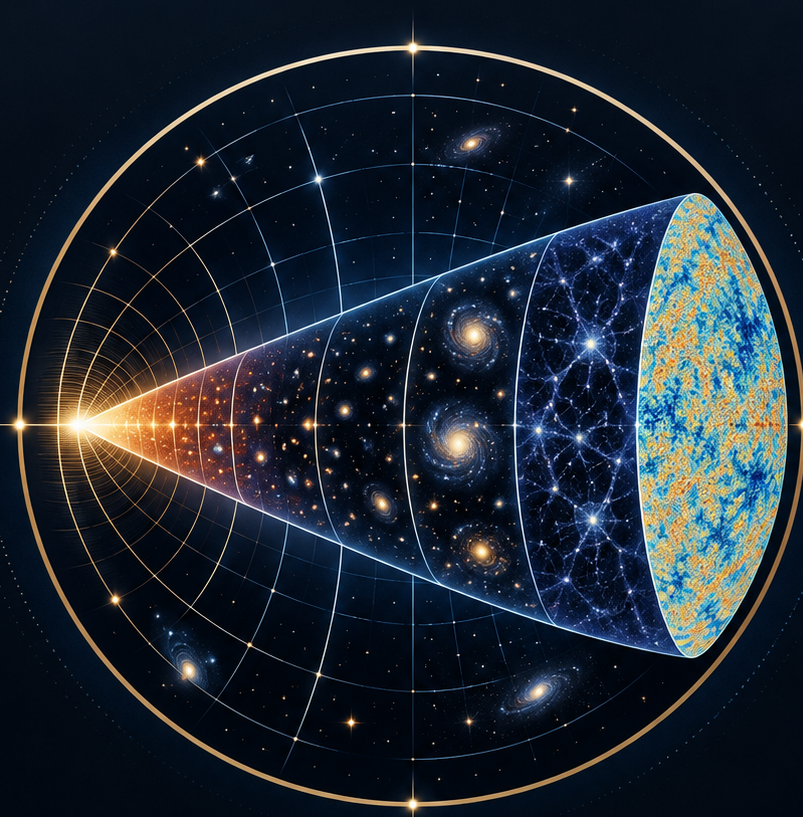
The cosmic microwave background (CMB) is the oldest light in the universe, a relic of the hot, dense state that existed just 380,000 years after the Big Bang. When we look at the CMB, we see a nearly perfect blackbody spectrum at a temperature of 2.725 Kelvin, uniform to about one part in 100,000 across the entire sky. This uniformity is a profound observation: regions of the sky that are separated by more than the horizon distance at the time the CMB was emitted should never have been in causal contact, yet they have the same temperature. This is known as the horizon problem, and its resolution lies in the theory of cosmic inflation.
Inflation posits that the universe underwent an exponential expansion in the first fraction of a second after the Big Bang, smoothing out any initial irregularities and bringing distant regions into causal contact before they were inflated apart. This explains why the CMB is so uniform. The tiny fluctuations we observe, at the level of ±0.004 Kelvin, are the seeds of all cosmic structure—galaxies, clusters, and superclusters—that formed later.
The CMB also marks the epoch of recombination, when protons and electrons combined to form neutral hydrogen, allowing photons to travel freely. Before this, the universe was an opaque plasma. The CMB is the snapshot of that moment, and its detailed measurements have confirmed the predictions of the Big Bang model and the Lambda-CDM cosmological model.
What We Know
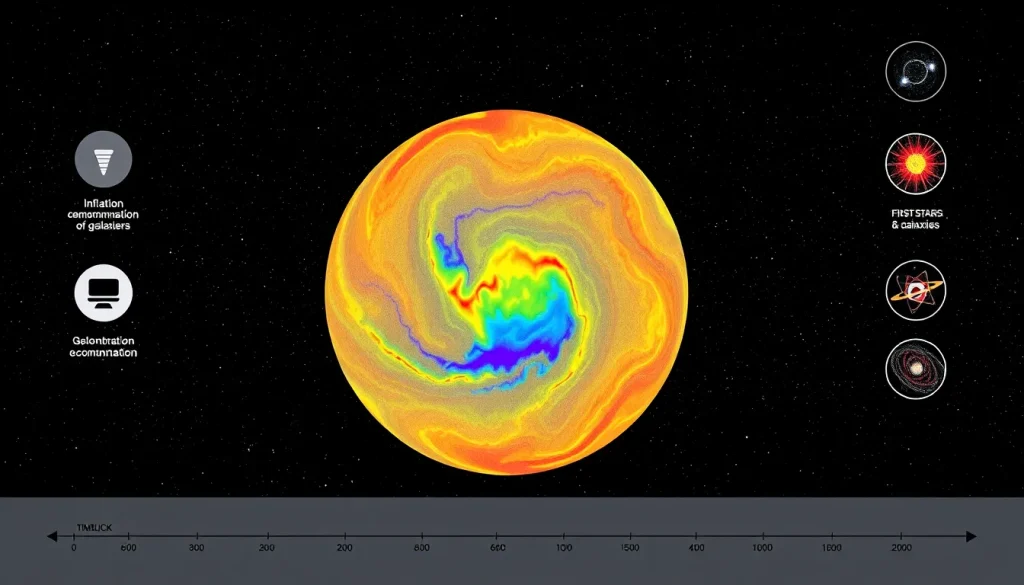
We know that the CMB is isotropic (the same in all directions) to high precision. The COBE satellite first measured the CMB spectrum and found it to be a perfect blackbody. Later, WMAP and Planck mapped the tiny temperature anisotropies, revealing a power spectrum that matches the predictions of inflation and provides precise values for cosmological parameters such as the density of matter, dark energy, and the curvature of space.
What We Don’t Know
While inflation is the leading explanation for the uniformity, we do not know the exact physical mechanism that drove inflation. The inflaton field, if it exists, has not been directly detected. Additionally, the initial conditions of the universe—why it began with such low entropy—remain an open question.
Evidence
The primary evidence is the uniformity itself. The CMB temperature is the same in all directions to within 0.004 K. This is consistent with the idea that the entire observable universe was once in thermal equilibrium. The acoustic peaks in the CMB power spectrum, first detected by WMAP and refined by Planck, provide further evidence for inflation and the standard model.
Competing Explanations
Alternatives to inflation include cyclic models, string gas cosmology, and varying speed of light theories. However, none of these have gained the same level of observational support as inflation, which successfully predicts a nearly scale-invariant spectrum of fluctuations and a flat universe.
Current Research
Current and future missions, such as the Simons Observatory and SPHEREx, aim to measure the CMB polarization and search for the primordial gravitational waves predicted by inflation. The James Webb Space Telescope is probing the era of reionization and structure formation, connecting the CMB to the first galaxies.
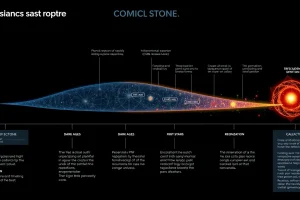
Timeline of the Early Universe
The following table outlines the major epochs of the universe, from the Planck epoch to the present.
| Epoch | Time after Big Bang | Temperature | Key Events |
|---|---|---|---|
| Planck epoch | <10⁻⁴³ s | >10³² K | Quantum gravity effects dominate |
| Grand Unification epoch | 10⁻⁴³–10⁻³⁶ s | 10²⁷–10³² K | Fundamental forces unify |
| Inflationary epoch | 10⁻³⁶–10⁻³² s | ~10²⁷ K | Exponential expansion, smoothing |
| Electroweak epoch | 10⁻¹² s | 10¹⁵ K | Electromagnetic and weak forces separate |
| Quark epoch | 10⁻¹²–10⁻⁶ s | 10¹²–10¹⁵ K | Quarks and gluons form plasma |
| Hadron epoch | 10⁻⁶–1 s | 10¹⁰–10¹² K | Protons and neutrons form |
| Lepton epoch | 1–10 s | 10⁹–10¹⁰ K | Leptons dominate, neutrinos decouple |
| Photon epoch | 10 s–380,000 yr | 3,000–10⁹ K | Photons dominate, nucleosynthesis occurs |
| Recombination | ~380,000 yr | ~3,000 K | Atoms form, CMB released |
| Dark Ages | 380,000 yr–~150 million yr | ~3,000 K–60 K | No stars yet, hydrogen gas |
| Reionization | ~150 million–1 billion yr | ~60 K–20 K | First stars and galaxies ionize hydrogen |
| Structure Formation | 1 billion yr–present | <20 K | Galaxies, clusters, and large-scale structure form |
Why It Matters
The uniformity of the CMB is not just a curiosity; it is a cornerstone of modern cosmology. It provides strong evidence for the Big Bang model and inflation, and it underpins our understanding of how the universe evolved from a hot, dense state to the structured cosmos we see today. By studying the CMB, we learn about the composition of the universe, the nature of dark matter and dark energy, and the ultimate fate of the cosmos.
Evidence / Sources
Key observations include the COBE satellite’s measurement of the CMB blackbody spectrum, WMAP’s mapping of temperature anisotropies, and Planck’s high-precision measurements of the power spectrum. These observations have confirmed predictions of the Lambda-CDM model and placed tight constraints on cosmological parameters.
References: [1] National Radio Astronomy Observatory, [2] ScienceBlogs, [3] Swinburne Astronomy Online, [4] Physics Stack Exchange.
Related Registry Entries
Related entries in this encyclopedia include: Cosmic Inflation, Recombination, Cosmic Microwave Background Anisotropies, Planck Mission, WMAP Mission, and the Big Bang.
Last reviewed: September 4, 2026.
FAQ
Why is the CMB so uniform across the sky?
The uniformity is explained by cosmic inflation, a rapid expansion in the early universe that brought distant regions into causal contact before they were separated. This allowed them to reach the same temperature before inflation stretched them apart.
What is the horizon problem?
The horizon problem is the puzzle that regions of the CMB that are far apart have the same temperature, even though they should not have been in causal contact given the finite speed of light. Inflation solves this by positing a period of rapid expansion that made the universe homogeneous.
How do we know the CMB is from the Big Bang?
The CMB has a perfect blackbody spectrum, matches the predicted temperature of the early universe, and its anisotropies align with the distribution of matter and structure we observe today. These are strong confirmations of the Big Bang model.



Leave a Reply