Short Answer
Short Answer: SPHEREx (Spectro-Photometer for the History of the Universe, Epoch of Reionization and Ices Explorer) is a NASA space telescope that will map the entire sky in near-infrared light, collecting spectra of over 450 million galaxies to answer fundamental questions about the universe’s origin, the history of galaxy formation, and the availability of water and organic molecules in planetary systems.
| Mission | SPHEREx |
|---|---|
| Launch Date | March 11, 2025 |
| Target | Stars and galaxies |
| Wavelength | Near-infrared (0.75–5.0 µm) |
| Mission Duration | 2 years (planned) |
| Orbit | Polar orbit around Earth |
| Principal Investigator | James Bock (Caltech) |
| Status | Current |
Main Explanation
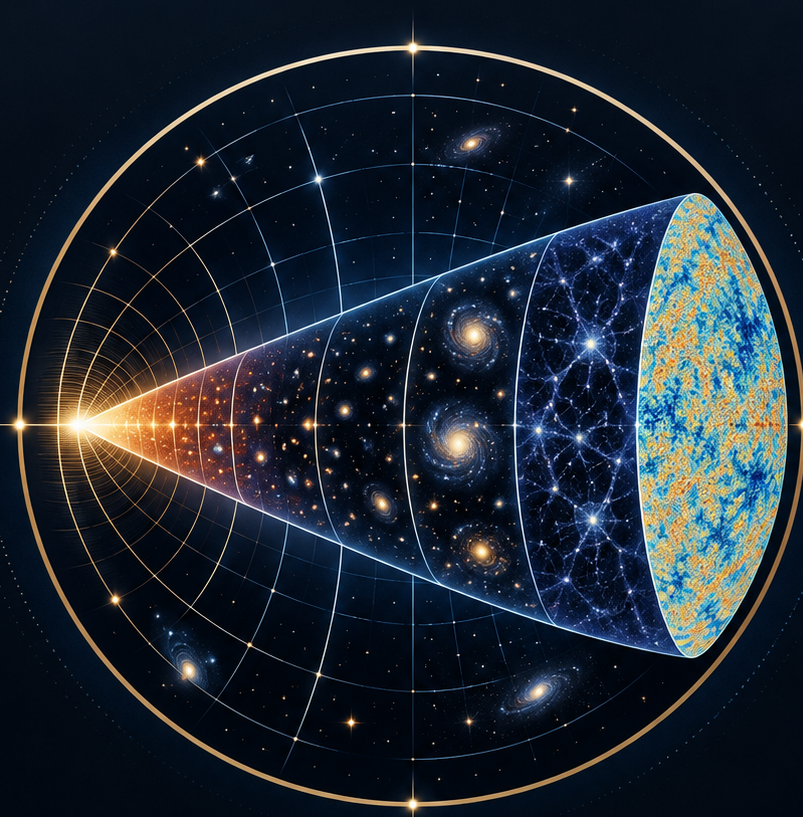
The universe began in a state of extreme heat and density, and has been expanding and cooling ever since. To understand how we got from that primordial fireball to the vast, structured cosmos we observe today, astronomers need to look back across cosmic time. SPHEREx is a new NASA mission designed to do exactly that, using spectroscopy to create a three-dimensional map of the sky in near-infrared light. By measuring the spectra of hundreds of millions of galaxies, SPHEREx will trace the large-scale distribution of matter and probe the physics of the early universe, including the epoch of cosmic inflation, the formation of the first stars and galaxies, and the presence of water and organic molecules in planet-forming regions.
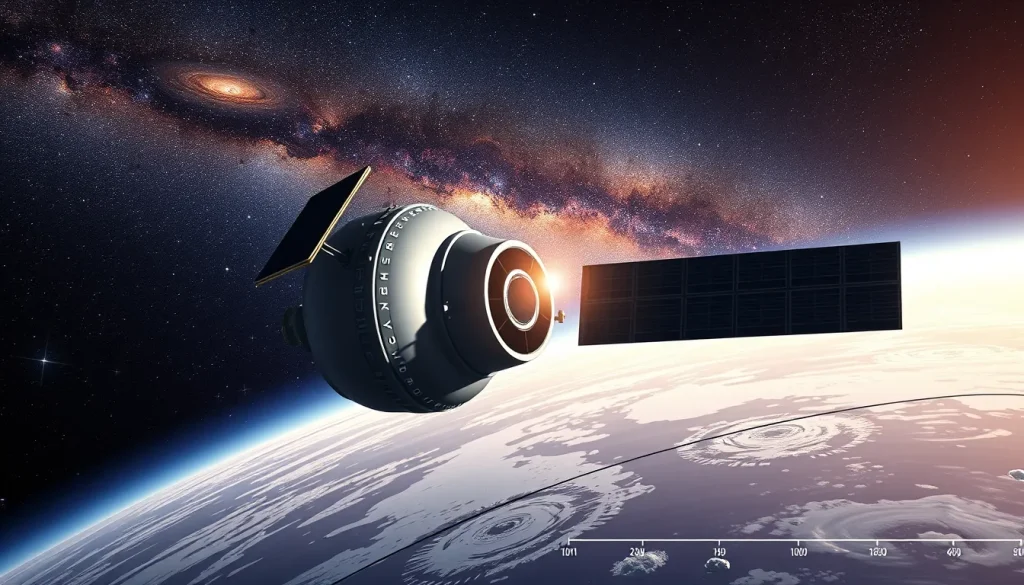
SPHEREx was selected by NASA in February 2019 as a Medium Explorer mission and launched on March 11, 2025, aboard a SpaceX Falcon 9 rocket from Vandenberg Space Force Base in California. It is now in a polar orbit around Earth, beginning its two-year all-sky survey. The mission will obtain near-infrared spectra (0.75–5.0 µm) every 6 arcseconds over the entire sky, producing a rich legacy archive that will support numerous scientific investigations.
The Cosmic Timeline
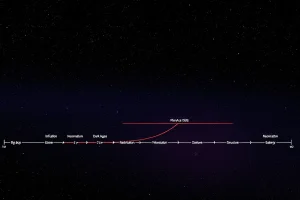
To appreciate what SPHEREx will reveal, it helps to understand the major epochs of cosmic evolution. The standard model of cosmology, known as Lambda-CDM, describes a universe that began about 13.8 billion years ago in the Big Bang. The following table summarizes the key epochs from the earliest moments to the present day.
| Epoch | Time After Big Bang | Temperature | Key Events |
|---|---|---|---|
| Planck epoch | < 10⁻⁴³ s | > 10³² K | Quantum gravity effects dominate; no current theory describes this regime. |
| Grand Unification epoch | 10⁻⁴³ – 10⁻³⁶ s | 10²⁷ – 10³² K | Strong and electroweak forces unify; inflation begins near the end. |
| Inflationary epoch | 10⁻³⁶ – 10⁻³² s | ~10²⁷ K | Exponential expansion flattens space and seeds density fluctuations. |
| Electroweak epoch | 10⁻¹² – 10⁻⁶ s | 10¹⁵ – 10²⁷ K | Electromagnetic and weak forces separate; quarks and leptons form. |
| Quark epoch | 10⁻⁶ – 10⁻⁴ s | 10¹² – 10¹⁵ K | Quarks and gluons exist in a quark–gluon plasma. |
| Hadron epoch | 10⁻⁴ – 1 s | 10¹⁰ – 10¹² K | Quarks combine to form protons and neutrons; matter–antimatter asymmetry emerges. |
| Lepton epoch | 1 – 10 s | 10⁹ – 10¹⁰ K | Leptons dominate; neutrinos decouple. |
| Photon epoch | 10 s – 380,000 yr | 3,000 – 10⁹ K | Photons dominate; nucleosynthesis produces light elements. |
| Recombination | ~380,000 yr | ~3,000 K | Electrons combine with protons to form neutral hydrogen; universe becomes transparent; CMB released. |
| Dark Ages | 380,000 – ~150 million yr | ~60 – 3,000 K | No stars yet; neutral hydrogen fills space; gravity slowly amplifies density fluctuations. |
| Reionization | ~150 million – 1 billion yr | ~10 – 60 K | First stars and galaxies form; ionizing radiation reionizes the intergalactic medium. |
| Structure Formation | 1 billion yr – present | ~2.7 K (now) | Galaxies cluster into large-scale structures; dark energy accelerates expansion. |
The Cosmic Microwave Background
One of the most important relics of the early universe is the cosmic microwave background (CMB) — the afterglow of the Big Bang, emitted at the moment of recombination. This faint radiation, now at a temperature of 2.725 K, carries imprints of density fluctuations that seeded the formation of galaxies. Missions like COBE, WMAP, and Planck have mapped the CMB with increasing precision, confirming the predictions of inflation and establishing the Lambda-CDM model as the standard framework. SPHEREx will complement these studies by measuring the distribution of galaxies across cosmic time, linking the early universe’s fluctuations to the large-scale structure we see today.
First Atoms and the Emergence of Stars
After recombination, the universe entered the Dark Ages — a period with no luminous sources. Over millions of years, gravity pulled matter into denser regions, eventually igniting the first stars. These Population III stars were massive and short-lived, and their radiation reionized the neutral hydrogen, ending the Dark Ages. SPHEREx will observe the imprint of this reionization epoch by measuring the clustering of galaxies and the distribution of hydrogen in the intergalactic medium, helping to pinpoint when the first stars formed and how they influenced their surroundings.
Mission
Mission Facts
- Full name: Spectro-Photometer for the History of the Universe, Epoch of Reionization and Ices Explorer
- Operator: NASA
- Planned duration: 25 months (nominal)
- All-sky survey: four complete maps
- Observing mode: single, simple design
Launch
SPHEREx launched on March 11, 2025, on a SpaceX Falcon 9 rocket from Space Launch Complex 4E at Vandenberg Space Force Base, California. It shared the ride with the PUNCH microsatellites. The launch placed SPHEREx into a polar low-Earth orbit, from which it will scan the entire sky.
Telescope/Instrument
SPHEREx uses a single instrument: a spectrophotometer that captures near-infrared spectra across 102 wavelength bands. The telescope has a 20-centimeter aperture and uses linear variable filters to obtain spectra for every point on the sky. This design allows it to measure the redshift of galaxies and identify molecular signatures with high efficiency.
Wavelength
The instrument covers 0.75 to 5.0 micrometers (near-infrared), a range that is invisible to the human eye but rich in information about cosmic distances, galaxy evolution, and the composition of ices and organic molecules.
Objective
SPHEREx has three primary science goals: (1) probe cosmic inflation by measuring the distribution of galaxies over a wide redshift range, (2) study the history of galaxy formation and evolution, and (3) survey the abundance of water and organic ices in star-forming regions and protoplanetary disks.
Major Results
As of September 2026, SPHEREx is in its operational phase and has begun releasing early data. While full results are pending, the mission is expected to deliver the first all-sky near-infrared spectroscopic catalog, with spectra of more than 450 million galaxies and 100 million stars in the Milky Way.
Dataset
SPHEREx will produce a publicly available database of spectra and derived products, including galaxy redshifts, spectral energy distributions, and maps of molecular absorption features. The data will be archived at the NASA/IPAC Infrared Science Archive and will serve as a legacy for future research.
Legacy
SPHEREx will complement other observatories such as JWST, which zooms in on individual targets, and Euclid, which studies dark energy and dark matter. Together, they will provide a comprehensive view of the universe from the first moments after the Big Bang to the present day.
Why It Matters
Understanding the beginning and evolution of the universe is not just a matter of curiosity — it helps us grasp our place in the cosmos. SPHEREx will address fundamental questions: What powered the inflationary expansion that shaped the universe? How did the first galaxies assemble? Where do the building blocks of life come from? By answering these questions, SPHEREx will deepen our understanding of cosmic origins and the conditions that made life on Earth possible.
Evidence / Sources
The information in this article is based on official NASA and mission documentation, including:
- NASA JPL SPHEREx mission page: https://www.jpl.nasa.gov/missions/spherex/
- Caltech SPHEREx About the Mission: https://spherex.caltech.edu/page/about-the-mission
- NASA JPL Press Kit: https://www.jpl.nasa.gov/press-kits/spherex/mission-overview/
- Wikipedia SPHEREx: https://en.wikipedia.org/wiki/SPHEREx
Related Registry Entries
This article is part of a series on the universe’s history. Related entries include:
FAQ
What does SPHEREx actually measure?
SPHEREx measures near-infrared spectra of every point on the sky, covering 0.75 to 5.0 micrometers. This allows it to determine the redshift of galaxies, identify molecular signatures, and map the three-dimensional distribution of matter.
How will SPHEREx help us understand the Big Bang?
SPHEREx will measure the large-scale distribution of galaxies over a wide range of distances, revealing the imprint of primordial density fluctuations. By comparing these observations with predictions from inflation and the Lambda-CDM model, scientists can test theories of the universe's earliest moments.
Is SPHEREx related to the James Webb Space Telescope?
Yes, but they are complementary. JWST provides high-resolution observations of individual objects, while SPHEREx conducts a broad all-sky survey. Together they offer both depth and breadth in near-infrared astronomy.

Leave a Reply