
Short Answer
Main Explanation
The cosmological principle is the cornerstone of modern physical cosmology. It states that on sufficiently large scales, the universe is both homogeneous (the same in all locations) and isotropic (the same in all directions). As astronomer William Keel puts it, “Viewed on a sufficiently large scale, the properties of the universe are the same for all observers.” This principle is not merely a philosophical preference; it is a testable assumption that has profound consequences for our understanding of the cosmos.
The principle implies that the part of the universe we can observe is a fair sample of the whole, and that the same physical laws apply everywhere. It also means the universe has no center and no edge—every observer in any galaxy would see a similar large-scale distribution of matter and radiation. This idea allows cosmologists to build models of the entire universe from local measurements, such as the cosmic microwave background (CMB) or the distribution of galaxies.
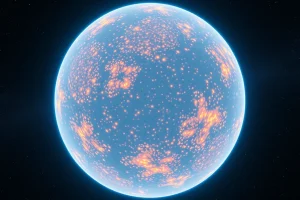
The two structural consequences—homogeneity and isotropy—are not obvious from everyday experience. On small scales, matter is clumped into planets, stars, galaxies, and clusters. But when averaged over scales of hundreds of millions of light-years, the universe becomes remarkably uniform. This uniformity is the basis for the Friedmann–Lemaître–Robertson–Walker (FLRW) metric, the mathematical foundation of the Big Bang model.
Cosmic Epochs and the Principle in Action
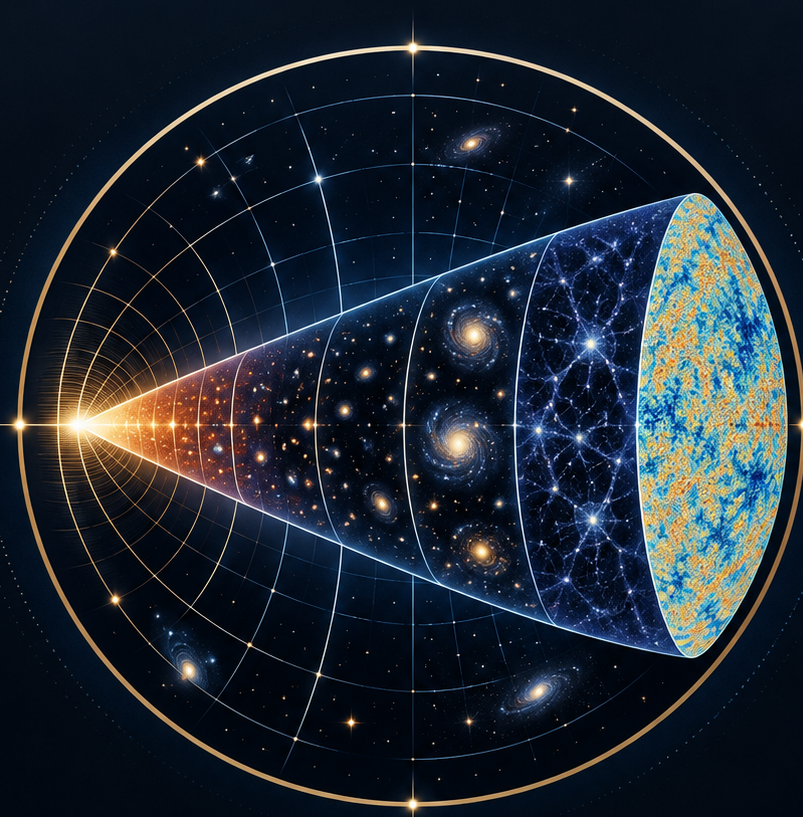
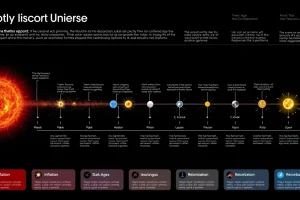
The cosmological principle is not just a static statement about the present universe; it also applies across cosmic time. The standard Lambda-CDM model describes a universe that evolves through distinct epochs, each governed by the same physical laws and the same large-scale uniformity. The following table summarizes the major epochs from the Planck epoch to the present day.
| Epoch | Time After Big Bang | Temperature | Key Events |
|---|---|---|---|
| Planck Epoch | 0 to ~10⁻⁴³ s | >10³² K | Quantum gravity effects dominate; no current theory fully describes this era. |
| Grand Unification Epoch | 10⁻⁴³ to 10⁻³⁶ s | ~10²⁷ K | Strong, weak, and electromagnetic forces are unified; inflation may begin. |
| Inflationary Epoch | 10⁻³⁶ to 10⁻³² s | ~10²⁷ K | Exponential expansion of space; quantum fluctuations seeded large-scale structure. |
| Electroweak Epoch | 10⁻³² to 10⁻¹² s | 10¹⁵ – 10²⁷ K | Electromagnetic and weak forces separate; particles acquire mass. |
| Quark Epoch | 10⁻¹² to 10⁻⁶ s | 10¹² – 10¹⁵ K | Quarks and gluons form a quark–gluon plasma; no bound hadrons yet. |
| Hadron Epoch | 10⁻⁶ to 1 s | 10¹⁰ – 10¹² K | Quarks combine into protons and neutrons; matter–antimatter annihilation leaves a net excess of matter. |
| Lepton Epoch | 1 to 10 s | 10⁹ – 10¹⁰ K | Leptons and antileptons dominate; neutrinos decouple. |
| Photon Epoch | 10 s to ~380,000 yr | ~3,000 – 10⁹ K | Photons are tightly coupled to matter; primordial nucleosynthesis creates light elements. |
| Recombination | ~380,000 yr | ~3,000 K | Electrons combine with protons to form neutral hydrogen; universe becomes transparent; CMB released. |
| Dark Ages | ~380,000 yr to ~150 million yr | ~100 – 3,000 K | No stars yet; universe is dark and neutral; gravitational collapse begins. |
| Reionization | ~150 million yr to ~1 billion yr | ~10 – 100 K | First stars and galaxies form; ultraviolet light reionizes hydrogen. |
| Structure Formation | ~1 billion yr to present | ~2.7 K (now) | Galaxies, clusters, and superclusters form; dark energy accelerates expansion. |
Each of these epochs is consistent with the cosmological principle: at every stage, the universe appears homogeneous and isotropic when smoothed over sufficiently large volumes. The cosmic microwave background, for example, shows temperature fluctuations of only about one part in 100,000, a direct confirmation of isotropy on the largest scales.
Concept
Definition
The cosmological principle is the assumption that the universe is spatially homogeneous and isotropic on large scales. Homogeneity means the same average density and composition everywhere; isotropy means the same appearance in every direction. It is sometimes phrased as “the universe looks the same whoever and wherever you are” (Andrew Liddle).
How It Works
The principle allows cosmologists to apply the laws of physics locally to the entire universe. It leads to the FLRW metric, which describes an expanding, uniformly curved space. Observations of galaxy distributions and the CMB confirm that the principle holds on scales beyond roughly 100 Mpc (about 300 million light-years).
Equation
There is no single equation for the principle itself, but it is encoded in the FLRW metric: ds² = -c²dt² + a(t)² [dr²/(1-kr²) + r²(dθ² + sin²θ dφ²)], where a(t) is the scale factor and k is the curvature parameter (0 for flat, ±1 for open/closed). The principle demands that k be constant and that no preferred direction or location exists.
Example
When we map the cosmic microwave background, we find that its temperature is almost identical in every direction—2.725 K with tiny fluctuations of about 0.0002 K. This isotropy is a direct demonstration of the principle at the time of recombination, about 380,000 years after the Big Bang.
Observable Consequences
The principle predicts that galaxy counts, the CMB, and the large-scale distribution of matter should be statistically uniform across the sky. It also implies that the universe has no edge and no center, and that the expansion we observe locally (Hubble–Lemaître law) applies everywhere.
Common Misconceptions
One misconception is that the principle means the universe is exactly the same everywhere, ignoring the lumpiness of galaxies and clusters. In reality, it applies only on very large scales, typically hundreds of millions of light-years. Another misconception is that it proves the universe is infinite; the principle is compatible with both finite and infinite universes, depending on its spatial curvature.
Why It Matters
The cosmological principle is not just a convenient assumption; it is the reason we can make any sense of the universe as a whole. Without it, we would have no justification for extrapolating local physics to distant regions or for interpreting the CMB as a relic of the Big Bang. It allows us to build the ΛCDM model, which successfully explains cosmic expansion, nucleosynthesis, the CMB, and the formation of large-scale structure. It also underpins our understanding of dark matter and dark energy, which are inferred from the behavior of the universe on the largest scales.
Evidence / Sources
Evidence for the cosmological principle comes from multiple observations:
- Cosmic Microwave Background: The CMB is isotropic to one part in 100,000, as measured by COBE, WMAP, and Planck missions.
- Galaxy Surveys: Redshift surveys, such as the Sloan Digital Sky Survey, show that galaxy distribution becomes homogeneous on scales beyond about 100 Mpc.
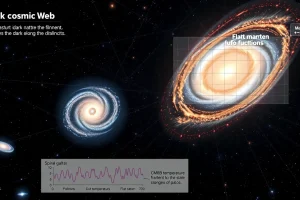
- Large-Scale Structure: The distribution of galaxy clusters and the cosmic web is consistent with homogeneity and isotropy when averaged over sufficiently large volumes.
- Hubble–Lemaître Law: The uniform expansion of space, observed in all directions, supports the principle.
Authoritative sources include the Wikipedia article on the cosmological principle, Britannica’s entry, and Professor Joseph Silk’s discussion at LBL.
Related Registry Entries
Explore related concepts in the Universe Guide registry:
- Big Bang
- Cosmic Microwave Background
- Inflation
- Large-Scale Structure
- ΛCDM Model
Last Reviewed: September 4, 2026
FAQ
Does the cosmological principle mean the universe is exactly the same everywhere?
No. It applies only on very large scales (hundreds of millions of light-years). On smaller scales, matter is clumped into galaxies, stars, and planets. The principle states that the average properties of the universe are the same, not that every point is identical.
Why is the cosmological principle important for the Big Bang model?
It allows us to apply the laws of physics observed locally to the entire universe and to use a single expanding solution (FLRW metric) to describe cosmic evolution. Without it, we could not interpret the CMB or the expansion of galaxies as evidence of a universal beginning.
What evidence supports the cosmological principle?
The most direct evidence is the isotropy of the cosmic microwave background, which shows temperature fluctuations of only about one part in 100,000. Galaxy surveys also show that the distribution of matter becomes homogeneous on scales beyond about 100 Mpc.

Leave a Reply