Short Answer
Main Explanation
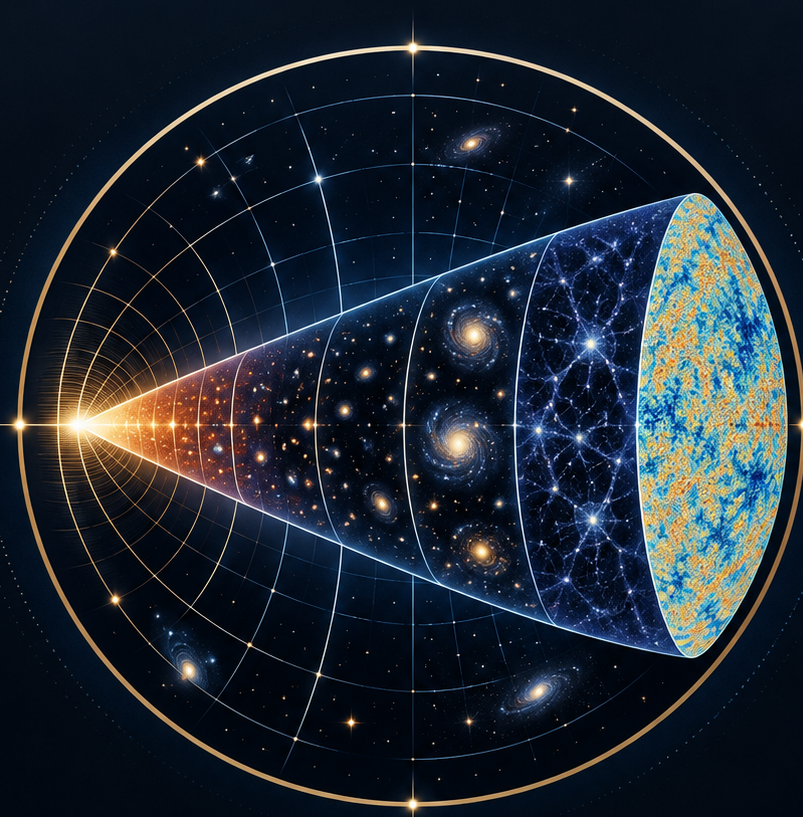
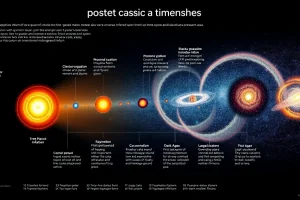
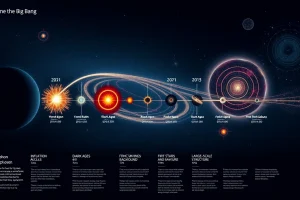
The Big Bang timeline is not a story of an explosion into pre-existing space, but of the expansion of space itself from an extremely hot, dense state. According to the standard Lambda-CDM model, the universe began 13.787 billion years ago, when it was so dense and hot that no familiar structures—atoms, nuclei, even protons and neutrons—could exist. Instead, the cosmos passed through a series of epochs defined by the dominant particles and forces. The timeline is often plotted on a logarithmic scale because the earliest events occurred in unimaginably tiny fractions of a second, while later epochs span millions to billions of years.
Because the early universe was opaque and dominated by quantum gravitational effects at the very beginning, our physical theories can only describe it from about 10−43 seconds onward. From that point, the universe expanded and cooled, allowing the four fundamental forces to separate, matter to form, and eventually atoms, stars, and galaxies to emerge.
Think of the expansion of space as the stretching of a rubber sheet: galaxies are not flying through static space; the space between them is growing. This is why the light from distant galaxies is stretched to longer, redder wavelengths—a phenomenon called redshift.
The Standard Model: Lambda-CDM
Modern cosmology is built on the Lambda-CDM model, which includes ordinary matter, cold dark matter, and dark energy (the cosmological constant Lambda). It successfully explains the cosmic microwave background, the large-scale distribution of galaxies, and the accelerating expansion of the universe. The timeline below follows this consensus model.
The Major Cosmic Epochs
The table summarizes the key epochs from the Planck era to structure formation. Times and temperatures are approximate and based on current theory.
| Epoch | Time after Big Bang | Temperature (K) | Approximate Redshift | Key events |
|---|---|---|---|---|
| Planck epoch | <10−43 s | undefined / >1032 | — | Quantum gravity dominates; current physics cannot describe this era. |
| Grand unification epoch | 10−43–10−35 s | ~1032 | — | Gravity separates from the strong, weak, and electromagnetic interactions. |
| Inflationary epoch | ~10−35–10−32 s | ~1027 | — | Exponential expansion by a factor of at least 1025; seeds of structure laid down. |
| Electroweak epoch | ~10−32–10−12 s | ~1028–1015 | — | Electromagnetic and weak forces separate; four fundamental forces become distinct. |
| Quark epoch | ~10−12–10−6 s | ~1015–1012 | — | Quark-gluon plasma fills the universe; all four forces are distinct. |
| Hadron epoch | ~10−6–1 s | ~1012–1010 | — | Quarks bind into protons and neutrons; matter-antimatter asymmetry emerges. |
| Lepton epoch | ~1 s–10 s | ~1010–109 | — | Lepton-antilepton annihilation; neutrinos decouple. |
| Photon epoch | ~10 s–380,000 yr | ~109–3000 | — | Big Bang nucleosynthesis produces hydrogen, helium, and trace lithium; universe dominated by photons. |
| Recombination | ~380,000 yr | ~3000 | z ≈ 1100 | First neutral atoms form; cosmic microwave background released. |
| Dark Ages | ~380,000 yr–~150 million yr | ~3000–60 | z ≈ 1100–20 | Neutral hydrogen fills the universe; no stars or galaxies yet. |
| Reionization | ~150 million–1 billion yr | ~60–20 | z ≈ 20–6 | First stars and galaxies ionize intergalactic gas. |
| Structure formation | ~1 billion yr–present | ~20–2.7 | z ≈ 6–0 | Galaxies, clusters, and the cosmic web form; dark energy accelerates expansion. |
Planck Epoch and the Limits of Knowledge
Before 10−43 seconds, the universe was dominated by quantum gravitational effects. Because we do not yet have a quantum theory of gravity, current physics cannot describe this era. The Planck epoch marks the boundary of our understanding; it is not that nothing happened, but that our equations break down.
Inflation: A Burst of Exponential Growth
Between roughly 10−35 and 10−32 seconds, the universe underwent inflation, expanding by a factor of at least 1025. This rapid stretching smoothed out irregularities and laid down the tiny quantum fluctuations that later grew into galaxies and large-scale structure. Inflation explains why the observable universe appears so uniform on large scales while still containing the seeds of structure.
From Quark-Gluon Plasma to Protons and Neutrons
As the universe cooled, quarks combined into protons and neutrons during the hadron epoch. By the first second, neutrinos decoupled and have been streaming through the cosmos ever since. After about six seconds, electrons and positrons annihilated, leaving a slight excess of matter over antimatter. During the first three minutes, Big Bang nucleosynthesis produced the lightest elements—mostly hydrogen and helium, with a small amount of lithium. The observed primordial abundances of these elements are a key test of the Big Bang model.
Cosmic Epoch: Recombination
- When It Happened: About 380,000 years after the Big Bang.
- Temperature: ~3000 K.
- Approximate Redshift: z ≈ 1100.
- Dominant Particles/Physics: Electrons, protons, hydrogen atoms, and photons.
- What Happened: Electrons combined with protons to form neutral hydrogen; photons decoupled from matter and began to travel freely.
- What Came Before: The photon epoch, a hot plasma of free electrons and nuclei that scattered light continuously.
- What Came Next: The cosmic dark ages, followed by reionization from the first stars.
- Evidence: The cosmic microwave background (CMB), with its near-perfect blackbody spectrum and tiny temperature anisotropies measured by COBE, WMAP, and Planck.
Recombination made the universe transparent. The photons released then have been stretched by cosmic expansion into the CMB we observe today at 2.725 K. The CMB is a snapshot of the universe at that moment, and its tiny temperature fluctuations—about one part in 100,000—reveal the density variations that seeded all cosmic structure.
Dark Ages, Reionization, and the First Stars
After recombination, the universe entered the cosmic dark ages, with no stars or galaxies. Over hundreds of millions of years, gravity pulled matter together, forming the first stars and galaxies. Their ultraviolet light reionized the intergalactic gas, ending the dark ages. The James Webb Space Telescope (JWST) is now observing galaxies from this era, pushing our direct view of cosmic dawn further back than ever before.
Structure Formation and the Present Universe
Over billions of years, small density fluctuations grew into the large-scale structure we see today: galaxies, clusters, and cosmic web filaments. Dark matter provided the gravitational scaffolding, while dark energy began accelerating the expansion about 5 billion years ago. The universe is now 13.787 billion years old, and its expansion is accelerating.
Why It Matters
Understanding the Big Bang timeline is fundamental to modern cosmology. It connects particle physics, general relativity, and astronomy into a single coherent story. The timeline explains the origin of the light elements, the existence of the cosmic microwave background, the formation of galaxies, and the accelerating expansion driven by dark energy. It also defines the limits of our knowledge—such as the Planck epoch—and guides current research with missions like JWST and future CMB experiments.
Evidence / Sources
The timeline is supported by multiple independent lines of evidence. The cosmic microwave background, discovered in 1965 and mapped in detail by COBE, WMAP, and Planck, provides a direct view of the universe at recombination. The observed abundances of hydrogen, helium, and lithium match Big Bang nucleosynthesis predictions. The large-scale distribution of galaxies and the accelerating expansion measured by supernova surveys confirm the Lambda-CDM model. Key sources include:
- Chronology of the universe — detailed timeline of the Big Bang.
- The history of the universe: Big Bang to now in 10 steps — Space.com overview.
- Timeline of the Universe fact sheet — University of Western Australia.
- Graphical timeline of the Big Bang — logarithmic scale visualization.
Related Registry Entries
- Cosmic Microwave Background
- Inflation
- Recombination
- Dark Ages
- Reionization
- Large-scale structure
- Lambda-CDM model
- Big Bang nucleosynthesis
Last reviewed / updated: September 8, 2026.
FAQ
What is the Big Bang?
The Big Bang is the prevailing cosmological model for the origin and evolution of the universe. It describes the expansion of space from an extremely hot, dense state about 13.787 billion years ago, not an explosion into pre-existing space.
What is cosmic inflation?
Cosmic inflation is a brief period of exponential expansion that occurred within the first tiny fraction of a second after the Big Bang. It stretched the universe by a factor of at least 10^25 and laid down the quantum fluctuations that seeded galaxies and large-scale structure.
What is the cosmic microwave background?
The cosmic microwave background (CMB) is the relic radiation released when the universe became transparent about 380,000 years after the Big Bang. It has cooled to 2.725 K and provides a snapshot of the early universe, with tiny temperature fluctuations that reveal the seeds of cosmic structure.
What happened during recombination?
During recombination, about 380,000 years after the Big Bang, the universe cooled enough for electrons and protons to combine into neutral hydrogen atoms. This made the universe transparent to light, releasing the photons we now observe as the CMB.
How do we know the universe is expanding?
Observations of distant galaxies show that their light is redshifted, meaning the wavelengths are stretched. This is interpreted as the expansion of space itself. The discovery of the accelerating expansion, driven by dark energy, came from observations of distant supernovae.
Leave a Reply