Short Answer
Main Explanation
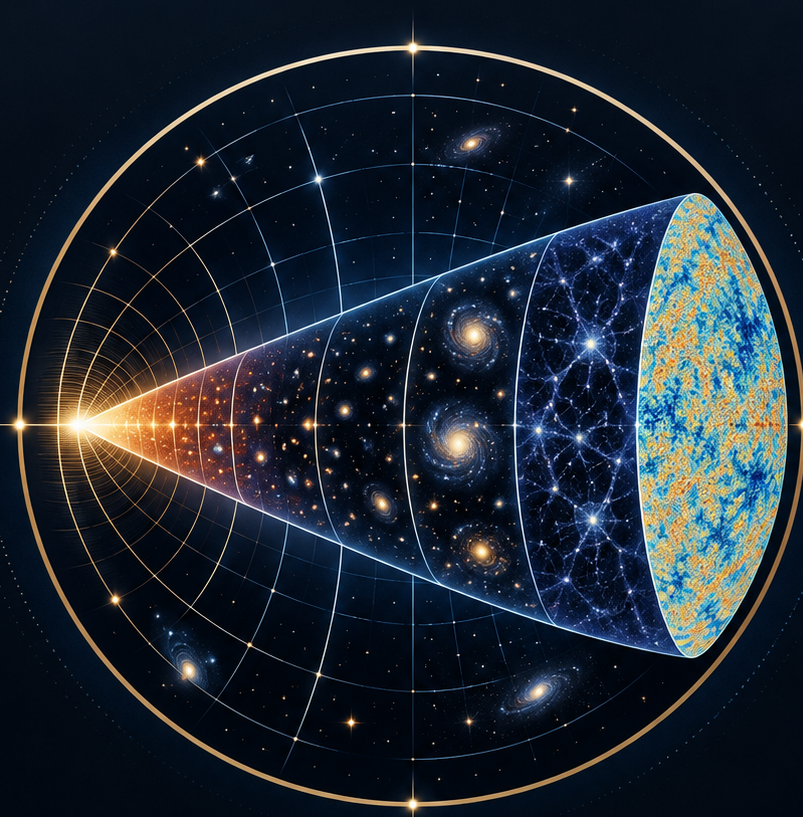
Redshift is the phenomenon by which light from distant astronomical objects is stretched to longer wavelengths as the universe expands. This stretching is a direct consequence of the expansion of space itself, first observed by Edwin Hubble in the 1920s. The redshift of a galaxy tells us how fast it is receding from us, and by extension, how far away it is. More fundamentally, redshift provides a cosmic time machine: because light takes time to travel, observing increasingly distant objects means looking further back in time. The most distant light we can see is the cosmic microwave background (CMB), a relic of the hot, dense early universe.
The cosmological redshift is different from the Doppler effect seen in everyday sound. It is not caused by the motion of the galaxy through space, but by the expansion of space itself stretching the wavelength of light as it travels. This is often described with the analogy of a rubber sheet being stretched: the wavelength of light is like a wave drawn on the sheet, and as the sheet expands, the wave stretches.
The relationship between redshift and the scale factor of the universe is given by the equation: 1 + z = a_0 / a_e, where z is the redshift, a_0 is the current scale factor, and a_e is the scale factor at the time the light was emitted. This simple equation underlies all of observational cosmology.
Cosmic Epochs: A Timeline of the Universe
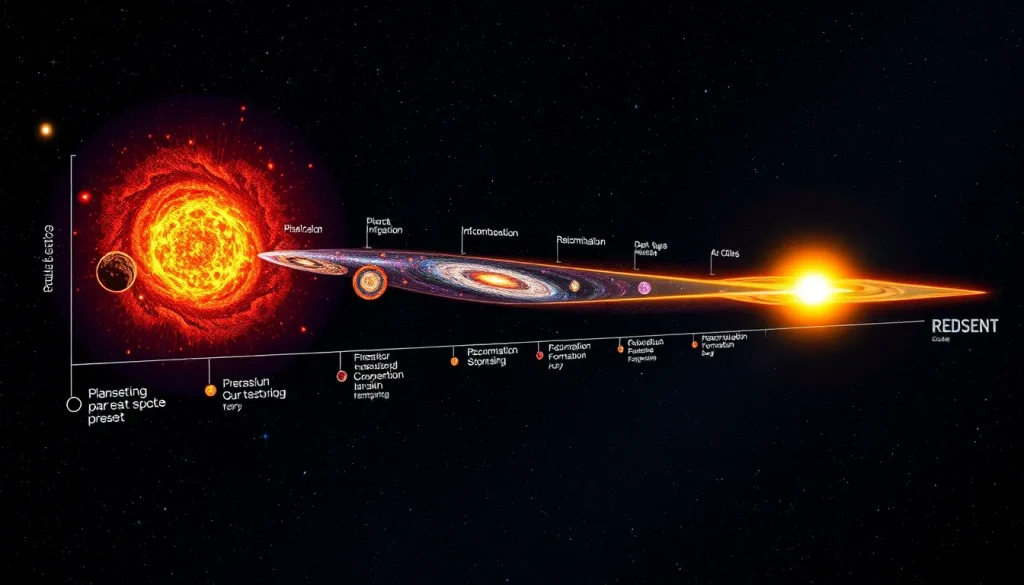
The history of the universe is divided into distinct epochs, each characterized by the dominant physical processes and particle content. The table below summarizes the major epochs from the Planck epoch to the present day.
| Epoch | Time after Big Bang | Approximate Redshift (z) | Temperature | Key Events |
|---|---|---|---|---|
| Planck Epoch | 0 to 10^-43 s | ∞ | >10^32 K | Quantum gravity effects dominate; no current theory |
| Grand Unification Epoch | 10^-43 to 10^-36 s | ~10^32 | >10^28 K | Strong and electroweak forces unified |
| Inflationary Epoch | 10^-36 to 10^-32 s | ~10^28 to 10^24 | ~10^27 K | Exponential expansion; quantum fluctuations seeded structure |
| Electroweak Epoch | 10^-32 to 10^-10 s | ~10^24 to 10^15 | 10^15 to 10^28 K | Electromagnetic and weak forces separate |
| Quark Epoch | 10^-10 to 10^-6 s | ~10^15 to 10^12 | >10^12 K | Quarks and gluons form a quark-gluon plasma |
| Hadron Epoch | 10^-6 to 1 s | ~10^12 to 10^10 | 10^10 to 10^12 K | Protons and neutrons form; matter-antimatter asymmetry |
| Lepton Epoch | 1 s to 10 s | ~10^10 to 10^9 | 10^9 to 10^10 K | Leptons dominate; neutrinos decouple |
| Photon Epoch | 10 s to 380,000 yr | ~10^9 to 1100 | 10^9 K to 3000 K | Photons coupled to matter; primordial nucleosynthesis |
| Recombination | ~380,000 yr | ~1100 | ~3000 K | Electrons combine with nuclei to form neutral atoms; CMB released |
| Dark Ages | 380,000 yr to ~100 million yr | 1100 to ~20 | 3000 K to ~60 K | Universe is dark; no stars or galaxies yet |
| Reionization | ~100 million to 1 billion yr | ~20 to ~6 | ~60 K to ~20 K | First stars and galaxies ionize hydrogen |
| Structure Formation | 1 billion yr to present | ~6 to 0 | >20 K to 2.7 K | Galaxies, clusters, and large-scale structure form |
Each epoch is defined by the dominant particles and interactions. The Planck epoch remains speculative because it requires a quantum theory of gravity. Inflation, proposed by Alan Guth in 1980, explains the remarkable uniformity of the CMB and the absence of magnetic monopoles. The synthesis of light elements (Big Bang nucleosynthesis) occurred during the Photon Epoch, producing roughly 75% hydrogen and 25% helium by mass.
Planck Epoch
This is the earliest moment, where the four fundamental forces are thought to be unified. Our current physics breaks down at these energies. No observational evidence directly probes this epoch, but it is the starting point of the standard model of cosmology.
Inflationary Epoch
Inflation is a period of exponential expansion lasting from 10^-36 to 10^-32 seconds. It stretched quantum fluctuations to cosmic scales, seeding the density variations that later grew into galaxies and clusters. The CMB temperature anisotropies observed by COBE, WMAP, and Planck are direct evidence for these primordial fluctuations.
Recombination and the CMB
At about 380,000 years after the Big Bang, the universe cooled to about 3000 K, allowing electrons and protons to combine into neutral hydrogen. Photons decoupled from matter and have been traveling freely ever since, forming the cosmic microwave background. The CMB is a near-perfect blackbody with a temperature of 2.725 K, as measured by COBE and refined by Planck. Its tiny fluctuations encode the seeds of all cosmic structure.
Dark Ages and Reionization
After recombination, the universe entered the Dark Ages, a period with no luminous sources. Gravity slowly amplified the density fluctuations, leading to the formation of the first stars and galaxies around 100 million years later. These first objects emitted ultraviolet radiation that reionized the neutral hydrogen, ending the Dark Ages. The James Webb Space Telescope (JWST) is now probing this era, revealing galaxies at redshifts as high as 13.
Structure Formation
Over billions of years, matter clumped under gravity to form galaxies, clusters, and the cosmic web. The large-scale structure we observe today is consistent with the Lambda-CDM model, which includes dark matter and dark energy. Redshift surveys, such as the Sloan Digital Sky Survey, map this structure and constrain cosmological parameters.
Why It Matters
Redshift is the primary tool for measuring cosmic distances and the expansion history of the universe. It underpins the discovery of cosmic acceleration (1998 Nobel Prize) and the mapping of the large-scale structure. The cosmic microwave background, a redshifted relic from the early universe, provides a snapshot of the universe at 380,000 years old. Missions like COBE, WMAP, and Planck have measured its properties to exquisite precision, confirming the standard model of cosmology.
Evidence / Sources
The evidence for the Big Bang and the epochs described above comes from multiple independent observations:
- The cosmic microwave background, discovered by Penzias and Wilson in 1965, and mapped by COBE (1989), WMAP (2001), and Planck (2009).
- The abundance of light elements (hydrogen, helium, lithium) matches predictions from Big Bang nucleosynthesis.
- The redshift-distance relation observed for galaxies (Hubble’s law) demonstrates cosmic expansion.
- The large-scale distribution of galaxies, measured by surveys like SDSS, matches the predictions of the Lambda-CDM model.
- The detection of the 21-cm line from neutral hydrogen is now being used to probe the Dark Ages and Reionization.
For further reading, see the references section below.
Related Registry Entries
Explore related articles on cosmic phenomena:
- What Is the Cosmic Microwave Background?
- What Is Cosmic Inflation?
- What Is the Hubble Constant?
- What Is Reionization?
Last reviewed: September 4, 2026
FAQ
What is the difference between cosmological redshift and Doppler redshift?
Doppler redshift arises from the motion of an object through space, while cosmological redshift is caused by the expansion of space itself stretching the wavelength of light as it travels across the universe.
How do astronomers measure redshift?
Astronomers measure redshift by observing the shift of known spectral lines (like hydrogen) toward longer wavelengths. The ratio of the observed wavelength to the rest wavelength gives the redshift z.
What does redshift tell us about the age of the universe?
Higher redshift corresponds to earlier times in cosmic history. The highest redshift objects we observe, such as galaxies seen by JWST at z>13, existed when the universe was only a few hundred million years old.
Why is the cosmic microwave background important?
The CMB is a snapshot of the universe at recombination, revealing the temperature fluctuations that seeded all later structure. Its precise measurement supports the Big Bang model and constrains cosmological parameters.
Leave a Reply