Short Answer
Short Answer / Definition
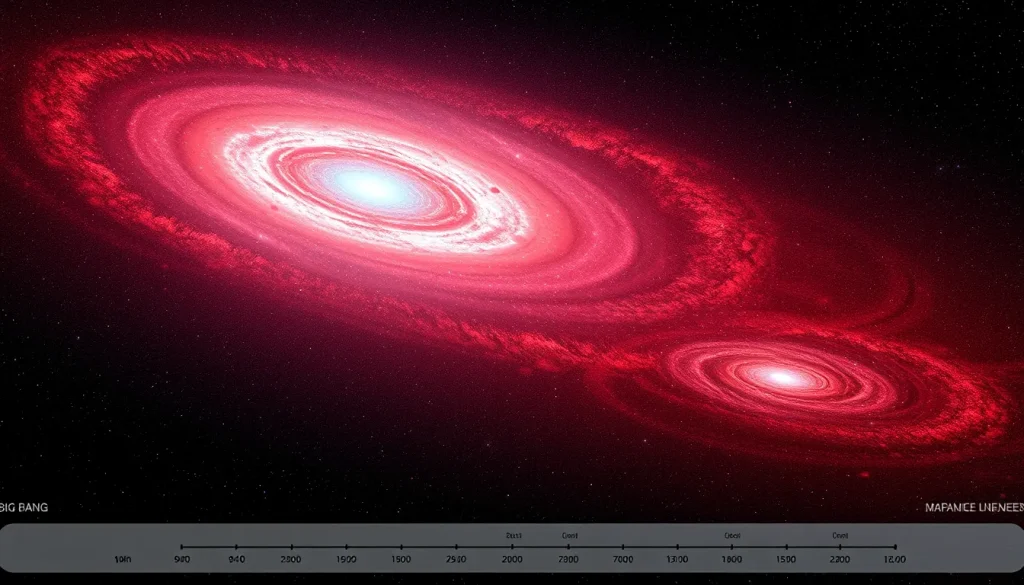
Galaxy redshift is the phenomenon where light from distant galaxies is stretched to longer, redder wavelengths as it travels through an expanding universe. This occurs because the space between galaxies is expanding, causing the wavelength of light to increase. The greater the distance to a galaxy, the more its light is redshifted, providing direct evidence that the universe is expanding. This relationship, codified as Hubble’s law, forms the observational foundation of the Big Bang model and modern cosmology.
Main Explanation
The Discovery of Cosmic Expansion
In the 1920s, astronomers were wrestling with the nature of faint, cloudy objects called nebulae. Edwin Hubble, using the 100-inch Hooker telescope at Mount Wilson, provided the critical observational proof that these nebulae were independent galaxies far beyond the Milky Way. More importantly, he discovered that these galaxies are moving away from us, a recession he confirmed using spectroscopy. As NASA’s Hubble site explains, light from galaxies stretches to increasingly longer, redder wavelengths as it travels through an ever-expanding universe.
This observation built on earlier work by Vesto Slipher, who had measured the redshifts of spiral nebulae in the 1910s. Slipher’s redshifts seemed to support the de Sitter model of a static universe, which predicted redshifted spectra from distant objects, against Einstein’s model which made no such predictions. However, it was Hubble’s systematic study that revealed a linear relationship between galaxy distance and recessional velocity.
How Redshift Works
Cosmological redshift is distinct from the Doppler effect seen with moving objects like fire trucks. While a fire truck’s siren changes pitch as it passes due to relative motion, cosmological redshift arises because the very fabric of space itself expands between the source and the observer. As photons travel through expanding space, their wavelengths stretch proportionally to the amount of expansion that occurs during their journey. This is why more distant galaxies exhibit greater redshifts—their light has traveled longer through more expanding space.
The redshift is quantified by the parameter z, defined as the fractional change in wavelength: z = (λ_observed − λ_emitted) / λ_emitted. A redshift of z = 1 means the wavelength has doubled; z = 10 means it has stretched by a factor of 11. Some of the most distant galaxies observed by JWST have redshifts exceeding z = 10, meaning we see them as they were when the universe was less than 500 million years old.
Hubble’s Law and the Expanding Universe
The relationship between distance and recessional velocity, known as Hubble’s law (or the Hubble–Lemaître law), is expressed as v = H₀ × d, where v is the recessional velocity, d is the distance, and H₀ is the Hubble constant. The current consensus value of H₀ is approximately 70 kilometers per second per megaparsec (km/s/Mpc), though there remains a notable tension between different measurement methods.
Hubble’s law implies that the universe is expanding uniformly. It is important to understand that galaxies are not moving through space; rather, the space between them is expanding. A useful analogy is a loaf of raisin bread rising in the oven. The raisins (galaxies) do not move on their own; they simply get farther apart as the dough (space) expands. An observer on any raisin would see all other raisins moving away, with more distant raisins receding faster.
The Cosmic Timeline: From Planck Epoch to Present
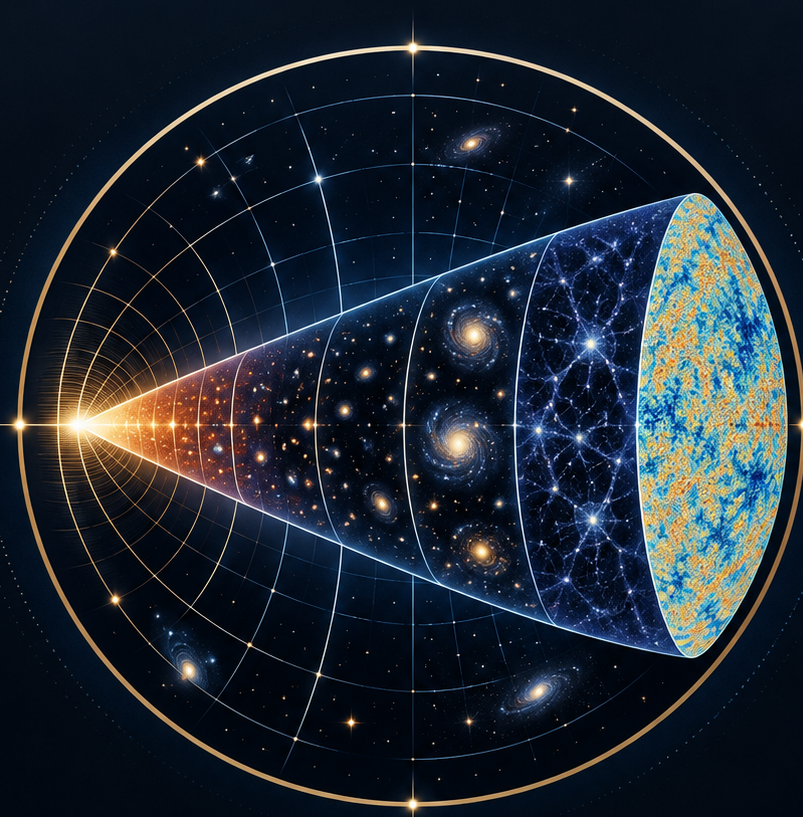
The expanding universe model allows us to run the clock backward, compressing the universe to an infinitesimally small, hot, dense state: the Big Bang. Modern cosmology has reconstructed a detailed timeline of cosmic epochs, each governed by different physical processes.
| Epoch | Time After Big Bang | Temperature | Approx. Redshift | Key Events |
|---|---|---|---|---|
| Planck Epoch | 0 to 10⁻⁴³ s | >10³² K | Infinite | Quantum gravity era; all four fundamental forces unified |
| Grand Unification Epoch | 10⁻⁴³ to 10⁻³⁶ s | 10²⁷–10³² K | ~10³² | Strong force separates from electroweak force |
| Inflationary Epoch | 10⁻³⁶ to 10⁻³² s | ~10²⁷ K | ~10³⁰ | Exponential expansion; quantum fluctuations seeded structure |
| Electroweak Epoch | 10⁻³² to 10⁻¹² s | 10¹⁵–10²⁷ K | ~10²⁹ | Electromagnetic and weak forces separate; particles acquire mass |
| Quark Epoch | 10⁻¹² to 10⁻⁶ s | 10¹²–10¹⁵ K | ~10¹⁵ | Quarks and gluons form quark-gluon plasma |
| Hadron Epoch | 10⁻⁶ to 1 s | 10¹⁰–10¹² K | ~10¹² | Protons and neutrons form; matter-antimatter annihilation |
| Lepton Epoch | 1 to 10 s | 10⁹–10¹⁰ K | ~10¹⁰ | Leptons dominate; neutrinos decouple |
| Photon Epoch | 10 s to 380,000 years | 3,000–10⁹ K | ~10⁹ to 1,100 | Universe is a plasma; photons tightly coupled to matter |
| Recombination | ~380,000 years | ~3,000 K | ~1,100 | Electrons combine with protons to form neutral hydrogen; CMB released |
| Dark Ages | 380,000 to ~150 million years | ~60–3,000 K | ~20–1,100 | No luminous sources; universe is dark and neutral |
| Reionization | ~150 million to 1 billion years | ~20–60 K | ~6–20 | First stars and galaxies ionize surrounding hydrogen |
| Structure Formation | 1 billion years to present | ~2.7 K | 0–6 | Galaxies cluster; dark energy accelerates expansion |
The Cosmic Microwave Background: A Relic of Recombination
One of the most powerful confirmations of the Big Bang model is the cosmic microwave background (CMB), the afterglow of the hot, dense early universe. During the Photon Epoch, the universe was filled with a hot plasma of protons, electrons, and photons. Photons were constantly scattered by free electrons, making the universe opaque. At recombination, about 380,000 years after the Big Bang, the temperature had dropped to roughly 3,000 K, cool enough for electrons and protons to combine into neutral hydrogen atoms. With free electrons no longer available to scatter them, photons were released to stream freely across the universe. These photons, stretched by cosmic expansion, now appear as the CMB at a temperature of just 2.725 K, with a redshift of about z = 1,100.
Missions like COBE, WMAP, and Planck have mapped the CMB with extraordinary precision, revealing tiny temperature fluctuations that correspond to the seeds of large-scale structure. These observations have established the Lambda-CDM model as the standard model of cosmology, with the universe composed of roughly 5% ordinary matter, 27% dark matter, and 68% dark energy.
The First Atoms, Stars, and Galaxies
After recombination, the universe entered the Dark Ages—a period with no luminous sources. The neutral hydrogen that formed during recombination was gradually pulled together by gravity into denser regions, following the patterns seeded by quantum fluctuations during inflation. These overdense regions eventually collapsed to form the first stars, likely massive and short-lived, which began to emit ultraviolet radiation. This radiation reionized the surrounding hydrogen gas during the epoch of Reionization, making the universe transparent to ultraviolet light and allowing the formation of the first galaxies.
The James Webb Space Telescope (JWST) has been instrumental in probing this era, detecting galaxies at redshifts beyond z = 10 and revealing that the early universe was more complex and active than previously thought.
Expansion and Dark Energy
About 13.8 billion years ago, the universe began with the Big Bang. The initial rapid expansion began to slow down almost instantaneously due to gravity. However, roughly five billion years ago, the expansion rate began accelerating due to a mysterious force called dark energy. This discovery, made through observations of distant Type Ia supernovae, was awarded the Nobel Prize in Physics in 2011. The Lambda-CDM model incorporates dark energy as the cosmological constant (Λ), which drives the current accelerated expansion.
Why It Matters
Galaxy redshift is not merely an astronomical curiosity; it is the empirical foundation of our understanding of the universe’s origin and evolution. The observation that the universe is expanding leads inevitably to the conclusion that it was once smaller, denser, and hotter—the Big Bang. The detailed cosmic timeline, from the Planck epoch to the present, is a triumph of modern physics, connecting quantum mechanics, particle physics, and general relativity. Understanding redshift allows astronomers to measure cosmic distances, map the large-scale structure of the universe, and study the evolution of galaxies over cosmic time. It also provides critical evidence for dark matter and dark energy, which together constitute 95% of the universe’s content. As NASA notes, the expansion of the universe is the framework within which all of modern cosmology operates, and galaxy redshift is the key observational tool that makes this framework visible.
Evidence / Sources
- NASA Science: Hubble Cosmological Redshift — https://science.nasa.gov/mission/hubble/science/science-behind-the-discoveries/hubble-cosmological-redshift/
- OpenStax Astronomy 2e, Section 26.5: The Expanding Universe — https://openstax.org/books/astronomy-2e/pages/26-5-the-expanding-universe
- Einstein-Online: Reddening galaxies — https://www.einstein-online.info/en/redshift/
- Nussbaumer, H. (2013). Slipher’s redshifts as support for de Sitter’s model and the discovery of the dynamic universe. arXiv:1303.1814
Related Registry Entries
- Cosmic Microwave Background
- Hubble–Lemaître Law
- Big Bang Nucleosynthesis
- Inflationary Cosmology
- Lambda-CDM Model
FAQ
What is the difference between cosmological redshift and the Doppler effect?
The Doppler effect arises from the relative motion of an object through space, like a fire truck moving past you. Cosmological redshift, by contrast, is caused by the expansion of space itself. As light travels through expanding space, its wavelength stretches, regardless of any relative motion between source and observer. This distinction is crucial for distant galaxies, where the expansion of space dominates.
How do we know the universe is expanding rather than galaxies just moving away?
The key evidence is that the rate of recession is proportional to distance, and the expansion appears uniform in all directions. If galaxies were simply moving through a static space, we would not expect such a consistent relationship. Moreover, the cosmic microwave background provides a snapshot of the early universe that matches the predictions of the expanding Big Bang model, including the abundance of light elements and the large-scale structure we observe today.
What does a redshift of z = 10 mean?
A redshift of z = 10 means that the wavelength of light has been stretched by a factor of 11 (since 1 + z = 11). This corresponds to light that was emitted when the universe was only about 500 million years old, roughly 3.5% of its current age. JWST has detected galaxies at even higher redshifts, pushing our view closer to the cosmic dawn.
Leave a Reply