Short Answer
Infographic Box
| Property | Value |
|---|---|
| Age of the universe | 13.8 billion years |
| Radius of observable universe | ~46.5 billion light-years (14.26 Gpc) |
| Diameter | ~93 billion light-years |
| Shape | Sphere (centered on observer) |
| Content | Ordinary matter, dark matter, dark energy, radiation |
| Key relic | Cosmic microwave background (CMB) |
Main Explanation
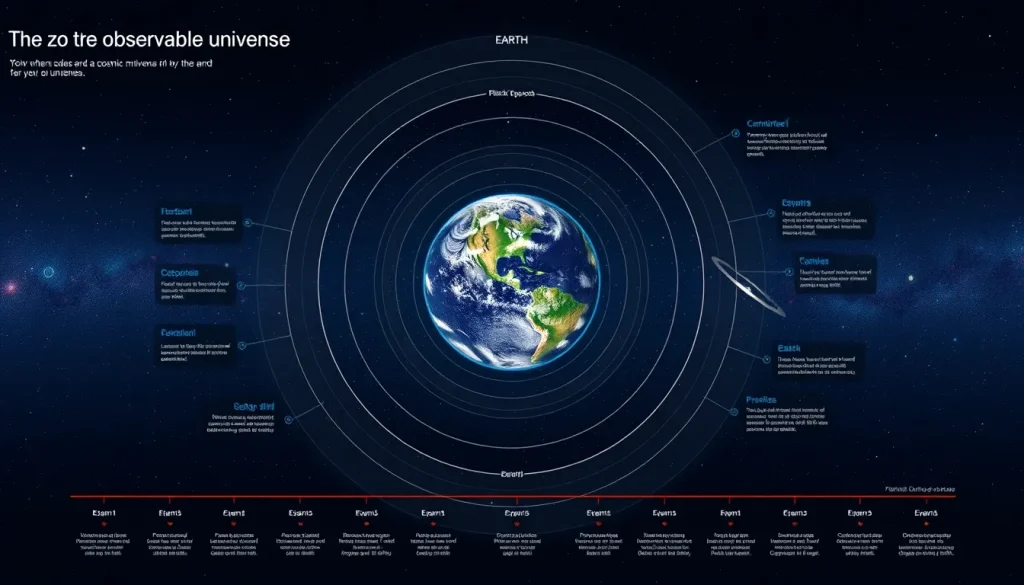
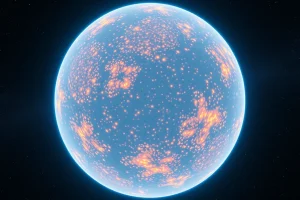
When we look up at the night sky, we are seeing light that has traveled across space for millions or billions of years. The observable universe is the maximum volume from which light has reached us since the beginning of cosmic expansion. It is not defined by technology, but by physics: no signal can travel faster than light, and the universe is only about 13.8 billion years old. Thus, any object farther than about 46.5 billion light-years (the comoving distance) lies beyond our particle horizon and is forever invisible to us.
Cosmic Epochs: From Planck to Present
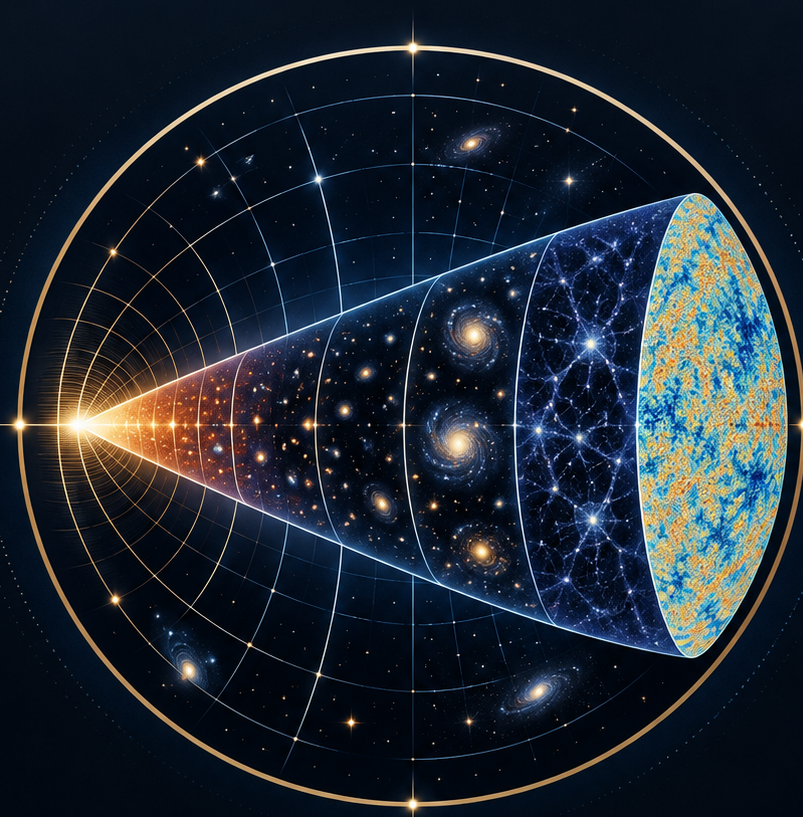
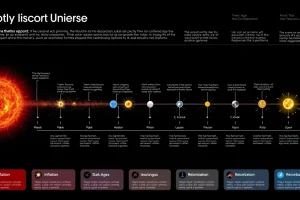
The standard model of cosmology (ΛCDM) describes a universe that began in a hot, dense state and has been expanding and cooling ever since. The timeline is divided into distinct epochs, each characterized by the dominant particles and physical processes. Below is a summary of the major epochs, followed by detailed explanations.
| Epoch | Time After Big Bang | Temperature | Key Events |
|---|---|---|---|
| Planck epoch | 0 to ~10⁻⁴³ s | ~10³² K | Quantum gravity dominates; all forces unified |
| Grand Unification epoch | 10⁻⁴³ to 10⁻³⁶ s | 10²⁷–10³² K | Strong force separates from electroweak |
| Inflationary epoch | 10⁻³⁶ to 10⁻³² s | ~10²⁷ K | Exponential expansion; seeds for structure |
| Electroweak epoch | 10⁻³² to 10⁻¹² s | 10¹⁵–10²⁷ K | Electromagnetic and weak forces separate |
| Quark epoch | 10⁻¹² to 10⁻⁶ s | 10¹²–10¹⁵ K | Quarks and gluons form quark-gluon plasma |
| Hadron epoch | 10⁻⁶ to 1 s | 10¹⁰–10¹² K | Quarks combine into protons and neutrons |
| Lepton epoch | 1 to 10 s | 10⁹–10¹⁰ K | Leptons dominate; neutrinos decouple |
| Photon epoch | 10 s to ~380,000 yr | ~10⁹ K down to 3000 K | Photons tightly coupled to matter |
| Recombination | ~380,000 yr | ~3000 K | Electrons combine with protons; CMB released |
| Dark Ages | 380,000 yr to ~150 million yr | ~3000 K to ~60 K | No stars yet; universe filled with neutral hydrogen |
| Reionization | ~150 million yr to 1 billion yr | ~60 K to ~20 K | First stars and galaxies ionize hydrogen |
| Structure Formation | ~1 billion yr to present | Cooling to 2.7 K | Galaxies, clusters, and large-scale structure form |
Planck Epoch and Inflation
The very first moments of the universe are beyond our current physical theories. During the Planck epoch, quantum gravity effects dominated, and the four fundamental forces were unified. Inflation, a period of exponential expansion lasting from about 10⁻³⁶ to 10⁻³² seconds, stretched quantum fluctuations to cosmic scales, seeding the density variations that later grew into galaxies and clusters. This expansion explains the remarkable uniformity of the cosmic microwave background and the flat geometry of space.
From Quarks to Atoms
As the universe cooled, quarks combined into protons and neutrons during the hadron epoch. A few minutes later, primordial nucleosynthesis produced light elements—mostly hydrogen and helium—with trace amounts of lithium. The photon epoch followed, during which photons were continually scattered by free electrons, making the universe opaque. About 380,000 years after the Big Bang, recombination occurred: electrons joined nuclei to form neutral atoms, and photons decoupled, creating the cosmic microwave background we observe today.
The Cosmic Microwave Background
The CMB is a relic radiation that fills the universe, with a temperature of about 2.7 K today. It provides a snapshot of the universe at recombination. Missions like COBE, WMAP, and Planck have mapped its tiny temperature fluctuations, which encode the initial conditions for structure formation. These measurements strongly support the ΛCDM model and have pinned down cosmological parameters with remarkable precision.
Dark Ages and Reionization
After recombination, the universe entered the Dark Ages—a period with no luminous sources. Gravity slowly amplified the density fluctuations, and eventually the first stars and galaxies formed. Their ultraviolet radiation reionized the neutral hydrogen, a process called reionization. The James Webb Space Telescope (JWST) is now probing this era, revealing galaxies that existed just a few hundred million years after the Big Bang.
Structure Formation and the Present Day
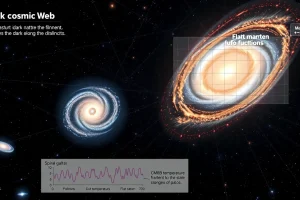
Over billions of years, gravity assembled galaxies, clusters, and filaments, forming the large-scale cosmic web. Dark energy, discovered through supernova observations in the 1990s, drives the accelerated expansion of the universe. The observable universe today contains roughly 200 billion galaxies, each hosting billions of stars, yet the vast majority of the universe lies beyond our horizon.
Why It Matters
Understanding the observable universe is fundamental to cosmology. It defines the limits of empirical knowledge—everything we can test and observe lies within this sphere. The cosmic epochs described above are not just historical milestones; they are the framework for interpreting data from telescopes, particle accelerators, and gravitational wave detectors. By studying the CMB, the abundance of light elements, and the distribution of galaxies, we can reconstruct the history of the cosmos and test the physics that governs it.
Evidence / Sources
The primary evidence for the observable universe and its evolution comes from:
- The cosmic microwave background, measured precisely by COBE, WMAP, and Planck.
- Primordial nucleosynthesis predictions matching observed helium and deuterium abundances.
- Redshift surveys of galaxies, mapping the large-scale structure.
- Supernova distance measurements revealing cosmic acceleration.
- Direct imaging of early galaxies by the Hubble and James Webb Space Telescopes.
These observations collectively support the ΛCDM model, which describes a flat, expanding universe composed of ~5% ordinary matter, ~27% dark matter, and ~68% dark energy.
Related Registry Entries
FAQ
How big is the observable universe?
The radius is about 46.5 billion light-years, giving a diameter of roughly 93 billion light-years. This is larger than the age of the universe times the speed of light because space itself has expanded.
Why can't we see the entire universe?
Light travels at a finite speed, and the universe has a finite age. Objects beyond a certain distance have not had time for their light to reach us, placing them outside our particle horizon.
What is the cosmic microwave background?
It is the leftover radiation from the Big Bang, emitted about 380,000 years after the start. It fills the universe and provides a snapshot of the early cosmos.
How do we know the universe is expanding?
Observations of distant galaxies show a redshift proportional to their distance, a relationship known as Hubble–Lemaître law. This indicates that space is stretching.
Leave a Reply