Short Answer
Main Explanation
The standard Big Bang model describes a universe that began from an extremely hot, dense state and has been expanding and cooling ever since. However, by the late 1970s, cosmologists recognized two profound puzzles that the model could not explain. The horizon problem asks why regions of the sky that have never been in causal contact have nearly identical temperatures. The flatness problem asks why the density of the universe is so close to the critical value that separates eternal expansion from recollapse. In 1981, Alan Guth introduced the idea of cosmic inflation to address these issues. According to the Centre for Theoretical Cosmology, inflation posits that the early universe expanded exponentially fast for a fraction of a second after the Big Bang. This rapid expansion would have stretched any initial irregularities to scales larger than the observable universe, making the universe appear homogeneous and isotropic, and flattening space-time to near-perfect flatness.
Inflation also provides a mechanism for the origin of structure. Quantum fluctuations in the microscopic inflationary region were magnified to cosmic size, becoming the seeds for the growth of galaxies and clusters. As the inflationary period ended, the energy driving the expansion was converted into a hot, dense soup of particles—a process called reheating—and the universe entered the familiar radiation-dominated era.
The Cosmic Epochs
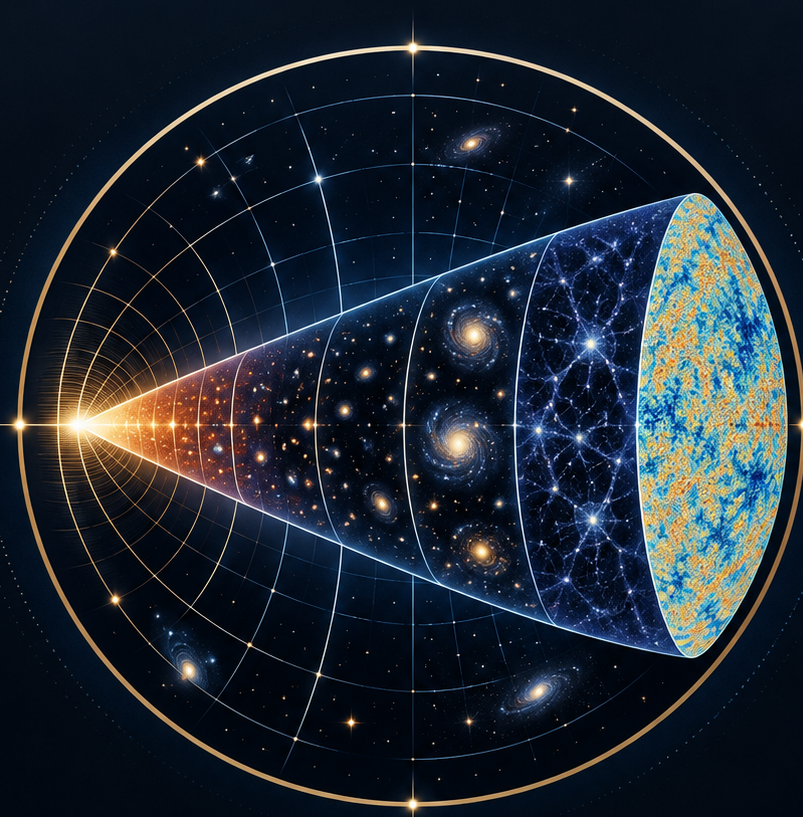
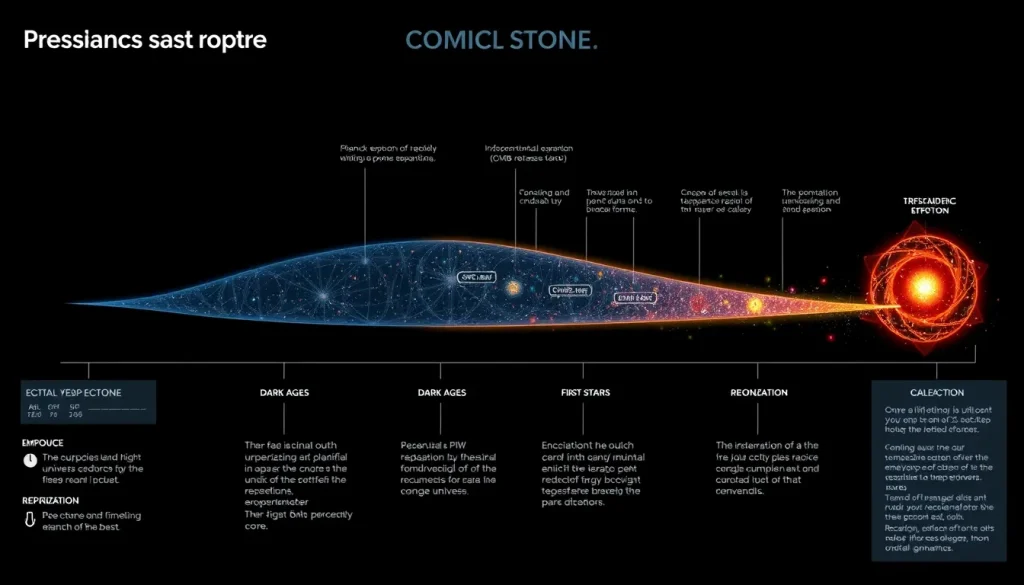
The history of the universe is often divided into distinct epochs, each characterized by the dominant physical processes and particle content. The table below summarizes the major epochs from the Planck epoch to the present day.
| Epoch | Time after Big Bang | Temperature | Approximate Redshift | Dominant Physics | Key Events |
|---|---|---|---|---|---|
| Planck Epoch | 0 to 10-43 s | >1032 K | >1032 | Quantum gravity | All four forces unified; quantum effects dominate |
| Grand Unification Epoch | 10-43 to 10-36 s | 1027 to 1032 K | 1027 to 1032 | Grand unified theories | Strong and electroweak forces separate |
| Inflationary Epoch | 10-36 to 10-32 s | Dropping rapidly | Varies | Inflaton field | Exponential expansion; quantum fluctuations seeded |
| Electroweak Epoch | 10-32 to 10-12 s | 1015 to 1027 K | 1015 to 1027 | Electroweak theory | Electromagnetic and weak forces separate; W, Z bosons acquire mass |
| Quark Epoch | 10-12 to 10-6 s | 1012 to 1015 K | 1012 to 1015 | Quark-gluon plasma | Quarks and gluons exist freely |
| Hadron Epoch | 10-6 to 1 s | 1010 to 1012 K | 1010 to 1012 | Strong force | Protons and neutrons form; matter-antimatter annihilation |
| Lepton Epoch | 1 to 10 s | 109 to 1010 K | 109 to 1010 | Weak interactions | Leptons dominate; neutrinos decouple |
| Photon Epoch | 10 s to 380,000 yr | 104 to 109 K | 104 to 109 | Radiation | Photons dominate; nucleosynthesis occurs |
| Recombination | ~380,000 yr | ~3000 K | ~1100 | Atomic physics | Electrons combine with nuclei; CMB released |
| Dark Ages | 380,000 yr to ~150 million yr | ~3000 K to ~50 K | 1100 to ~20 | Gravity | No stars yet; neutral hydrogen fills space |
| Reionization | ~150 million to ~1 billion yr | ~50 K to ~10 K | 20 to ~6 | First stars and galaxies | UV light reionizes hydrogen |
| Structure Formation | ~1 billion yr to present | <10 K | <6 | Gravity, dark matter, dark energy | Galaxies, clusters, and large-scale structure form |
Planck Epoch
The Planck epoch is the earliest period, from time zero to about 10-43 seconds (the Planck time). At this stage, the universe was so hot and dense that the four fundamental forces—gravity, electromagnetism, the weak nuclear force, and the strong nuclear force—are thought to have been unified into a single force. Quantum effects of gravity dominated, and our current physical theories, which combine general relativity and quantum mechanics, break down. A complete theory of quantum gravity is still lacking, so this epoch remains speculative.
Grand Unification Epoch
From 10-43 to 10-36 seconds, the universe cooled enough for gravity to separate from the other forces. The remaining three forces—strong, weak, and electromagnetic—were still unified under a Grand Unified Theory (GUT). As the temperature dropped below about 1029 K, the strong force separated from the electroweak force, potentially releasing energy that could have driven inflation.
Inflationary Epoch
Inflation is believed to have occurred during this period, roughly 10-36 to 10-32 seconds after the Big Bang. A hypothetical field called the inflaton drove an exponential expansion of space, increasing the scale factor by at least a factor of 1026. This rapid expansion smoothed out any initial irregularities, explaining the uniformity of the cosmic microwave background (CMB). Quantum fluctuations in the inflaton field were stretched to macroscopic scales, providing the density perturbations that later grew into galaxies and clusters. The inflationary epoch ended when the inflaton field decayed, reheating the universe to a high temperature and filling it with particles.
Electroweak Epoch
After inflation, the universe was filled with a hot plasma of quarks, leptons, and bosons. During the electroweak epoch (10-32 to 10-12 s), the electromagnetic and weak forces separated as the universe cooled below about 1015 K. The W and Z bosons acquired mass through the Higgs mechanism, and the universe entered a phase where the fundamental forces we observe today became distinct.
Quark Epoch
From 10-12 to 10-6 seconds, the universe was a quark-gluon plasma—a state of matter where quarks and gluons were not yet bound into hadrons. The temperature was too high for quarks to combine. As the universe expanded and cooled, the strong force began to confine quarks into protons and neutrons.
Hadron Epoch
During the hadron epoch (10-6 to 1 s), the universe had cooled enough for quarks to combine into hadrons, such as protons and neutrons. This period also saw the annihilation of matter and antimatter, leaving a slight excess of matter that would eventually form the visible universe. The baryon asymmetry—why matter survived—is still not fully understood.
Lepton Epoch
From 1 to 10 seconds, the universe was dominated by leptons (electrons, muons, and neutrinos). Neutrinos decoupled from the rest of the matter at about 1 second, creating a cosmic neutrino background that we can still detect indirectly. Electron-positron annihilation occurred at the end of this epoch, heating the photon gas.
Photon Epoch
The photon epoch lasted from 10 seconds to about 380,000 years. During this time, the universe was radiation-dominated, with photons constantly interacting with free electrons and nuclei. Big Bang nucleosynthesis occurred in the first few minutes, producing light elements like hydrogen, helium, and lithium. The universe remained opaque because photons were continually scattered by free electrons.
Recombination
About 380,000 years after the Big Bang, the universe had cooled to about 3000 K. Electrons combined with protons and helium nuclei to form neutral atoms—a process called recombination. This allowed photons to travel freely, producing the cosmic microwave background (CMB). The CMB is the oldest light we can observe, a relic of this epoch. Its near-perfect blackbody spectrum and tiny temperature fluctuations (about 1 part in 100,000) provide a snapshot of the universe at that time.
Dark Ages
After recombination, the universe entered the Dark Ages—a period with no stars or galaxies. The universe was filled with neutral hydrogen and helium, and the only radiation was the CMB, which continued to cool as the universe expanded. Gravity slowly amplified the density fluctuations seeded by inflation, setting the stage for the first structures.
Reionization
Around 150 million to 1 billion years after the Big Bang, the first stars and galaxies formed. Their intense ultraviolet radiation reionized the neutral hydrogen, breaking it back into protons and electrons. This epoch of reionization is a key frontier in cosmology, studied with telescopes like the James Webb Space Telescope (JWST).
Structure Formation
From about 1 billion years after the Big Bang to the present, gravity assembled galaxies, clusters, and the large-scale structure of the universe. Dark matter played a crucial role, providing the gravitational scaffolding for visible matter. Dark energy, discovered in the late 1990s, is now driving an accelerated expansion. The standard model of cosmology, Lambda-CDM, combines cold dark matter and a cosmological constant to explain the observed structure and expansion history.
Why It Matters
Cosmic inflation is not just a historical curiosity; it is a cornerstone of modern cosmology. It explains the uniformity of the CMB, the flatness of the universe, and the origin of structure. Without inflation, the horizon and flatness problems would remain unresolved, and we would have no mechanism to seed the galaxies we see today. Inflation also makes testable predictions, such as the near-scale-invariant spectrum of density fluctuations and the absence of magnetic monopoles. Observations from COBE, WMAP, and Planck have confirmed these predictions to remarkable precision, cementing inflation as the leading theory of the very early universe.
Evidence / Sources
The following sources provide authoritative information on cosmic inflation and the evolution of the universe:
- Centre for Theoretical Cosmology, University of Cambridge: The Origins of the Universe: Inflation Introduction
- Wikipedia: Cosmic inflation
- Astronomy.com: Astronomy 101: Cosmic Inflation
- Lawrence Berkeley National Laboratory: Inflation for Beginners
Related Registry Entries
- Big Bang
- Cosmic Microwave Background
- Recombination
- Reionization
- Large-scale Structure
- Planck Mission
FAQ
What is cosmic inflation?
Cosmic inflation is a theory that the universe underwent an exponential expansion in the first fraction of a second after the Big Bang, solving the horizon and flatness problems and seeding the large-scale structure.
Who proposed cosmic inflation?
Alan Guth proposed the theory in 1981, with important contributions from Alexei Starobinsky and Andrei Linde.
How does inflation solve the horizon problem?
Inflation expands a tiny, causally connected region to a size larger than the observable universe, so regions that appear separate today were once in contact.
What is the cosmic microwave background?
The CMB is the relic radiation from recombination, about 380,000 years after the Big Bang, and it provides a snapshot of the early universe.
What missions have studied the CMB?
COBE, WMAP, and Planck have mapped the CMB with increasing precision, confirming inflation's predictions.

Leave a Reply