Short Answer
Main Explanation
The question of how small the universe was at the Big Bang has fascinated cosmologists and the public alike. The classic picture of a point-like singularity—a zero-volume, infinitely dense state—has been refined by modern inflationary theory. According to the standard Lambda-CDM model, the observable universe we see today originated from a region that was not infinitesimally small but rather a finite patch of space that underwent a period of exponential expansion known as cosmic inflation. This inflationary phase, lasting at least ~10-32 seconds, stretched quantum fluctuations to cosmic scales, setting the initial conditions for the hot Big Bang.
At the end of inflation, the universe was still incredibly small by today’s standards—roughly the size of a grapefruit or smaller—but it was not a singularity. The observable universe, which now spans 46.1 billion light-years in radius, was once compressed into a volume that was a fraction of a centimeter across. The exact size depends on the details of inflation, but it was certainly finite and macroscopic.
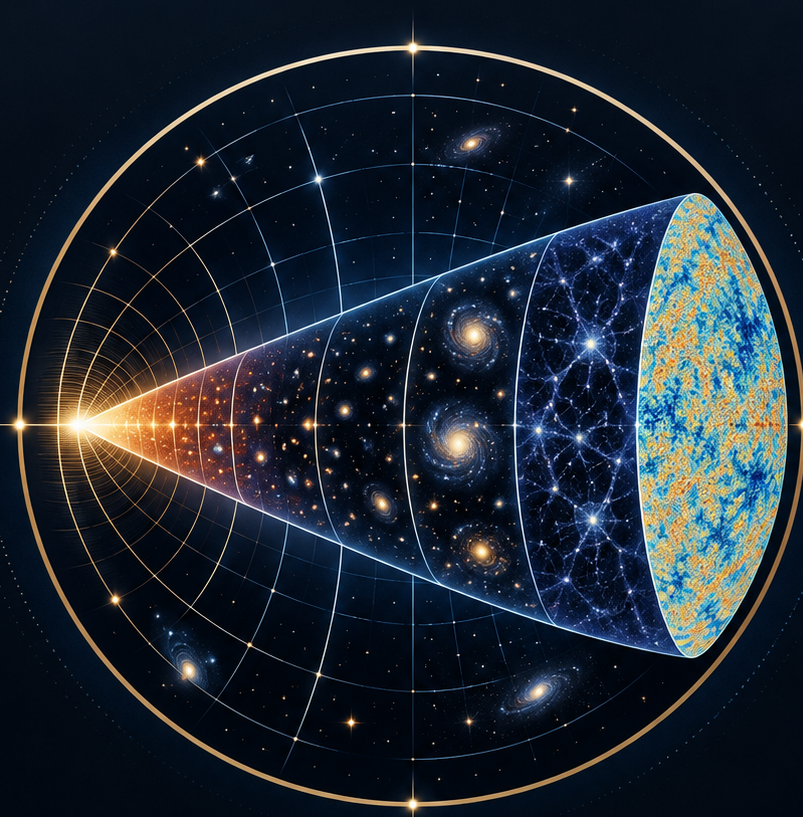
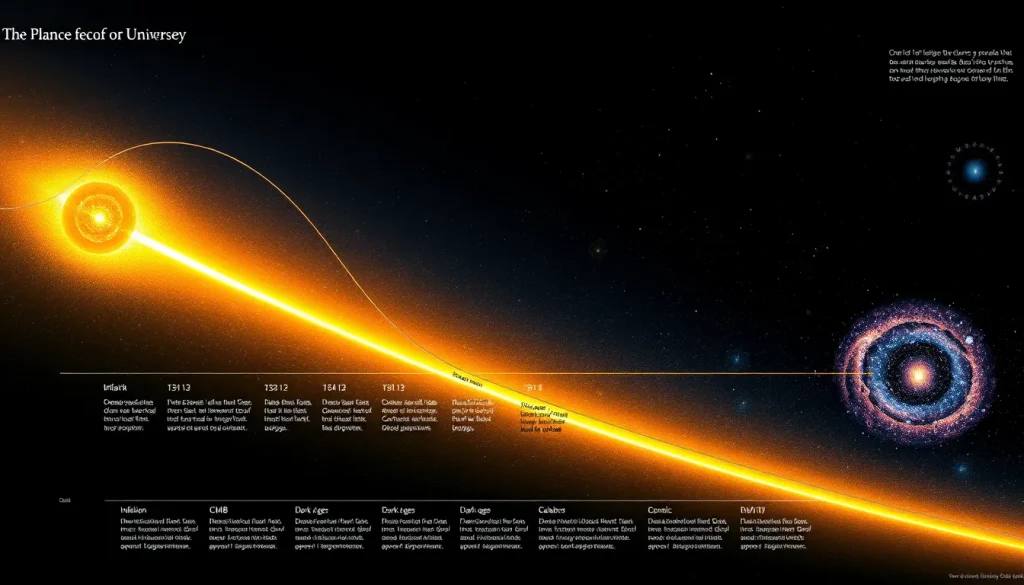
To understand the full story, we must trace the universe through its major epochs, from the Planck epoch to the present day. Each epoch is characterized by distinct physical processes, temperatures, and particle content.
The Cosmic Epochs
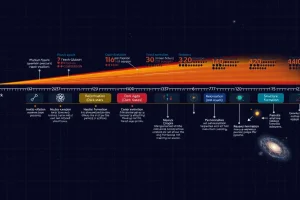
The following table summarizes the key epochs in cosmic history, from the earliest moments to the formation of large-scale structure. Times are measured from the beginning of the hot Big Bang (t=0), and temperatures are approximate.
| Epoch | Time | Temperature | Key Events |
|---|---|---|---|
| Planck Epoch | < 10-43 s | > 1032 K | Quantum gravity effects dominate; no known physics. |
| Grand Unification Epoch | 10-43 to 10-36 s | 1028 to 1032 K | Strong and electroweak forces unify; inflation may begin. |
| Inflationary Epoch | ~10-36 to 10-32 s | Dropping rapidly | Exponential expansion; quantum fluctuations seeded structure. |
| Electroweak Epoch | 10-32 to 10-12 s | 1015 to 1028 K | Electromagnetic and weak forces separate; Higgs mechanism gives mass. |
| Quark Epoch | 10-12 to 10-6 s | 1012 to 1015 K | Quarks and gluons form a quark-gluon plasma. |
| Hadron Epoch | 10-6 to 1 s | 1010 to 1012 K | Protons and neutrons form; matter-antimatter asymmetry emerges. |
| Lepton Epoch | 1 to 10 s | 109 to 1010 K | Leptons dominate; neutrinos decouple. |
| Photon Epoch | 10 s to 380,000 yr | 104 to 109 K | Photons dominate; nucleosynthesis forms light elements. |
| Recombination | ~380,000 yr | ~3000 K | Electrons combine with nuclei; CMB released. |
| Dark Ages | 380,000 yr to ~150 million yr | ~100 to 3000 K | No stars yet; neutral hydrogen fills space. |
| Reionization | ~150 million to 1 billion yr | ~10 to 100 K | First stars and galaxies ionize hydrogen. |
| Structure Formation | 1 billion yr to present | 2.7 K (today) | Galaxies, clusters, and large-scale structure form. |
From Inflation to the First Atoms
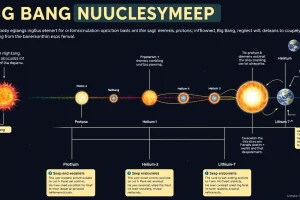
Inflation not only set the size of the universe but also produced the density fluctuations that later grew into galaxies and clusters. After inflation ended, the universe was filled with a hot, dense plasma of quarks, gluons, leptons, and photons. As it expanded and cooled, quarks combined into protons and neutrons (hadron epoch), and then nucleosynthesis produced helium and trace amounts of lithium (photon epoch).
About 380,000 years after the Big Bang, the universe had cooled to about 3000 K, allowing electrons to bind with nuclei to form neutral atoms—a process called recombination. This released the cosmic microwave background (CMB), a relic radiation that we observe today as a nearly uniform glow at 2.725 K. The CMB, first detected by Penzias and Wilson in 1965, and mapped with increasing precision by COBE, WMAP, and Planck, provides a snapshot of the universe at that early time.
The Cosmic Microwave Background and Structure Formation
The CMB is not perfectly uniform; it contains tiny temperature fluctuations (anisotropies) at the level of one part in 100,000. These fluctuations are the seeds of all cosmic structure. Over billions of years, gravity amplified these density variations, leading to the formation of the first stars and galaxies during the epoch of reionization, and eventually to the large-scale structure we see today.
Missions such as COBE (1989), WMAP (2001), and Planck (2009) have measured the CMB with extraordinary precision, confirming the predictions of the Lambda-CDM model and determining cosmological parameters to high accuracy. The James Webb Space Telescope (JWST) is now probing the era of reionization and the first galaxies, providing direct observations of the universe’s early structure formation.
Why It Matters
Understanding the size of the universe at the Big Bang is not just a curiosity—it is fundamental to our comprehension of cosmic origins. The finite size at the start, as opposed to a singularity, resolves the horizon problem and the flatness problem, which are naturally explained by inflation. Moreover, the detailed study of cosmic epochs allows us to test fundamental physics at energies far beyond any particle accelerator. The CMB and the large-scale structure are powerful probes of the universe’s composition, geometry, and evolution. By tracing the universe from its earliest moments to the present, we gain insight into the nature of space, time, and matter, and our place in the cosmos.
Evidence / Sources
The standard model of cosmology is supported by multiple independent lines of evidence:
- The cosmic microwave background, measured by COBE, WMAP, and Planck, matches the predicted blackbody spectrum and anisotropy pattern.
- Big Bang nucleosynthesis correctly predicts the primordial abundances of hydrogen, helium, and lithium.
- The large-scale distribution of galaxies, as mapped by surveys like SDSS and DES, agrees with the Lambda-CDM model.
- The observed accelerating expansion, discovered via Type Ia supernovae, is consistent with dark energy.
For further reading, see the references below.
Related Registry Entries
This article is part of a series on cosmic history. Related entries include:
- Cosmic Microwave Background
- Inflation
- Recombination
- Reionization
- Big Bang Nucleosynthesis
- Dark Ages
FAQ
Was the universe ever a singularity?
In the original Big Bang model, the universe began as a singularity of zero volume. However, cosmic inflation, which is now part of the standard Lambda-CDM model, suggests that the observable universe emerged from a finite, macroscopic region after inflation, not a singularity. The state before inflation is unknown and may or may not have been singular.
How big was the observable universe at the end of inflation?
The exact size depends on the details of inflation, but it was likely on the order of a grapefruit or smaller—certainly macroscopic and finite. The observable universe today has a radius of 46.1 billion light-years, so the expansion factor is enormous.
What is the cosmic microwave background and why is it important?
The CMB is the oldest light in the universe, emitted about 380,000 years after the Big Bang when the universe cooled enough for electrons to combine with nuclei. It provides a snapshot of the early universe and contains tiny temperature fluctuations that seeded the formation of galaxies and large-scale structure. Missions like COBE, WMAP, and Planck have mapped it with high precision, confirming the Lambda-CDM model.

Leave a Reply