Short Answer
Main Explanation
The large-scale structure of the universe—the distribution of galaxies, galaxy clusters, and dark matter spanning hundreds of millions of light-years—is a direct fossil of the conditions that prevailed in the first moments after the Big Bang. By mapping this structure and measuring its statistical properties, cosmologists can test the fundamental assumptions of the standard model of cosmology, known as Lambda-CDM (Lambda for dark energy, CDM for cold dark matter).
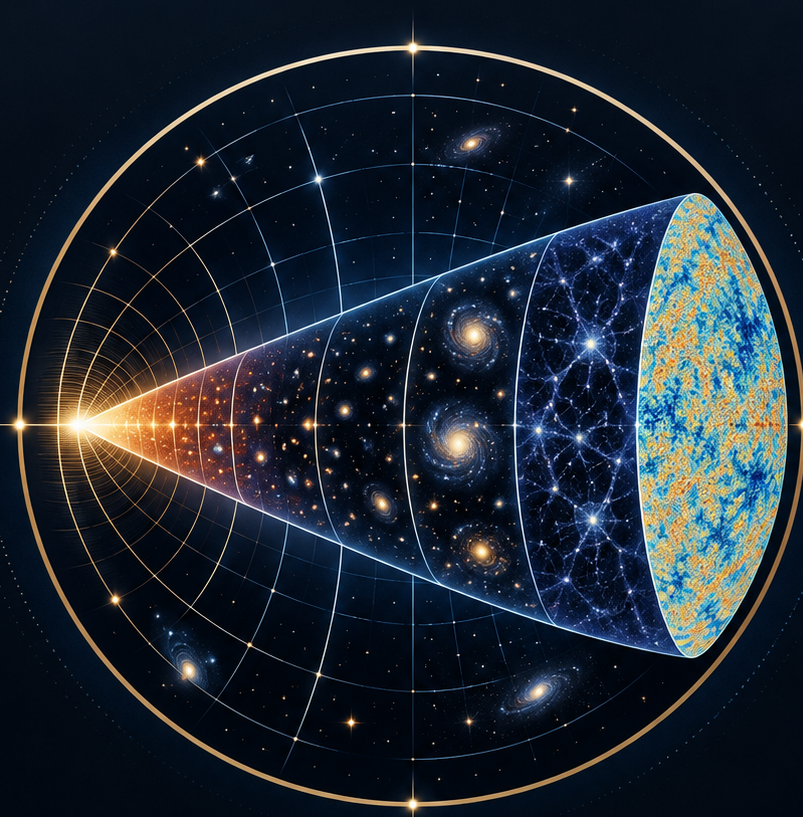
In the standard picture, tiny quantum fluctuations seeded during an early period of cosmic inflation were stretched to astronomical scales. These fluctuations left imprints in the cosmic microwave background (CMB) radiation and later grew under gravity into the vast cosmic web we observe today. The growth of structure depends on the expansion rate, the density of matter and dark energy, and the nature of gravity—making large-scale structure a precision laboratory for cosmological tests.
How Large-Scale Structure Tests Cosmology
Large-scale structure tests cosmology in several complementary ways:
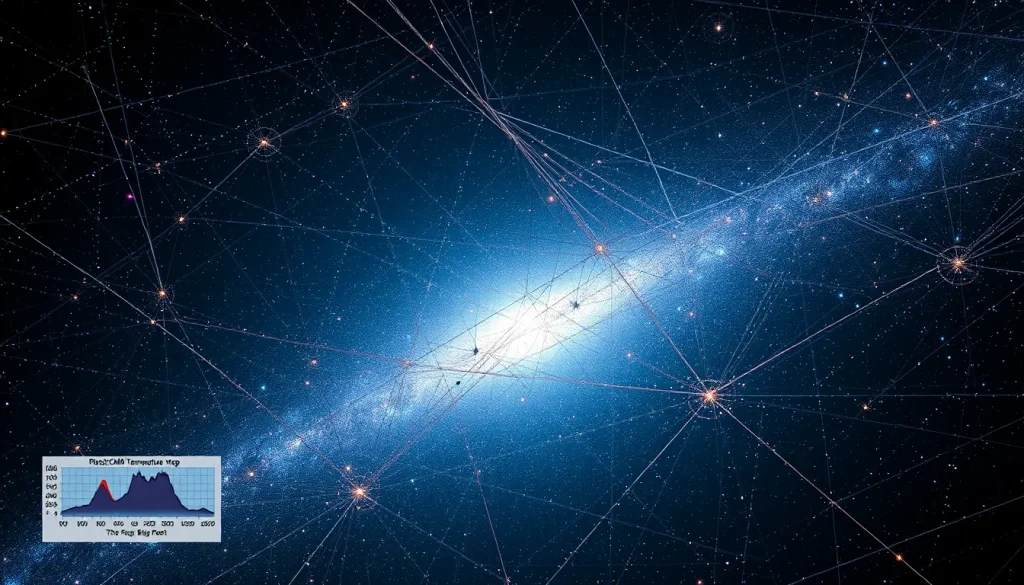
- Baryon Acoustic Oscillations (BAO): The regular spacing of galaxy clusters caused by sound waves in the early plasma provides a “standard ruler” to measure the expansion history of the universe, constraining dark energy and the Hubble constant.
- Growth of Structure: The rate at which density fluctuations grow into galaxies and clusters depends on the amount of matter and the strength of gravity. Comparing observed clustering with predictions tests general relativity and the nature of dark matter.
- Redshift-Space Distortions: The apparent squashing of galaxy clustering along the line of sight reveals the velocity field of galaxies, directly probing the growth rate of structure.
- Cosmic Shear: Weak gravitational lensing of background galaxies by foreground matter maps the dark matter distribution, testing the connection between luminous and total matter.
These measurements are complemented by the CMB, which provides an initial condition snapshot of the universe at a redshift of about 1100. Together, CMB and large-scale structure data tightly constrain the parameters of the Lambda-CDM model, including the densities of baryons, dark matter, and dark energy, as well as the amplitude and spectral index of primordial fluctuations.
The Cosmic Epochs
The evolution of the universe from the Planck epoch to the present day is a story of cooling and structure formation. The table below summarizes the major epochs, their approximate times, temperatures, redshifts, key physics, and the evidence that supports our understanding.
| Epoch | Time After Big Bang | Temperature | Redshift | Key Physics | What Happened | Evidence |
|---|---|---|---|---|---|---|
| Planck Epoch | < 10⁻⁴³ s | > 10³² K | infinite | Quantum gravity | All four fundamental forces unified; physics unknown. | Indirect: quantum fluctuations seeded structure. |
| Grand Unification Epoch | 10⁻⁴³ – 10⁻³⁶ s | 10²⁸ – 10³² K | ~10²⁸ | Grand unified theories | Strong and electroweak forces separate. | Inflationary predictions. |
| Inflationary Epoch | 10⁻³⁶ – 10⁻³² s | ~10²⁷ K | ~10²⁷ | Scalar field (inflaton) | Exponential expansion; quantum fluctuations stretched to cosmic scales. | CMB anisotropy spectrum, flatness, horizon problem. |
| Electroweak Epoch | 10⁻³² – 10⁻¹² s | 10¹⁵ – 10²⁸ K | ~10¹⁵ | Electroweak symmetry breaking | W and Z bosons acquire mass; electromagnetic and weak forces separate. | Particle physics experiments. |
| Quark Epoch | 10⁻¹² – 10⁻⁶ s | 10¹² – 10¹⁵ K | ~10¹² | Quark-gluon plasma | Quarks and gluons exist freely; baryon asymmetry generated. | Baryon asymmetry observations. |
| Hadron Epoch | 10⁻⁶ – 1 s | 10¹⁰ – 10¹² K | ~10¹⁰ | QCD confinement | Protons and neutrons form; matter-antimatter annihilation leaves small excess. | Primordial abundances. |
| Lepton Epoch | 1 – 10 s | 10⁹ – 10¹⁰ K | ~10⁹ | Leptons dominate | Neutrinos decouple; electrons and positrons annihilate. | CMB neutrino background (indirect). |
| Photon Epoch | 10 s – 380,000 yr | 10³ – 10⁹ K | ~10⁹ – 1100 | Radiation dominated | Photons tightly coupled to baryons; big bang nucleosynthesis occurs. | BBN abundances, CMB. |
| Recombination | ~380,000 yr | ~3000 K | ~1100 | Plasma → neutral gas | Electrons combine with protons to form hydrogen; photons decouple, producing the CMB. | CMB temperature maps (COBE, WMAP, Planck). |
| Dark Ages | 380,000 yr – ~150 million yr | ~3000 – 60 K | 1100 – 20 | Gravity dominates | No stars yet; matter clumps under gravity; dark matter halos form. | 21-cm hydrogen line (upcoming). |
| Reionization | ~150 million – 1 billion yr | ~60 – 20 K | 20 – 6 | First stars and galaxies | First stars emit UV, ionizing intergalactic hydrogen; universe becomes transparent again. | Quasar spectra, CMB polarization. |
| Structure Formation | 1 billion yr – present | ~20 K – 2.7 K | 6 – 0 | Dark energy accelerates | Galaxies cluster into filaments and sheets; cosmic web emerges. | Galaxy surveys (SDSS, DESI), CMB lensing. |
The cosmic microwave background, discovered by Penzias and Wilson in 1965 and mapped precisely by COBE, WMAP, and Planck, is the relic radiation from recombination. Its near-perfect blackbody spectrum and tiny temperature anisotropies encode the initial conditions for large-scale structure. The angular power spectrum of the CMB—showing acoustic peaks—confirms the geometry of the universe and the density of baryons and dark matter.
From these initial seeds, gravity took over. Dark matter, interacting only gravitationally, collapsed first into halos, pulling in baryons that formed stars and galaxies. Over billions of years, these galaxies aggregated into the cosmic web of filaments, clusters, and voids that we see in surveys like the Sloan Digital Sky Survey (SDSS) and the Dark Energy Spectroscopic Instrument (DESI). The baryon acoustic oscillation signal, a subtle clustering pattern at a characteristic scale of about 150 megaparsecs, provides a standard ruler that measures the expansion history and tests dark energy.
Why It Matters
Large-scale structure is not just a catalogue of galaxies—it is a direct probe of the physics that governed the universe from its first instants. By comparing the observed distribution of matter with the predictions of Lambda-CDM, we test the theory of inflation, the nature of dark matter and dark energy, and the validity of general relativity on cosmological scales. Any deviation—such as unexpected clustering, anomalous growth rates, or a Hubble constant mismatch—would point to new physics beyond the standard model. The ongoing and future surveys, including Euclid, the Vera C. Rubin Observatory’s Legacy Survey of Space and Time (LSST), and the Nancy Grace Roman Space Telescope, will map billions of galaxies, providing unprecedented precision to answer these fundamental questions.
Evidence / Sources
The scientific foundation of this article rests on peer-reviewed literature and authoritative white papers:
- Ferraro, S., Sailer, N., Slosar, A., & White, M. (2022). Snowmass2021 Cosmic Frontier White Paper: Cosmology and Fundamental Physics from the three-dimensional Large Scale Structure. arXiv:2203.07506.
- Zhan, H., et al. (2009). Large-Scale Structure and Baryon Oscillations. LSST Science Book, Chapter 13.
- Percival, W. J. (2014). Large Scale Structure Observations. Lecture notes, Institute of Cosmology and Gravitation, University of Portsmouth.
- Durrer, R. (2022). Testing general relativity with cosmological large scale structure. General Relativity and Gravitation, 54, 84.
Related Registry Entries
For further exploration, see these related topics in the cosmology registry:
- Cosmic Microwave Background
- Baryon Acoustic Oscillations
- Inflation and the Primordial Universe
- Dark Matter and Structure Formation
- Lambda-CDM Model
Last Reviewed / Updated: September 4, 2026
FAQ
How does large-scale structure test the Big Bang model?
Large-scale structure provides a direct test of the Big Bang model by comparing the observed distribution of galaxies and dark matter with predictions based on the initial conditions imprinted in the cosmic microwave background. The growth of structure over cosmic time depends on the expansion rate and the amount of matter and dark energy, so measuring clustering patterns, BAO, and redshift-space distortions validates or refines the standard model.
What is the role of the cosmic microwave background in large-scale structure studies?
The CMB is the earliest direct snapshot of the universe, showing tiny temperature fluctuations that correspond to density variations. These fluctuations are the seeds from which all large-scale structure grew. By measuring the CMB power spectrum, cosmologists infer the initial conditions, which are then evolved forward in time to predict the large-scale structure we observe today.
Why are baryon acoustic oscillations important?
BAO are a subtle periodic clustering pattern in the distribution of galaxies, caused by sound waves in the early plasma. The characteristic scale of these oscillations (~150 Mpc) is known from CMB physics, so it acts as a standard ruler. Measuring BAO at different redshifts allows cosmologists to map the expansion history of the universe and constrain dark energy properties.
What missions have been crucial for large-scale structure cosmology?
Key missions include COBE (1989–1993) and WMAP (2001–2010) for CMB measurements, Planck (2009–2013) for high-resolution CMB maps, and ground-based surveys like SDSS, BOSS, and DESI for galaxy clustering. Upcoming missions like Euclid, LSST, and Roman will push precision further.
Leave a Reply