Short Answer
Main Explanation
Critical density is the average density of matter required for the universe to just halt its expansion, but only after an infinite time. In the standard model of cosmology, this value acts as a cosmic dividing line: if the actual density is greater than critical density, the universe will eventually stop expanding and recollapse; if it is less, the universe will expand forever. If it equals critical density, the universe is spatially flat and expands forever, with the expansion rate asymptotically approaching zero.
This concept emerges from the Friedmann equations, which govern cosmic expansion in homogeneous and isotropic models of the universe. These equations, derived from Einstein’s field equations of general relativity, relate the expansion rate (Hubble parameter) to the energy density and curvature of space. For a universe with zero spatial curvature (a flat geometry), the density must equal the critical density, often denoted ρc.
The critical density is not a fixed constant; it depends on the Hubble constant H0 at the current epoch. The formula is:
ρc = 3H02 / (8πG)
where G is the gravitational constant. This relation is derived from the Einstein–de Sitter model, which describes a flat, matter-dominated universe.
The Cosmic Epochs
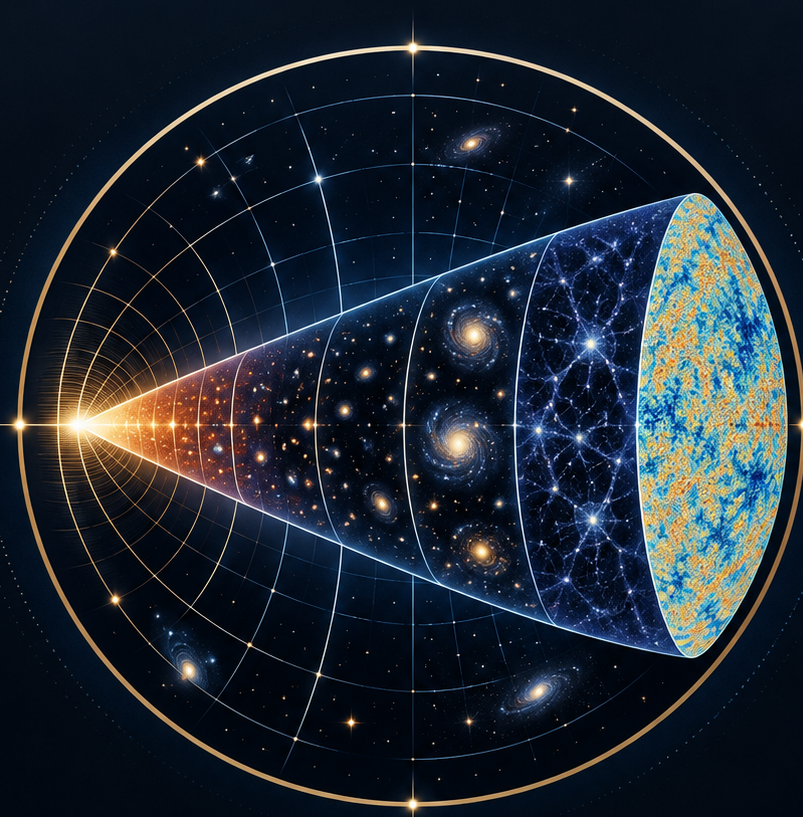
The universe’s history is often divided into distinct epochs, each characterized by the dominant physical processes and particle content. The table below summarizes the major epochs from the Planck epoch to the present day, along with their approximate times, redshifts, and key events.
| Epoch | Time | Redshift | Key Events |
|---|---|---|---|
| Planck Epoch | < 10−43 s | > 1032 | Quantum gravity dominates; all fundamental forces unified. |
| Grand Unification Epoch | 10−43 to 10−36 s | 1032 to 1028 | Strong force separates from electroweak force; inflation may begin. |
| Inflationary Epoch | 10−36 to 10−32 s | ~1028 to 1024 | Exponential expansion smooths and flattens the universe; seeds of structure form. |
| Electroweak Epoch | 10−32 to 10−12 s | 1024 to 1015 | Electromagnetic and weak forces separate; W and Z bosons acquire mass. |
| Quark Epoch | 10−12 to 10−6 s | 1015 to 1012 | Quarks and gluons form a quark–gluon plasma; matter–antimatter asymmetry develops. |
| Hadron Epoch | 10−6 to 1 s | 1012 to 1010 | Quarks combine into protons and neutrons; hadrons annihilate with anti-hadrons. |
| Lepton Epoch | 1 s to 10 s | 1010 to 109 | Leptons and antileptons dominate; neutrinos decouple. |
| Photon Epoch | 10 s to 380,000 yr | 109 to 1100 | Photons dominate; nucleosynthesis produces light elements (BBN). |
| Recombination | ~380,000 yr | ~1100 | Electrons combine with protons to form hydrogen; universe becomes transparent; CMB released. |
| Dark Ages | 380,000 yr to ~100 million yr | 1100 to ~30 | No stars yet; neutral hydrogen fills space; gravitational collapse begins. |
| Reionization | ~100 million to ~1 billion yr | 30 to 6 | First stars and galaxies form; ultraviolet light reionizes hydrogen. |
| Structure Formation | ~1 billion yr to present | < 6 | Galaxies cluster; large-scale structure evolves; dark energy accelerates expansion. |
These epochs are not arbitrary; they reflect the cooling of the universe as it expands, allowing different particle interactions to freeze out. The critical density plays a role in determining the geometry and fate of this entire sequence.
Concept
Definition
Critical density is the density of matter (and energy) that makes the universe spatially flat, corresponding to a total energy density Ω = 1 in the Lambda-CDM model. In such a universe, the expansion velocity exactly balances the gravitational attraction, leading to an asymptotically expanding universe that never recollapses.
How It Works
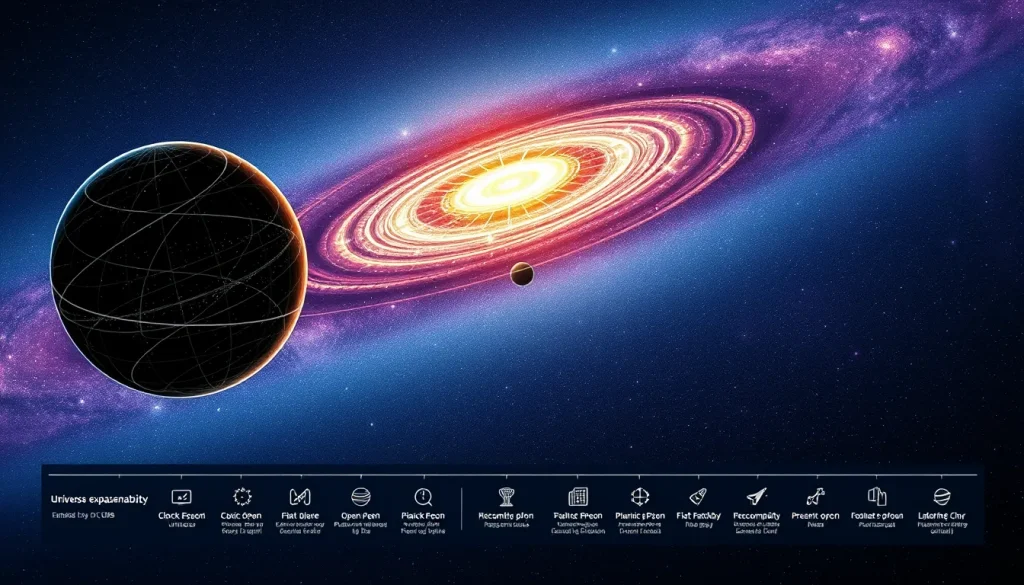
The Friedmann equations show that the curvature of space is determined by the total energy density relative to critical density. If Ω > 1, the universe is positively curved (closed) and will eventually collapse; if Ω < 1, it is negatively curved (open) and expands forever; if Ω = 1, it is flat. The critical density is therefore the threshold that separates these fates.
Equation
ρc = 3H2 / (8πG)
Here H is the Hubble parameter (which changes with time), and G is Newton’s gravitational constant. At the present epoch, using H0 ≈ 68 km/s/Mpc, the critical density is about 9.2 × 10⁻²⁷ kg/m3 (approximately 5.5 protons per cubic meter).
Example
Imagine a sphere of radius R centered on any galaxy. The mass inside is M = (4π/3)ρR3. A galaxy on the surface has kinetic energy (1/2)mV2 with V = H0R from Hubble’s law, and gravitational potential energy −GMm/R. Setting total energy to zero gives the critical density. This simple Newtonian derivation yields the same result as the full relativistic treatment.
Observable Consequences
If the density is critical, the geometry of space is flat, meaning parallel light rays remain parallel and the sum of angles in a triangle equals 180°. Observations of the cosmic microwave background (CMB) by missions like COBE, WMAP, and Planck have measured the angular size of acoustic peaks, indicating a flat universe with Ω ≈ 1. This implies that the total density (including dark matter and dark energy) is very close to critical.
Common Misconceptions
A common misconception is that critical density means the universe is exactly balanced and will stop expanding. In reality, the presence of dark energy causes the expansion to accelerate, so even a flat universe expands forever at an ever-increasing rate. Another misconception is that critical density is a fixed number; it depends on the Hubble constant and changes with cosmic time.
Why It Matters
Critical density is a cornerstone of modern cosmology. It links the geometry of the universe to its fate and provides a benchmark for measuring the actual density of matter and energy. The near-critical density observed today is a key prediction of inflationary theory, which naturally drives the universe to a flat geometry. Understanding critical density also helps interpret observations of dark matter, dark energy, and the cosmic microwave background, allowing us to reconstruct the history of the universe from the Planck epoch to the present.
Evidence / Sources
The concept of critical density is derived from the Friedmann equations, which are well-established in general relativity. The formula ρc = 3H2/(8πG) appears in textbooks and encyclopedic sources. For example, the Encyclopaedia Britannica states that the closure density (critical density) equals 3H02/8πG (source: https://www.britannica.com/science/closure-density). The Swinburne Astronomy Online describes critical density as the average density required for the universe to just halt its expansion after infinite time (source: https://astronomy.swin.edu.au/cosmos/c/Critical%2BDensity).
Measurements of the CMB by COBE, WMAP, and Planck have provided strong evidence for a flat universe, consistent with Ω = 1. The Planck mission’s final data release in 2018 confirmed the six-parameter Lambda-CDM model with high precision, yielding ΩΛ ≈ 0.689 and Ωm ≈ 0.311, which sum to 1.0 within uncertainties. These observations validate the critical density framework.
Related Registry Entries
Explore related topics in this registry: Cosmic Microwave Background, Inflation, Friedmann Equations, Hubble Constant, Dark Energy.
FAQ
What is critical density in simple terms?
Critical density is the exact average density of matter that would make the universe spatially flat and cause its expansion to slow down to a halt only after infinite time. If the actual density is higher, gravity wins and the universe collapses; if lower, it expands forever.
Why is the universe's density close to critical?
Inflationary theory predicts that a rapid exponential expansion in the first fraction of a second would stretch any initial curvature to near zero, driving the density to almost exactly critical. Observations of the CMB confirm a flat universe with Ω ≈ 1.
How does critical density relate to the fate of the universe?
The ratio of actual density to critical density (Ω) determines whether the universe is open, closed, or flat. For Ω 1, it recollapses; for Ω = 1, it expands forever but with deceleration. However, dark energy complicates this by causing acceleration.
Leave a Reply