Short Answer
Main Explanation
Baryogenesis is the physical process hypothesized to have generated the observed asymmetry between baryonic matter (protons and neutrons) and antibaryonic matter (antiprotons and antineutrons) in the early universe. The observable universe is overwhelmingly made of matter, yet the Standard Model of particle physics and general relativity do not explain why this should be so. This puzzle, known as the baryon asymmetry problem, is one of the great mysteries in physics. In 1967, Andrei Sakharov proposed three necessary conditions for any baryon-generating interaction: baryon number violation, C and CP violation, and a departure from thermal equilibrium. These conditions must have been met during the first moments after the Big Bang, when the universe was a hot, dense plasma of elementary particles.
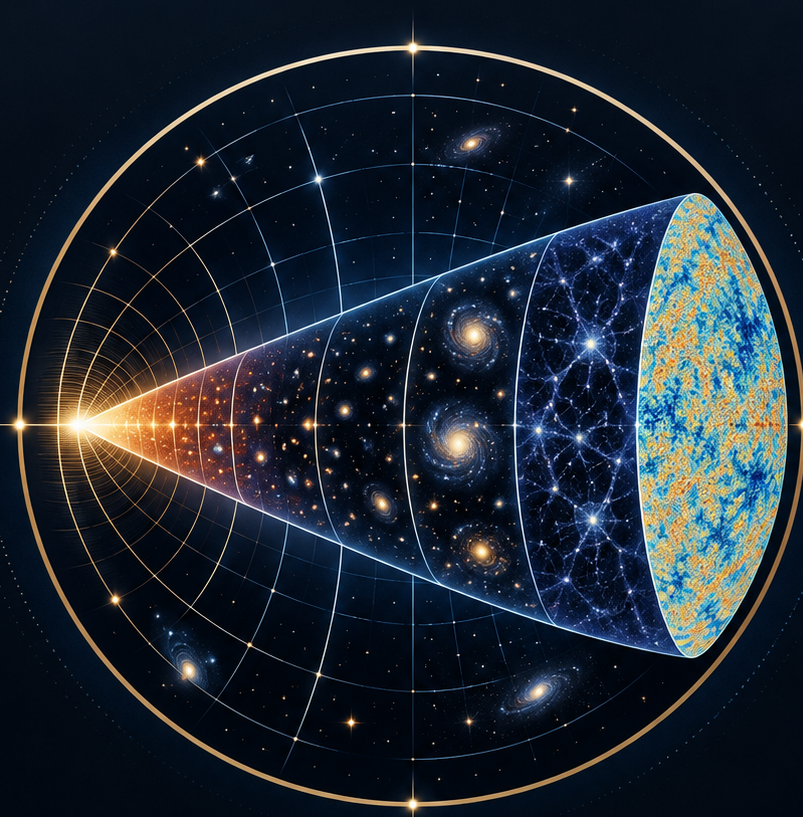
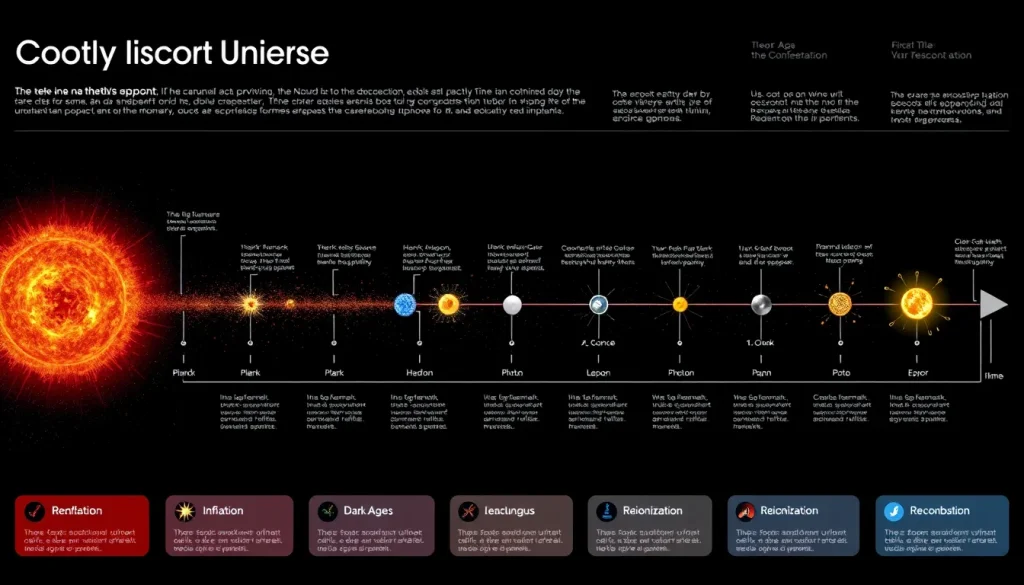
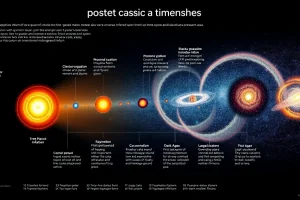
The cosmic history that led to our matter-dominated universe spans a series of distinct epochs, each characterized by specific temperatures, particles, and physical processes. The standard Lambda-CDM model provides the consensus framework for this evolution. The earliest phase, the Planck epoch (from time zero to about 10−43 seconds), is where quantum gravity effects dominated; our current physics cannot describe it. Next came the Grand Unification epoch (10−43 to 10−36 seconds), when the strong, weak, and electromagnetic forces were unified. During the Inflationary epoch (around 10−36 to 10−32 seconds), the universe expanded exponentially, smoothing out irregularities and setting the initial conditions for structure formation. The Electroweak epoch (10−32 to 10−12 seconds) saw the separation of the electromagnetic and weak forces; this is a candidate period for baryogenesis. Then followed the Quark epoch (10−12 to 10−6 seconds), when quarks and gluons existed in a quark-gluon plasma. As the universe cooled, quarks combined into hadrons during the Hadron epoch (10−6 to 1 second), followed by the Lepton epoch (1 to 10 seconds) when leptons dominated. The Photon epoch (10 seconds to about 380,000 years) began after electron-positron annihilation, leaving photons as the dominant radiation. At Recombination (around 380,000 years), electrons and protons combined to form neutral hydrogen, releasing the cosmic microwave background (CMB). The Dark Ages followed, a period of darkness until gravity pulled matter into clumps. Reionization began with the first stars and galaxies, ionizing the intergalactic medium. Finally, Structure Formation led to the large-scale cosmic web of galaxies and clusters we observe today.
| Epoch | Time After Big Bang | Temperature | Key Events |
|---|---|---|---|
| Planck | <10−43 s | >1032 K | Quantum gravity effects; unknown physics |
| Grand Unification | 10−43–10−36 s | 1028–1032 K | Unified forces; possible baryogenesis |
| Inflation | 10−36–10−32 s | Dropping rapidly | Exponential expansion; horizon problem solved |
| Electroweak | 10−32–10−12 s | 1015–1016 K | Electroweak symmetry breaking; possible baryogenesis |
| Quark | 10−12–10−6 s | 1012–1015 K | Quark-gluon plasma |
| Hadron | 10−6–1 s | 1010–1012 K | Protons and neutrons form |
| Lepton | 1–10 s | 109–1010 K | Leptons dominate; neutrino decoupling |
| Photon | 10 s–380,000 yr | 104–109 K | Radiation-dominated; nucleosynthesis |
| Recombination | ~380,000 yr | ~3000 K | Neutral atoms form; CMB released |
| Dark Ages | 380,000 yr–~150 million yr | ~100–3000 K | No stars; dark matter clumps |
| Reionization | ~150 million yr–1 billion yr | ~100 K | First stars and galaxies ionize gas |
| Structure Formation | >1 billion yr | <100 K | Galaxies, clusters, large-scale structure |
Concept
Definition
Baryogenesis is the process by which an excess of baryons over antibaryons was created in the early universe. The observed ratio of baryons to photons is approximately 6×10⁻¹⁰, meaning that for every billion photons there is about one baryon. This tiny asymmetry is sufficient to explain the matter-dominated universe we see today.
How It Works
According to Sakharov’s conditions, baryogenesis requires:
- Baryon number violation: A process that changes the number of baryons.
- C and CP violation: A difference in the behavior of matter and antimatter.
- Departure from thermal equilibrium: The universe must not be in perfect equilibrium, allowing reactions to proceed irreversibly.
In the Standard Model, these conditions are not satisfied strongly enough to produce the observed asymmetry. Extensions such as electroweak baryogenesis, leptogenesis, or GUT-scale baryogenesis are proposed. For example, in leptogenesis, heavy right-handed neutrinos decay out of equilibrium, generating a lepton asymmetry that is later converted to a baryon asymmetry via sphaleron processes.
Equation
The baryon asymmetry parameter is defined as η = (nb − nanti-b) / nγ, where nb and nanti-b are the number densities of baryons and antibaryons, and nγ is the photon number density. Observations from the cosmic microwave background and big bang nucleosynthesis give η ≈ 6.1 × 10⁻¹⁰.
Example
Electroweak baryogenesis occurs during the electroweak phase transition when the Higgs field acquires a vacuum expectation value. If the transition is first-order, bubbles of new phase expand, providing out-of-equilibrium conditions. CP-violating interactions at the bubble walls generate a baryon asymmetry. However, the observed Higgs mass (125 GeV) makes a strong first-order transition unlikely in the Standard Model, so new physics is required.
Observable Consequences
The most direct consequence is the existence of a matter-dominated universe. If baryogenesis had not occurred, matter and antimatter would have annihilated completely, leaving a universe filled with radiation and no atoms, stars, or life. The cosmic microwave background temperature and the primordial abundances of light elements (from Big Bang nucleosynthesis) depend on the baryon density, providing indirect evidence for the asymmetry.
Common Misconceptions
One misconception is that baryogenesis created all matter from nothing. In reality, it created a tiny excess of matter over antimatter; most particles annihilated, leaving only the small surplus. Another is that antimatter is completely absent; in fact, antiparticles are produced in high-energy collisions (e.g., cosmic rays) but are extremely rare on macroscopic scales. Finally, some believe baryogenesis is a solved problem, but it remains an active area of research with no consensus theory.
Why It Matters
Baryogenesis is central to our existence. Without it, the universe would contain no matter—only radiation. Understanding the origin of the baryon asymmetry is a key test of particle physics beyond the Standard Model. It connects cosmology to high-energy physics, and any successful theory must explain both the observed asymmetry and the properties of dark matter, inflation, and the large-scale structure. Missions like COBE, WMAP, and Planck have measured the CMB with exquisite precision, confirming the baryon density and the overall Lambda-CDM model. Future experiments, such as the Simons Observatory and JWST, will probe the epoch of reionization and structure formation, providing further constraints on early-universe physics.
Evidence / Sources
The baryon asymmetry is well established through multiple observations. The cosmic microwave background, measured by COBE, WMAP, and Planck, shows temperature fluctuations that depend on the baryon density. Big bang nucleosynthesis predictions of light-element abundances agree with observations only if the baryon-to-photon ratio matches the CMB-derived value. The absence of annihilation gamma rays from antimatter regions in the nearby universe (as noted in the UCR physics FAQ) provides further evidence that the universe is matter-dominated. Theoretical work, including Sakharov’s 1967 paper and reviews such as Bödeker & Buchmüller (2021), outlines the required conditions and candidate mechanisms.
Related Registry Entries
FAQ
Why is there more matter than antimatter in the universe?
This is the baryon asymmetry problem. Baryogenesis is the hypothesized process that created a tiny excess of baryons over antibaryons in the early universe, likely due to conditions that violated baryon number, C/CP symmetry, and thermal equilibrium, as outlined by Sakharov.
What are the Sakharov conditions?
Three conditions necessary for baryogenesis: (1) baryon number violation, (2) C and CP violation, and (3) a departure from thermal equilibrium. These allow a net baryon number to develop from an initially symmetric state.
Is baryogenesis a solved problem?
No. While the need for baryogenesis is clear, no single mechanism has been confirmed. Candidate theories include electroweak baryogenesis, leptogenesis, and GUT-scale baryogenesis, but all require physics beyond the Standard Model.
How is the baryon asymmetry measured?
The baryon-to-photon ratio is inferred from cosmic microwave background fluctuations (WMAP, Planck) and from the primordial abundances of light elements produced during Big Bang nucleosynthesis. Both methods agree on a value of about 6 × 10⁻¹⁰.
Leave a Reply