
Short Answer
Main Explanation
Definition
Cepheid variables are a class of variable stars that undergo regular, predictable pulsations in brightness. They are named after Delta Cephei, the prototype, whose variability was discovered by John Goodricke in 1784. Cepheids are typically spectral type F at maximum brightness and type G at minimum, meaning they are moderately hot to Sun-like in temperature. They are massive, luminous stars that have evolved off the main sequence.
How It Works
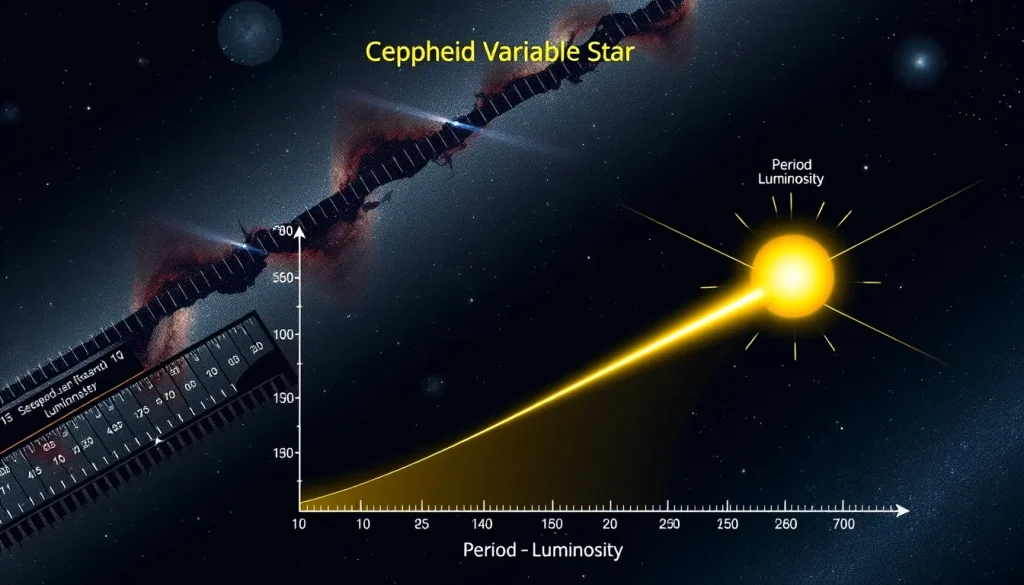
The pulsation of a Cepheid is driven by the ionization of helium in its outer layers. As the star contracts, helium becomes doubly ionized, increasing opacity and trapping heat, causing the star to expand. When it expands, the helium recombines, decreasing opacity, and the star contracts again. This cycle produces a regular change in brightness. The period of this cycle is tightly correlated with the star’s average luminosity—a longer period corresponds to a more intrinsically luminous star. This relationship, known as the period-luminosity relationship or Leavitt’s law, was discovered by Henrietta Swan Leavitt in 1912 while studying Cepheids in the Magellanic Clouds. Because all the stars in the Magellanic Clouds are at roughly the same distance, Leavitt could compare their apparent brightnesses and see that the brighter ones had longer periods.
Equation
The period-luminosity relationship can be expressed as a logarithmic relation between absolute magnitude M and period P:

M = a log10(P) + b
where a and b are empirical constants calibrated using nearby Cepheids with known distances (e.g., from parallax or cluster membership). Once the period is measured, the absolute magnitude is known, and the distance can be derived from the difference between absolute and apparent magnitude using the distance modulus formula:
m – M = 5 log10(d/10 pc)
where d is the distance in parsecs.
Example
Consider a Cepheid with a period of 10 days. From the calibrated period-luminosity relationship, we might infer an absolute magnitude of about -4. If we measure its apparent magnitude as 16, the distance modulus is 20, which corresponds to a distance of 10,000 parsecs (about 32,600 light-years). This method has been applied to Cepheids in galaxies like the Large Magellanic Cloud and M31, providing distances that anchor the cosmic distance ladder.
Observable Consequences
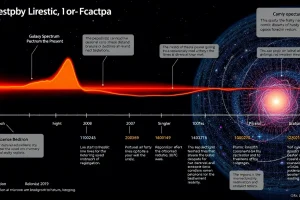
Cepheid variables are crucial for measuring the expansion rate of the universe, the Hubble constant. By measuring distances to galaxies containing Cepheids and comparing them with the galaxies’ recession velocities (measured via redshift), astronomers can determine how fast the universe is expanding. This expansion rate, combined with other cosmological observations, leads to the age of the universe and the timeline of cosmic epochs. The standard model of cosmology, ΛCDM, describes the universe’s evolution from the Planck epoch to the present. Key epochs include:
| Epoch | Time After Big Bang | Key Events |
|---|---|---|
| Planck epoch | 0 to 10-43 s | Quantum gravity effects dominate; all forces unified. |
| Grand Unification epoch | 10-43 to 10-36 s | Strong force separates from electroweak force. |
| Inflationary epoch | 10-36 to 10-32 s | Exponential expansion; quantum fluctuations seeded structure. |
| Electroweak epoch | 10-32 to 10-12 s | Electromagnetic and weak forces separate. |
| Quark epoch | 10-12 to 10-6 s | Quarks and gluons form a quark-gluon plasma. |
| Hadron epoch | 10-6 to 1 s | Protons and neutrons form. |
| Lepton epoch | 1 s to 10 s | Leptons dominate; neutrinos decouple. |
| Photon epoch | 10 s to 380,000 years | Photons dominate; nucleosynthesis of light elements. |
| Recombination | ~380,000 years | Electrons combine with nuclei; photons decouple, releasing the cosmic microwave background (CMB). |
| Dark Ages | 380,000 years to ~150 million years | The universe is dark; no stars yet. |
| Reionization | ~150 million to ~1 billion years | First stars and galaxies form; reionize hydrogen. |
| Structure Formation | ~1 billion years to present | Galaxies cluster; large-scale structure emerges. |
The cosmic microwave background, a relic of recombination, provides a snapshot of the universe at 380,000 years. Missions like COBE, WMAP, and the Planck satellite have mapped the CMB with increasing precision, confirming the predictions of the Big Bang model. The James Webb Space Telescope (JWST) is now probing the epoch of reionization and the first galaxies.
Common Misconceptions
One common misconception is that Cepheids can measure distances to the edge of the observable universe. In reality, they are only visible out to about tens of millions of light-years, which covers nearby galaxies. For greater distances, astronomers use Type Ia supernovae or other standard candles. Another misconception is that the period-luminosity relationship is universal; it requires calibration and has slight variations between classical and type II Cepheids.
Why It Matters
Cepheid variables are the first rung of the cosmic distance ladder, enabling us to measure distances to galaxies and calibrate other distance indicators. These measurements directly feed into determinations of the Hubble constant, which tells us the rate of expansion of the universe. The Hubble constant is a key parameter in cosmology, affecting estimates of the age and fate of the universe. Discrepancies between different methods of measuring the Hubble constant—known as the Hubble tension—are a major focus of current research, potentially pointing to new physics beyond the standard model.
Evidence / Sources
The period-luminosity relationship is supported by extensive observations. Leavitt’s original work on Cepheids in the Magellanic Clouds established the correlation. Modern observations using space telescopes like Hubble have refined the calibration. The cosmic microwave background measurements from COBE, WMAP, and Planck provide independent evidence for the Big Bang model, and the expansion rate inferred from Cepheids is consistent with the overall cosmological framework.
Related Registry Entries
Explore related entries in the cosmic timeline: Planck Epoch, Inflation, Recombination, Reionization, Cosmic Microwave Background, Hubble Constant.
Last Reviewed: September 5, 2026
FAQ
How do Cepheid variables pulsate?
Cepheids pulsate due to the ionization and recombination of helium in their outer layers. This changes opacity and traps or releases heat, causing the star to expand and contract regularly, producing a periodic brightness variation.
Why is the period-luminosity relationship important?
It allows astronomers to determine a Cepheid's intrinsic brightness from its period. By comparing that with the observed apparent brightness, they can calculate the distance to the star and its host galaxy.
Can Cepheids measure distances to the edge of the universe?
No. Cepheids are only visible out to about tens of millions of light-years. For greater distances, astronomers use Type Ia supernovae or other standard candles.

Leave a Reply