
Short Answer
Main Explanation
The Higgs mechanism is a cornerstone of modern particle physics and cosmology. It explains how fundamental particles such as the W and Z bosons, quarks, and charged leptons acquire mass, while the photon remains massless. In the very early universe, before the electroweak phase transition, these particles were massless. The Higgs field’s change to its present non-zero value shaped the subsequent thermal history, from the formation of protons and neutrons to the release of the cosmic microwave background and the growth of galaxies.
According to CERN, theorists Robert Brout, François Englert and Peter Higgs proposed in 1964 that particles acquire mass by interacting with a Higgs field. This solved a major problem in the unified electroweak theory, whose basic equations left the W and Z bosons massless, even though they are known to be nearly 100 times as massive as a proton.
From the Planck Epoch to the Present
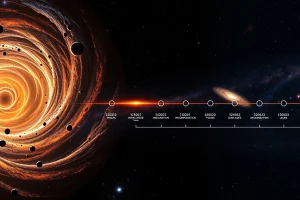
The standard Lambda-CDM cosmological model describes the universe as expanding and cooling from an extremely hot, dense state. The following table summarizes the major epochs.

| Epoch | Time after Big Bang | Temperature | Key events |
|---|---|---|---|
| Planck epoch | <10⁻⁴³ s | >10³² K | Quantum gravity dominates; all four forces possibly unified. |
| Grand Unification epoch | 10⁻⁴³–10⁻³⁶ s | 10³²–10²⁸ K | Strong force separates; possible baryogenesis conditions. |
| Inflationary epoch | 10⁻³⁶–10⁻³² s | Drops rapidly | Exponential expansion stretches quantum fluctuations into seeds of structure. |
| Electroweak epoch | 10⁻³²–10⁻¹² s | ~100 GeV | Higgs field acquires non-zero value; W and Z gain mass; quarks and leptons gain mass. |
| Quark epoch | 10⁻¹²–10⁻⁶ s | 10¹²–10¹⁰ K | Quark-gluon plasma; all particles present. |
| Hadron epoch | 10⁻⁶–1 s | 10¹⁰–10⁹ K | Quarks bind into protons and neutrons. |
| Lepton epoch | 1–10 s | 10⁹–10⁸ K | Leptons and antileptons dominate; neutrinos decouple. |
| Photon epoch | 10 s–380,000 yr | 10⁸–3,000 K | Big Bang nucleosynthesis creates light nuclei; photons dominate. |
| Recombination | ~380,000 yr | ~3,000 K | Electrons combine with nuclei; atoms form; CMB released. |
| Dark Ages | 380,000–~150 million yr | 3,000–~60 K | Neutral hydrogen fills universe; no stars yet. |
| Reionization | ~150 million–1 billion yr | ~60–20 K | First stars and galaxies ionize intergalactic gas. |
| Structure formation | ~100 million yr–present | ~20–2.7 K | Galaxies, clusters, and cosmic web grow under gravity. |
Redshift, often denoted z, measures how much the wavelength of light has been stretched by cosmic expansion. A galaxy observed at redshift z=10 emitted its light when the universe was about one-eleventh its present size. The CMB has a redshift of about 1100, meaning the universe has expanded by that factor since recombination.
During the electroweak epoch, the Higgs field settled into a non-zero vacuum expectation value. This broke the electroweak symmetry, giving mass to the W and Z bosons while leaving the photon massless. Quarks and charged leptons also acquired mass through their Yukawa couplings to the Higgs field. This transition was crucial: without it, protons, neutrons, atoms, and chemistry as we know them could not exist. Some cosmological models propose that the Higgs field, or a field like it, drove inflation or helped create the matter-antimatter asymmetry. These ideas remain active research areas.
Later, during the photon epoch, the first atomic nuclei formed in the process known as Big Bang nucleosynthesis. At recombination, about 380,000 years after the Big Bang, the universe had cooled enough for electrons to bind to nuclei, forming neutral atoms. This allowed photons to travel freely, producing the cosmic microwave background (CMB) we observe today. The CMB is a relic of that time and carries imprints of the density fluctuations that later grew into galaxies and large-scale structure.
Inflation is a brief period of accelerated expansion that stretched quantum fluctuations to cosmic scales. These fluctuations became the slight over- and under-densities that later collapsed into galaxies and clusters. The CMB anisotropies measured by COBE, WMAP, and Planck are the fossil record of those primordial fluctuations.
After recombination, the universe entered the Dark Ages, filled with neutral hydrogen and no luminous sources. The first stars and galaxies ended this era by emitting ultraviolet radiation that reionized the intergalactic medium. JWST is observing galaxies at redshifts beyond 10, directly probing this transition.
Missions such as COBE, WMAP, and Planck measured the CMB’s temperature and tiny anisotropies with increasing precision. These measurements support the Lambda-CDM model, which includes dark energy, cold dark matter, and ordinary matter. The James Webb Space Telescope (JWST) is now observing the first galaxies and helping to map the epoch of reionization.
The Higgs Mechanism as a Concept
Definition
The Higgs mechanism, also called the Brout-Englert-Higgs mechanism, is the process by which gauge bosons and fermions acquire mass through their interaction with a scalar field that has a non-zero value in the vacuum.
How It Works
In quantum field theory, particles are excitations of underlying fields. The Higgs field fills all of space. Particles that interact strongly with this field behave as if they have more inertia, or mass. A useful analogy is a room full of people: a celebrity trying to cross the room is slowed by interactions, while a non-famous person moves freely. The photon does not interact with the Higgs field and remains massless; the W and Z bosons interact strongly and become heavy.
Equation
The Higgs potential can be written as V(φ) = μ2 φ2 + λ φ4. When μ² is negative, the potential has a ‘Mexican hat’ shape, and the field chooses a non-zero minimum. This spontaneous symmetry breaking gives mass to particles that couple to the field.
Example
The W boson has a mass of about 80 GeV/c² and the Z boson about 91 GeV/c², nearly 100 times the proton mass. The top quark, which couples most strongly to the Higgs field, has a mass of about 173 GeV/c². The Higgs boson itself was discovered at CERN in 2012 with a mass of about 125–126 GeV/c².
Observable Consequences
The most direct consequence was the discovery of the Higgs boson at the Large Hadron Collider. The measured masses of the W and Z bosons, and the pattern of quark and lepton masses, are consistent with the Higgs mechanism. In cosmology, the Higgs field may have influenced inflation, baryogenesis, and dark matter production, although these roles are still under investigation.
Common Misconceptions
- The Higgs field does not act like friction or a viscous fluid that slows particles down; it gives mass by changing the nature of particle propagation.
- Not all mass comes from the Higgs mechanism. Most of the mass of protons and neutrons comes from the strong-force binding energy of quarks and gluons.
- The Higgs boson is not the same as the Higgs field. The boson is a localized excitation of the field, just as a photon is an excitation of the electromagnetic field.
- The Higgs mechanism did not cause the Big Bang, nor is it responsible for dark energy or the expansion of the universe.
Why It Matters
The Higgs mechanism is essential for the existence of atoms, stars, planets, and life. Without it, the W and Z bosons would be massless, the weak force would be long-range, and the universe would be radically different. The electroweak phase transition in the early universe set the stage for nucleosynthesis, recombination, and the formation of structure. Understanding the Higgs field also connects particle physics to cosmology, offering possible insights into inflation, the matter-antimatter asymmetry, and dark matter.
The cosmic microwave background is a direct window into the early universe. Its tiny temperature fluctuations, measured by COBE, WMAP, and Planck, reveal the seeds of all cosmic structure. The standard Lambda-CDM model, supported by these observations, describes how those seeds grew under gravity, dark matter, and dark energy into the galaxies and clusters we see today. JWST is now extending this story by observing the first stars and galaxies during reionization.
Evidence / Sources
The Higgs mechanism is supported by the discovery of the Higgs boson at CERN and by precision measurements of the W and Z boson masses. CERN’s public resources describe the origins of the Brout-Englert-Higgs mechanism and the nature of the Higgs boson. Reviews of the Higgs field in early universe cosmology discuss its possible roles in inflation, baryogenesis, and dark matter. The cosmic microwave background and large-scale structure provide independent evidence for the Lambda-CDM model and the thermal history of the universe.
Related Registry Entries
Last reviewed / updated: September 8, 2026
FAQ
What is the Higgs mechanism?
It is the process by which particles acquire mass through interactions with the Higgs field, which has a non-zero value in the vacuum. It explains why W and Z bosons are massive while the photon is massless.
How did the Higgs field shape the early universe?
During the electroweak epoch, the Higgs field acquired its non-zero value, giving mass to W and Z bosons, quarks, and charged leptons. This set the conditions for nucleosynthesis, atoms, and later structure formation.
Did the Higgs boson cause the Big Bang?
No. The Higgs boson is an excitation of the Higgs field. The Big Bang is the initial hot, dense state of the universe, and the Higgs mechanism operated later during the electroweak epoch.
What evidence supports the Higgs mechanism?
The discovery of the Higgs boson at CERN in 2012 and precision measurements of W and Z boson masses strongly support the mechanism. Cosmological observations of the CMB and large-scale structure are consistent with the standard model's thermal history.

Leave a Reply