
Short Answer
Main Explanation
In everyday life, distance is straightforward. In an expanding universe, it is not. Cosmologists use two related measures: comoving distance and proper distance. Comoving distance factors out the expansion of the universe, giving a coordinate separation that does not change with time except for local motions. Proper distance is the physical separation you would measure with a ruler at a specific cosmic time. The two are defined to be equal at the present day, but at earlier times the proper distance was smaller because the universe had expanded less.
This distinction is not a technical footnote; it is the key to reading the cosmic timeline. When astronomers say the observable universe has a radius of about 46.5 billion light-years, they are quoting a comoving distance. The light now reaching us from that edge was emitted when the universe was only about 13.7 billion years old, and the proper distance to that source at emission was much smaller. The expansion of space stretched the journey.
Concept: Comoving and Proper Distance
Definition
Comoving distance is the distance between two points measured in a coordinate system that expands with the universe. Proper distance is the physical distance at a given cosmic time, equal to the comoving distance multiplied by the scale factor a(t). At the present time, a(t₀)=1, so the two coincide.

How It Works
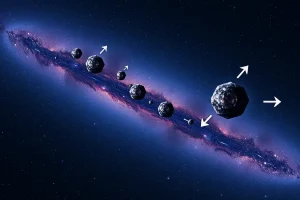
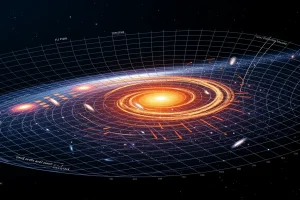
Imagine a loaf of raisin bread rising in the oven. The raisins move apart because the dough expands, not because they are walking through the dough. In comoving coordinates, each raisin keeps the same coordinate label; the grid itself stretches. The proper distance between raisins grows as the loaf expands. In cosmology, galaxies are the raisins and the scale factor a(t) describes how much the grid has stretched since a reference time.
This coordinate choice is not arbitrary; it reflects the cosmological principle that the universe is homogeneous and isotropic on large scales. Comoving coordinates are the natural frame in which the cosmic expansion is removed, leaving only peculiar motions such as a galaxy moving within a cluster.
Equation
The relationship is:
dproper(t) = a(t) × χ
where χ is the comoving distance and a(t) is the scale factor. The line-of-sight comoving distance to a source at redshift z is:
DC = ∫0z c dz′ / H(z′)
with H(z) the Hubble parameter. For a flat universe, the transverse comoving distance DM equals DC; in curved space it involves sinh or sin functions.
Example
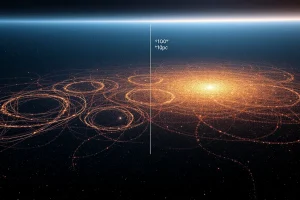
The cosmic microwave background was emitted at redshift z ≈ 1100, when the scale factor was about 1/1101 of its present value. The comoving distance to the CMB last-scattering surface is roughly 45–46 billion light-years. The proper distance at the time of emission was therefore about 42 million light-years. Today that same surface is at a proper distance of about 45–46 billion light-years because the universe has expanded by a factor of about 1100 since then.
Observable Consequences
Because light travels at finite speed, we see distant objects as they were when the universe was smaller. A galaxy at redshift z=1 is observed when the scale factor was 1/2, so its proper distance then was half its comoving distance. This affects luminosity distance, angular diameter distance, and the apparent size of features in the CMB. The angular scale of the first acoustic peak in the CMB power spectrum is a direct measurement of the geometry and expansion history, and it is expressed naturally in comoving coordinates.
The table below summarizes the major cosmic epochs and how the scale factor and proper/comoving distances evolve.
| Epoch | Time after Big Bang | Redshift | Temperature | Key events | Distance note |
|---|---|---|---|---|---|
| Planck epoch | <10⁻⁴³ s | — | ~10³² K | Quantum gravity; all forces unified | No reliable distance measure |
| Grand Unification epoch | 10⁻⁴³–10⁻³⁶ s | — | ~10²⁹ K | Strong force separates | Scale factor extremely small |
| Inflationary epoch | 10⁻³⁶–10⁻³² s | — | ~10²⁷ K | Exponential expansion; seeds of structure | Comoving scales stretched enormously |
| Electroweak epoch | 10⁻³²–10⁻¹² s | — | ~10¹⁵ K | Weak force separates; Higgs field | Proper distances grow rapidly |
| Quark epoch | 10⁻¹²–10⁻⁶ s | — | ~10¹² K | Quark-gluon plasma | Universe still radiation-dominated |
| Hadron epoch | 10⁻⁶–1 s | — | ~10¹⁰ K | Protons and neutrons form | Scale factor ~10⁻¹⁰ |
| Lepton epoch | 1 s–10 s | — | ~10⁹ K | Neutrinos decouple; electron-positron annihilation | Proper distance to horizon ~light-seconds |
| Photon epoch | 10 s–380,000 yr | ~10⁹–1100 | ~10⁹–3000 K | Big Bang nucleosynthesis; universe becomes transparent at recombination | Comoving distance to CMB fixed; proper distance grows |
| Recombination | ~380,000 yr | ~1100 | ~3000 K | First atoms form; CMB released | Proper distance to CMB ~42 million ly; comoving ~45–46 Gly |
| Dark Ages | 380,000 yr–~150 million yr | 1100–~20 | ~3000–60 K | Neutral hydrogen; no stars | Comoving structure grows slowly |
| Reionization | ~150 million–1 billion yr | ~20–6 | ~60–20 K | First stars and galaxies ionize hydrogen | Proper distances to first galaxies smaller than comoving |
| Structure Formation | ~1 billion yr–present | 6–0 | ~20–2.7 K | Galaxies, clusters, large-scale structure | Comoving distances remain fixed; proper distances grow with a(t) |
Missions such as COBE, WMAP, and Planck measured the CMB temperature and anisotropies, pinning down the scale factor at recombination and the geometry of the universe. JWST now observes the first galaxies during reionization, testing how structure formation proceeded in comoving coordinates.
Common Misconceptions
- “The observable universe is 13.7 billion light-years in radius.” That is the light-travel time, not the current proper distance. The comoving radius is about 46.5 billion light-years because space expanded while light traveled.
- “Comoving distance is just proper distance at the present.” They are equal today by definition, but comoving distance is a coordinate label that remains constant; proper distance changes with time.
- “Expansion means galaxies move through space faster than light.” Galaxies can recede faster than light without violating relativity because the expansion of space itself is not a local motion through space.
- “The CMB is at the edge of the observable universe.” The CMB is the oldest light, but the particle horizon extends slightly beyond it; the CMB is the surface of last scattering, not a physical edge.
Why It Matters
Comoving distance is the natural ruler for mapping the universe because it removes the expansion that would otherwise make every cosmic structure appear to move. It allows astronomers to compare the sizes of structures at different redshifts, to compute the power spectrum of CMB anisotropies, and to measure baryon acoustic oscillations as a standard ruler. The standard ΛCDM model uses comoving coordinates to describe how small density fluctuations grew into the cosmic web of galaxies. Without the comoving/proper distinction, the cosmic timeline would be unreadable.
Evidence / Sources
The definitions and relationship between comoving and proper distance are standard in cosmology. The comoving distance to the CMB and the 46.5 billion light-year radius of the observable universe are widely cited. The transverse comoving distance formula appears in standard references. The scale factor and redshift relation is fundamental to the expanding universe model. Observational evidence includes the CMB temperature of 2.725 K, the angular scale of acoustic peaks, supernova distance measurements, and large-scale structure surveys.
Related Registry Entries
Last reviewed / updated: September 8, 2026.
FAQ
What is the difference between comoving and proper distance?
Comoving distance is measured in coordinates that expand with the universe, so it stays constant for objects moving only with the expansion. Proper distance is the physical separation at a given cosmic time and equals the comoving distance multiplied by the scale factor. They are equal today by definition.
Why is the observable universe 46.5 billion light-years across if the universe is only 13.8 billion years old?
The 46.5 billion light-year figure is a comoving distance. Light traveled for 13.8 billion years, but the space through which it traveled expanded during the journey, so the current proper distance to the most distant visible objects is much larger than the light-travel distance.
Does comoving distance change with time?
No, not due to cosmic expansion. Comoving distance remains constant for objects that are at rest in the expanding frame. It can change only because of local motions, such as a galaxy moving within a cluster.
How does redshift relate to proper distance?
Redshift z is related to the scale factor by 1+z = 1/a(t). At the time light was emitted, the proper distance to a source was its comoving distance divided by (1+z). So higher redshift means the source was physically closer when the light was emitted.
Leave a Reply