
Short Answer
Main Explanation
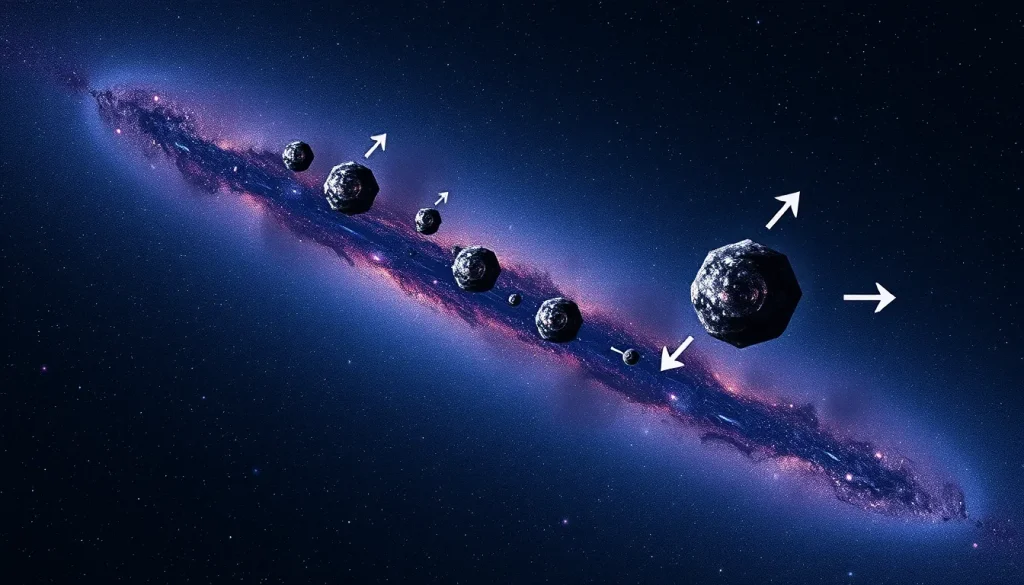
The universe began 13.8 billion years ago with the Big Bang, a rapid expansion that lasted a fraction of a second. After that, gravity began to slow the expansion. But about nine billion years later, the expansion started speeding up again, driven by an unknown force now called dark energy (NASA). Dark energy is the dominant component of the universe, contributing roughly 68–70% of its total mass-energy content (NASA, Britannica). It acts as a repulsive force, pushing galaxies apart and causing the cosmic expansion to accelerate.
Dark energy was discovered in the late 1990s through observations of Type Ia supernovae, which have a constant luminosity and therefore serve as accurate distance markers. By comparing their distances to their redshifts, astronomers found that distant supernovae were fainter than expected, meaning they were farther away than the expansion rate predicted—implying the expansion was accelerating (NASA, Britannica). The term “dark energy” was coined by University of Chicago astrophysicist Michael Turner in 1998 (UChicago).
Dark energy is not the same as dark matter. Dark matter exerts gravitational attraction and helps hold galaxies together, while dark energy drives cosmic acceleration. The leading explanation for dark energy is the cosmological constant—a constant energy density permeating empty space, first proposed by Einstein (though he later abandoned it). Other ideas include quintessence, a dynamic field, or a modification of general relativity (NASA). As of now, the standard model of cosmology, Lambda-CDM, incorporates dark energy as a cosmological constant (Λ) and fits observations well (Wikipedia).

Cosmic Epochs and the Role of Dark Energy
To understand dark energy, it helps to see the universe’s entire history. The following table outlines the major epochs from the Planck era to the present. Dark energy only became dominant about 5 billion years ago, but its seeds were present from the beginning.
| Epoch | Time After Big Bang | Key Events |
|---|---|---|
| Planck Epoch | 0 – 10⁻⁴³ s | Quantum gravity dominates; all forces unified. |
| Grand Unification Epoch | 10⁻⁴³ – 10⁻³⁶ s | Strong force separates from electroweak force. |
| Inflationary Epoch | 10⁻³⁶ – 10⁻³² s | Exponential expansion; seeds of structure form. |
| Electroweak Epoch | 10⁻³² – 10⁻¹² s | Electromagnetic and weak forces separate. |
| Quark Epoch | 10⁻¹² – 10⁻⁶ s | Quarks and gluons exist in a plasma. |
| Hadron Epoch | 10⁻⁶ – 1 s | Quarks combine to form protons and neutrons. |
| Lepton Epoch | 1 s – 10 s | Leptons dominate; electron-positron annihilation. |
| Photon Epoch | 10 s – 380,000 yr | Photons dominate; universe is opaque. |
| Recombination | 380,000 yr | Electrons combine with nuclei to form atoms; cosmic microwave background (CMB) released. |
| Dark Ages | 380,000 yr – 150 million yr | No stars; universe is dark and neutral. |
| Reionization | 150 million – 1 billion yr | First stars and galaxies ionize hydrogen. |
| Structure Formation | 1 billion yr – present | Galaxies cluster; dark energy becomes dominant ~5 billion years ago. |
The cosmic microwave background, a relic of recombination, provides a snapshot of the universe when it was just 380,000 years old. Missions like COBE, WMAP, and Planck have mapped its temperature fluctuations with increasing precision, confirming the Lambda-CDM model and the existence of dark energy (Wikipedia). The James Webb Space Telescope (JWST) is now probing the era of reionization and the first galaxies, helping refine our understanding of structure formation and the role of dark energy.
FAQ
How do we know dark energy exists?
Observations of distant Type Ia supernovae in the late 1990s showed they were dimmer than expected, indicating they were farther away than the expansion rate predicted. This implies the expansion is accelerating, requiring a repulsive force—dark energy.
Is dark energy the same as dark matter?
No. Dark matter attracts gravitationally and helps bind galaxies, while dark energy repels and drives cosmic acceleration. Dark matter makes up about 27% of the universe, while dark energy makes up about 70%.
What is the leading explanation for dark energy?
The cosmological constant (Λ), a constant energy density of empty space, is the simplest and most widely accepted explanation. It fits the Lambda-CDM model, although its value is puzzlingly small compared to theoretical predictions.
Leave a Reply