
Short Answer
Main Explanation
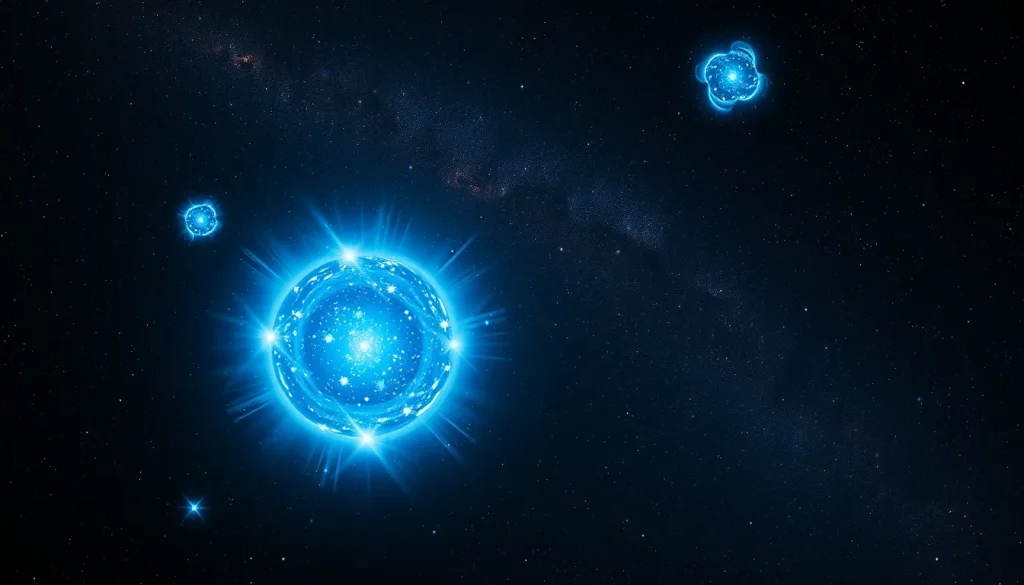
The universe began in a hot, dense state about 13.8 billion years ago. In the first few minutes, Big Bang nucleosynthesis produced only the lightest elements: hydrogen, helium, and trace amounts of lithium. All heavier elements—carbon, oxygen, iron, gold, and everything else—were forged later, inside stars. The first stars, called Population III (Pop III), were the cosmic forges that initiated this enrichment process.
Pop III stars formed from metal-free primordial gas at redshifts z ~ 30 and below, dominating star formation until z ~ 15–20, when metal-enriched Population II stars took over (Klessen & Glover, 2023). These first stars were likely massive, hot, and short-lived, exploding as supernovae that dispersed newly synthesized elements into the surrounding gas. This process transformed the universe from a simple mixture of hydrogen and helium into a chemically diverse cosmos capable of forming planets and life.
The Cosmic Timeline
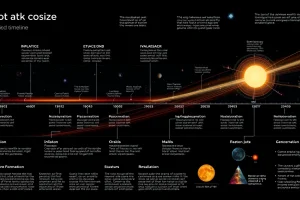
To understand the first stars, we must place them in the broader context of cosmic evolution. The standard Lambda-CDM model describes a sequence of epochs from the Planck era to the present:

| Epoch | Time After Big Bang | Key Events |
|---|---|---|
| Planck Epoch | < 10⁻⁴³ s | Quantum gravity effects dominate; no current physics describes this era. |
| Grand Unification Epoch | 10⁻⁴³ – 10⁻³⁶ s | Strong and electroweak forces unify; inflation begins. |
| Inflationary Epoch | 10⁻³⁶ – 10⁻³² s | Exponential expansion smooths and flattens the universe. |
| Electroweak Epoch | 10⁻³² – 10⁻¹² s | Electromagnetic and weak forces separate; particles acquire mass. |
| Quark Epoch | 10⁻¹² – 10⁻⁶ s | Quarks and gluons form a quark-gluon plasma. |
| Hadron Epoch | 10⁻⁶ – 1 s | Quarks combine into protons and neutrons; matter-antimatter asymmetry emerges. |
| Lepton Epoch | 1 – 10 s | Leptons dominate; neutrinos decouple. |
| Photon Epoch | 10 s – 380,000 yr | Photons are tightly coupled to matter; nucleosynthesis occurs. |
| Recombination | ~380,000 yr | Electrons combine with protons to form neutral hydrogen; the cosmic microwave background (CMB) is released. |
| Dark Ages | 380,000 yr – ~150 million yr | The universe is dark; no stars have formed yet. |
| Reionization | ~150 million – 1 billion yr | First stars and galaxies emit ultraviolet radiation, reionizing the intergalactic medium. |
| Structure Formation | 1 billion yr – present | Galaxies, clusters, and large-scale structure assemble under gravity. |
The first stars formed at the end of the Dark Ages, when gravity pulled together the densest regions of neutral hydrogen. Numerical simulations show that primordial gas is highly susceptible to fragmentation, so Pop III stars likely formed in small clusters with a logarithmically flat mass function (Klessen & Glover, 2023). These stars were typically tens to hundreds of times more massive than the Sun, with surface temperatures exceeding 100,000 K.
Question Article
Short Answer
The first stars enriched the universe with heavy elements through nuclear fusion in their cores and through supernova explosions that dispersed these elements into space. Without this process, the universe would have remained composed almost entirely of hydrogen and helium, and rocky planets like Earth could not have formed.
What We Know
Pop III stars are the first generation of stars, formed from gas with zero metallicity (no elements heavier than helium). Their formation is a direct consequence of the initial conditions set by the Big Bang and the growth of dark matter halos. Observations of the most metal-poor stars in the Milky Way’s halo provide fossil records of the nucleosynthesis yields of the first supernovae (Karlsson, Bromm, & Bland-Hawthorn, 2013). These ancient stars show abundance patterns consistent with enrichment by massive Pop III progenitors.
The key nuclear processes are:
- Hydrogen burning: Fusion of hydrogen into helium, the main energy source of all main-sequence stars.
- Helium burning and beyond: In massive stars, successive fusion stages produce carbon, oxygen, neon, magnesium, silicon, and eventually iron.
- Neutron capture: Elements heavier than iron are synthesized via the slow (s-process) and rapid (r-process) neutron-capture reactions, which occur in evolved stars and supernovae (Cowan et al., 2006).
When a massive Pop III star ends its life as a core-collapse supernova, it ejects these newly formed elements into the interstellar medium. The blast wave also triggers the formation of subsequent generations of stars, which incorporate the metals into their composition.
What We Don’t Know
The exact mass distribution of Pop III stars remains uncertain. Some models predict a top-heavy initial mass function, while others suggest a broader range. The efficiency of metal mixing and the survival of low-mass Pop III stars (which could still exist today) are open questions. Additionally, the relative contributions of different supernova types (e.g., pair-instability vs. core-collapse) to early enrichment are not fully constrained.
Evidence
Evidence for Pop III enrichment comes from:
- Chemical abundances in ancient stars: Extremely metal-poor stars in the Galactic halo show abundance patterns (e.g., high carbon-to-iron ratios) that match theoretical yields of Pop III supernovae.
- Cosmic microwave background: The CMB provides the initial conditions and confirms the primordial composition (hydrogen, helium, lithium) from Big Bang nucleosynthesis.
- Reionization history: The reionization of neutral hydrogen at z ~ 6–10 is attributed to the ultraviolet radiation from the first stars and galaxies, as observed by WMAP, Planck, and JWST.
- High-redshift galaxies: JWST has detected galaxies at z > 10, some of which show signatures of early metal enrichment.
Competing Explanations
Alternative scenarios for early metal enrichment include direct collapse black holes, which could produce heavy elements via accretion disks, and primordial magnetic fields that might affect star formation. However, the standard model of Pop III stars as the primary source of the first metals is strongly supported by nucleosynthesis calculations and observations of the most metal-poor stars.
Current Research
Current research focuses on:
- Simulating the formation and feedback of Pop III stars in cosmological simulations.
- Identifying direct observational signatures of Pop III stars, such as their supernova remnants or the chemical imprints in high-redshift gas clouds.
- Using JWST and future telescopes (e.g., the Extremely Large Telescope) to probe the epoch of reionization and the first galaxies.
- Refining nucleosynthesis models to match the detailed abundance patterns observed in ancient stars.
Why It Matters
The enrichment of the universe with heavy elements is a fundamental step in cosmic evolution. Without it, there would be no carbon-based life, no rocky planets, and no complex chemistry. Understanding how the first stars forged these elements connects the physics of the early universe to the existence of life today. It also informs our search for habitable exoplanets and the conditions necessary for life to emerge elsewhere.
Evidence / Sources
The following sources provide authoritative reviews and data on the first stars and heavy element enrichment:
- Karlsson, T., Bromm, V., & Bland-Hawthorn, J. (2013). Pregalactic metal enrichment: The chemical signatures of the first stars. Reviews of Modern Physics, 85, 809. Link
- Bromm, V., & Larson, R. B. (2004). The First Stars. Annual Review of Astronomy and Astrophysics, 42, 79–118. Link
- Cowan, J. J., et al. (2006). Heavy element synthesis in the oldest stars and the early Universe. Nature, 440, 1151–1156. Link
- Klessen, R. S., & Glover, S. C. O. (2023). The first stars: formation, properties, and impact. arXiv:2303.12500. Link
Related Registry Entries
FAQ
What exactly are Population III stars?
Population III stars are the first generation of stars, formed from gas that contained only hydrogen and helium, with no heavier elements. They are thought to have been very massive and short-lived.
How did the first stars produce heavy elements?
Through nuclear fusion in their cores, which built elements up to iron, and through supernova explosions that synthesized even heavier elements via neutron capture and dispersed all these elements into space.
Why are heavy elements important for life?
Heavy elements like carbon, oxygen, nitrogen, and iron are essential for the formation of rocky planets and for the chemistry of life as we know it. Without them, the universe would be unable to form complex structures.
Can we observe the first stars directly?
Direct observation is extremely difficult because they are faint and distant. However, JWST and future telescopes aim to detect their supernovae or the chemical signatures they left in ancient gas clouds.
Leave a Reply