Short Answer
Main Explanation
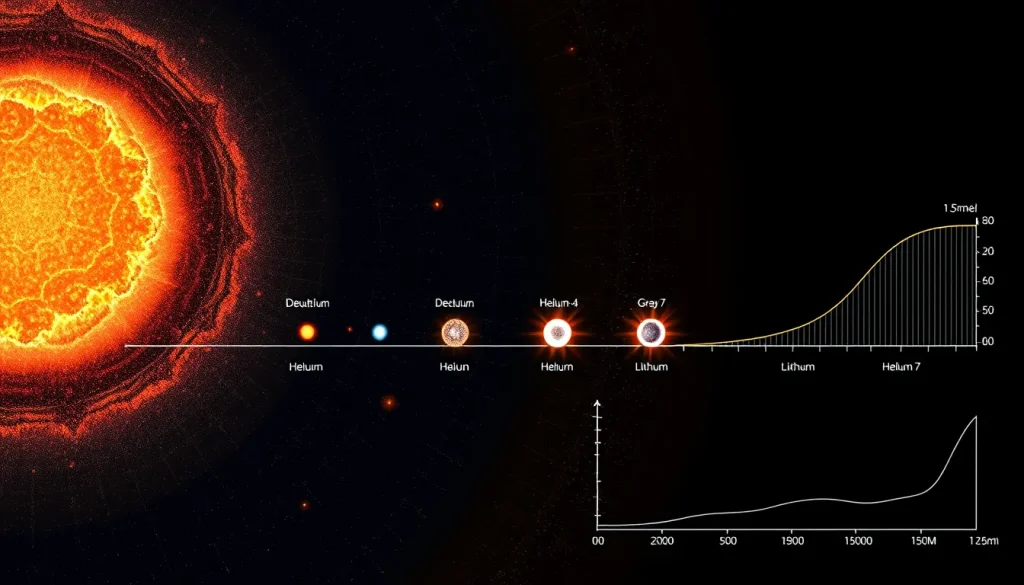
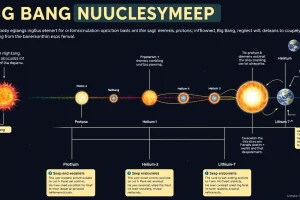
Big Bang nucleosynthesis (BBN) is the cornerstone of our understanding of the early universe. It is based on well-understood Standard Model physics and offers the deepest reliable probe of the first seconds of cosmic time. During the radiation-dominated era, when the universe was about one second old and had a temperature of roughly one million electronvolts (MeV), the conditions were ripe for nuclear reactions to build the lightest elements. The synthesis of deuterium, helium-3, helium-4, and lithium-7 occurred in a dynamic interplay among the four fundamental forces, and the resulting abundances span nine orders of magnitude—from 4He/H ≈ 0.08 down to 7Li/H ≈ 10⁻¹⁰ (ratios by number). This extraordinary range makes BBN a powerful test of the standard cosmology and a sensitive probe for new physics beyond the Standard Model.
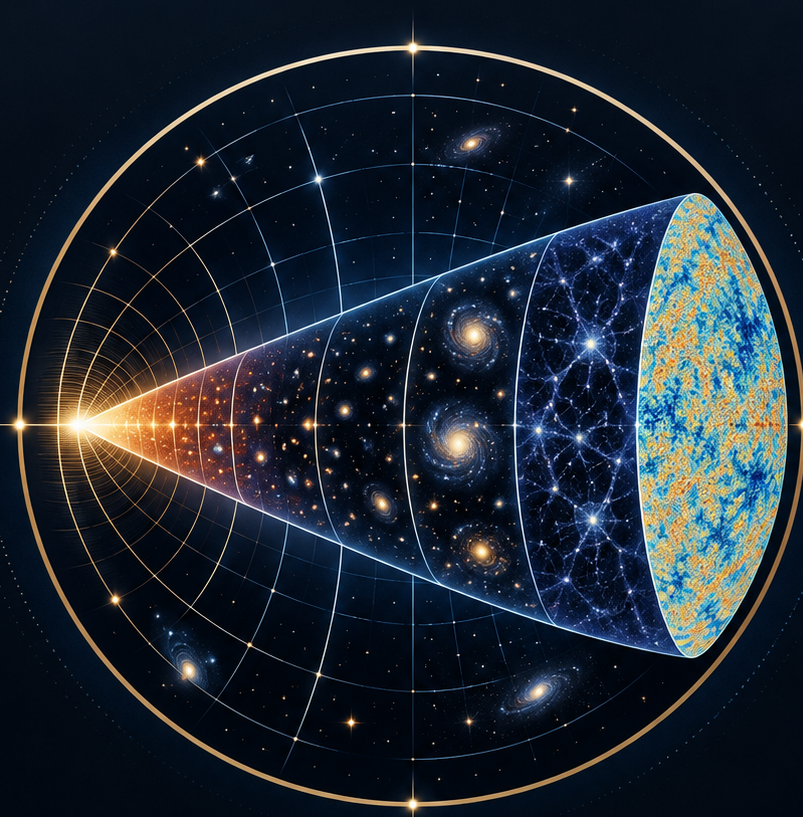
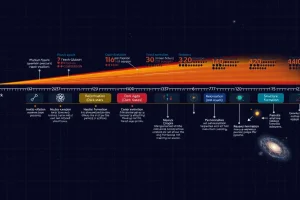
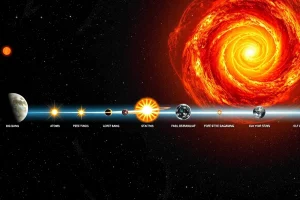
The universe’s evolution from the Planck epoch to the present day is a story of cooling and structure formation. The major cosmic epochs are summarized in the table below, with BBN occupying a brief but crucial window.
| Epoch | Time | Temperature | Key Events |
|---|---|---|---|
| Planck epoch | <10⁻⁴³ s | >10³² K | Quantum gravity era; unification of all forces |
| Grand Unification epoch | 10⁻⁴³–10⁻³⁶ s | 10²⁷–10³² K | Unification of strong, weak, and electromagnetic forces |
| Inflationary epoch | 10⁻³⁶–10⁻³² s | ~10²⁷ K | Exponential expansion; seeds for large-scale structure |
| Electroweak epoch | 10⁻³²–10⁻¹² s | 10¹⁵–10²⁷ K | Electromagnetic and weak forces separate |
| Quark epoch | 10⁻¹²–10⁻⁶ s | 10¹²–10¹⁵ K | Quarks and gluons; baryogenesis |
| Hadron epoch | 10⁻⁶–1 s | 10¹⁰–10¹² K | Protons and neutrons form; annihilation of matter-antimatter |
| Lepton epoch | 1–10 s | 10⁹–10¹⁰ K | Leptons dominate; neutrinos decouple |
| Photon epoch (BBN) | 10 s–3 min | 10⁸–10⁹ K | Nucleosynthesis of light elements |
| Recombination | ~380,000 yr | ~3000 K | Electrons and protons form neutral hydrogen; CMB released |
| Dark Ages | 380,000 yr–~150 million yr | ~3000 K to ~50 K | No luminous sources; universe dark |
| Reionization | ~150 million–1 billion yr | ~50 K to ~10 K | First stars and galaxies ionize neutral hydrogen |
| Structure Formation | 1 billion yr–present | ~10 K to 2.7 K | Galaxies, clusters, and large-scale structure grow via gravity |
The cosmic microwave background (CMB) is a direct relic of recombination, when the universe became transparent. Missions like COBE, WMAP, and Planck have mapped its anisotropies with extraordinary precision, revealing the seeds of cosmic structure and confirming the geometry and composition of the universe. The James Webb Space Telescope (JWST) is now probing reionization and the formation of the first galaxies, connecting the early universe to the present.
Evidence
Observation
The primordial abundances of deuterium, helium-3, helium-4, and lithium-7 are inferred from observations of metal-poor gas clouds, quasar absorption systems, and H II regions. The most robust measurement is that of deuterium, which is highly sensitive to the baryon density and is best determined from high-redshift quasar absorbers. Helium-4 is measured in extragalactic H II regions, while lithium-7 is observed in the atmospheres of old, metal-poor stars.
Prediction
BBN theory calculates the light-element yields as a function of the baryon density (or equivalently, the baryon-to-photon ratio). The predictions are made by solving a network of nuclear reactions in an expanding, cooling universe. The standard model of BBN, which assumes three neutrino flavors and standard physics, produces a single-parameter family of abundance predictions.
Measurement
The baryon density can be independently measured from the cosmic microwave background anisotropies. The Planck satellite, for example, gives Ω_b h² ≈ 0.0224, which, when inserted into BBN calculations, yields predictions that agree remarkably well with observed abundances for deuterium and helium-4. The agreement is within a few percent for 4He and within about 1% for D, although lithium-7 remains an anomaly (the “lithium problem”).
Why It Supports the Model
The concordance between BBN predictions and observations validates the standard hot Big Bang model. The fact that the same baryon density explains both the CMB power spectrum and the primordial light-element abundances is a powerful confirmation of the Lambda-CDM model. BBN also provides a direct measurement of the baryon density of the universe, independent of the CMB, and sets the stage for understanding dark matter and dark energy.
Limitations
The lithium-7 abundance predicted by BBN is a factor of 3–4 higher than observed in the oldest stars. This discrepancy remains unresolved, though it may involve stellar depletion or new physics. Additionally, BBN probes only the first three minutes, so it cannot directly test earlier epochs such as inflation or baryogenesis, which are inferred from other observations (e.g., CMB anisotropies and the baryon asymmetry).
Alternative Explanations
Non-standard BBN models, such as those with additional neutrino species, varying fundamental constants, or decaying particles, have been proposed to address the lithium problem. However, none has achieved broad acceptance, and the standard model remains the consensus. The observed abundances are consistent with the standard cosmology when systematic uncertainties are taken into account.
Current Scientific Consensus
The scientific community accepts BBN as a cornerstone of cosmology. The 2025 Particle Data Group review states that predictions are in “good overall agreement” with observations, validating the standard hot Big Bang cosmology. The baryon density derived from BBN is consistent with CMB measurements, and the framework of Lambda-CDM is the prevailing model. Ongoing work focuses on refining nuclear reaction rates and addressing the lithium discrepancy.
Why It Matters
Big Bang nucleosynthesis is not merely a historical curiosity; it is a precision probe of the early universe. It tells us how much ordinary matter exists, provides a cross-check for CMB measurements, and imposes constraints on new physics. The agreement between BBN and observations is one of the pillars of the Big Bang model, alongside the expansion of the universe and the cosmic microwave background. Understanding BBN also illuminates the conditions that led to the formation of the first stars and galaxies, linking the primordial universe to the cosmos we observe today.
Evidence / Sources
The following sources provide authoritative, up-to-date information on big bang nucleosynthesis and its evidence:
- Particle Data Group (PDG) 2025 Review on Big Bang Nucleosynthesis by Fields, Molaro, and Sarkar.
- Cyburt, Fields, Olive, and Yeh, “Big bang nucleosynthesis: Present status,” Reviews of Modern Physics 88, 015004 (2016).
- Tytler, O’Meara, Suzuki, and Lubin, “Review of Big Bang Nucleosynthesis and Primordial Abundances,” Physica Scripta (2000).
- Schramm and Turner, “Big-Bang Nucleosynthesis and the Baryon Density of the Universe,” Science (1998).
Related Registry Entries
Explore related topics in cosmology and early-universe physics:
- Cosmic Microwave Background
- Recombination
- Inflation
- Dark Matter
- Lambda-CDM Model
FAQ
What is Big Bang nucleosynthesis?
Big Bang nucleosynthesis is the production of light elements (deuterium, helium-3, helium-4, and lithium-7) during the first few minutes of the universe, when temperatures were high enough for nuclear reactions to occur.
How do we know BBN happened?
The observed primordial abundances of these light elements match theoretical predictions based on the standard hot Big Bang model. The inferred baryon density also agrees with independent measurements from the cosmic microwave background.
What is the lithium problem?
The predicted abundance of lithium-7 from BBN is about 3–4 times higher than what is observed in the oldest stars. This discrepancy is an unsolved problem, possibly due to stellar depletion or new physics.
What missions have provided evidence for BBN and the early universe?
COBE, WMAP, and Planck have mapped the cosmic microwave background, providing precise measurements of the baryon density and cosmological parameters. JWST is now studying the epoch of reionization and first galaxies.

Leave a Reply