Short Answer
Main Explanation
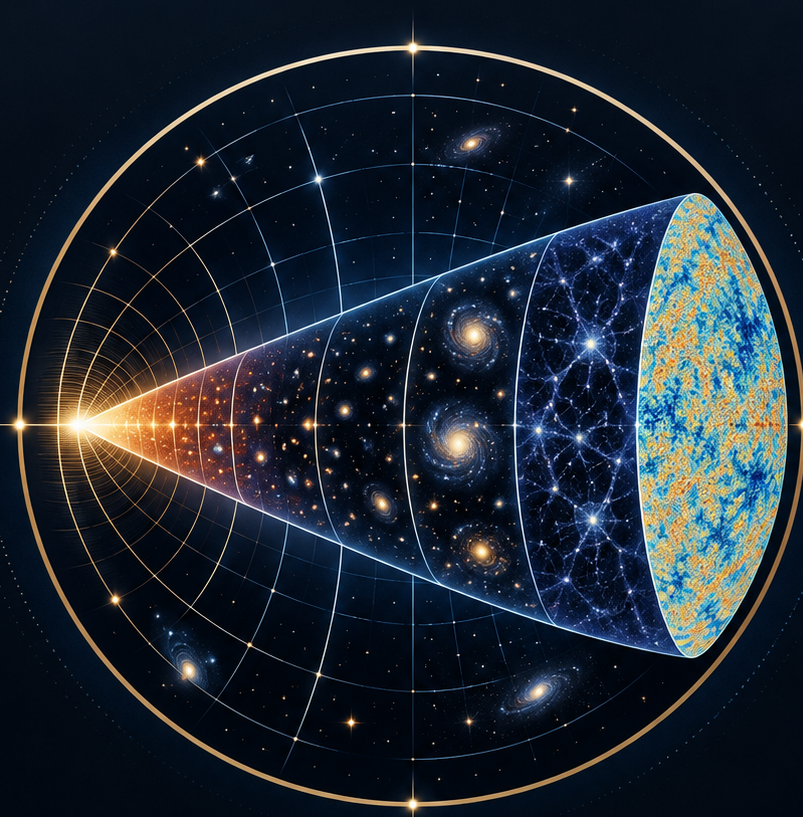
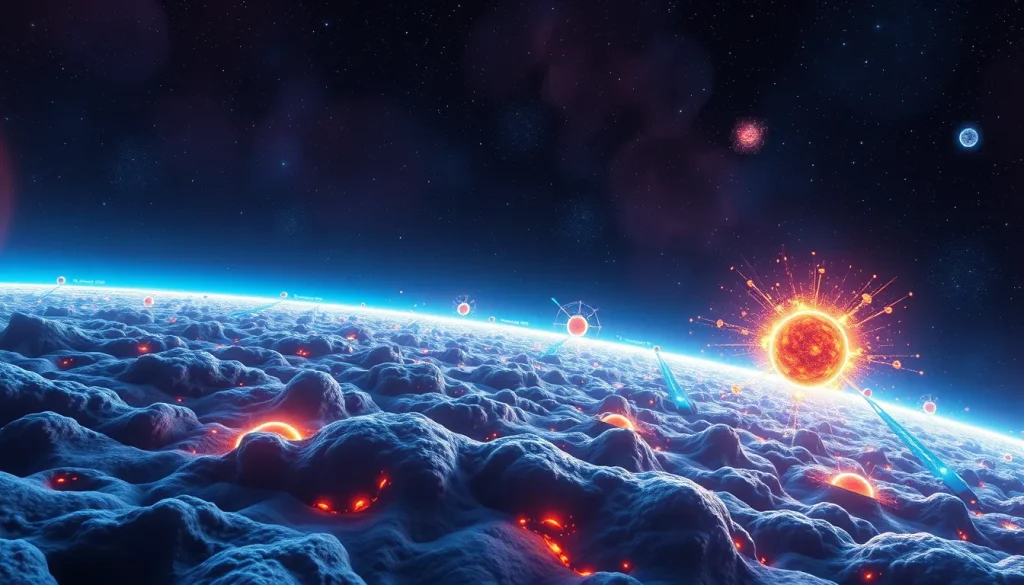
The hadron epoch is a pivotal interval in the history of the universe, occurring just moments after the Big Bang. It is the period when the fundamental quarks that had been free in the preceding quark epoch began to bind together into composite particles called hadrons—most notably protons and neutrons. This epoch marks a crucial transition from a quark–gluon plasma to a state where matter as we know it could form.
According to current cosmological models, the hadron epoch started about 20 microseconds after the Big Bang, though some sources place it as early as 10−6 seconds (1 microsecond) and lasting until roughly 1 second after the Big Bang. The temperature of the universe had fallen to around 10 thousand million degrees Celsius (1010 K), cool enough for the strong nuclear force—carried by gluons—to confine quarks into bound states. Initially, the universe was hot and dense enough to produce hadron–anti-hadron pairs in thermal equilibrium. As expansion and cooling continued, these pairs annihilated, leaving a tiny excess of matter over antimatter—a nano-asymmetry that persists to this day. Most hadrons and anti-hadrons were eliminated, leaving a small residue of protons, neutrons, and other hadrons. This residue would later serve as the building blocks for all atomic nuclei.
The hadron epoch is a key chapter in the broader cosmic story. It bridges the quark epoch, when quarks and gluons existed in a free plasma, and the lepton epoch, when the universe was dominated by photons, neutrinos, and electron–positron pairs. Understanding this transition is essential for explaining why the universe is made of matter rather than antimatter and why the abundance of light elements matches observations.
The Hadron Epoch in Detail
When It Happened
The hadron epoch began approximately 20 microseconds after the Big Bang, according to the most widely cited value from the Wikipedia article on the hadron epoch. However, other sources (e.g., historyoftheuniverse.com) give a range from 10−6 seconds to about 1 second. The exact timing depends on the specific particle physics model and the treatment of the quark–hadron transition. The epoch ended when the universe cooled enough that hadrons no longer formed in abundance and the remaining particles were mostly leptons and photons.
Temperature
At the start of the hadron epoch, the temperature was roughly 1010 K (10 thousand million degrees Celsius). This is the energy scale at which quarks can bind into hadrons via the strong force. As the universe expanded, the temperature dropped, eventually reaching about 109 K by the end of the epoch.
Approximate Redshift
The redshift corresponding to the hadron epoch is extremely high, on the order of 1012 to 1013. This is not directly observable today, but it is inferred from the standard ΛCDM model of cosmology.
Dominant Particles/Physics
During the hadron epoch, the universe was filled with a hot, dense soup of quarks, gluons, hadrons (such as pions, protons, and neutrons), and their antiparticles. The strong nuclear force was the dominant interaction, governing the binding and annihilation of these particles. The lightest meson, the pion, was temporarily the most common hadron.
What Happened
As the universe cooled, quarks lost the energy needed to remain free. The gluon field between quarks, which behaves like an elastic band, strengthened with increasing separation. When the distance exceeded about 10−15 meters, the gluon field broke, producing new quark–antiquark pairs. Eventually, quarks became permanently confined in groups of two or three, forming mesons and baryons. The subsequent annihilation of hadrons and anti-hadrons left a small excess of matter—roughly one part per billion—that survived to become the basis of the present universe.
What Came Before
Before the hadron epoch was the quark epoch, which began about 10−12 seconds after the Big Bang. During that time, the universe was so hot and dense that quarks and gluons existed in a free, unbound state known as a quark–gluon plasma.
What Came Next
After the hadron epoch, the universe entered the lepton epoch. The temperature had fallen enough that hadrons were no longer produced in significant numbers, and the universe was dominated by photons, neutrinos, and electron–positron pairs. This epoch continued until about 10 seconds after the Big Bang, when neutrinos decoupled and electrons and positrons annihilated.
Evidence
Direct evidence from the hadron epoch is impossible to observe because it happened so early and any signals have been vastly redshifted or washed out. However, the standard model of particle physics and the observed abundances of light elements (big bang nucleosynthesis) provide strong indirect evidence. The matter–antimatter asymmetry that originated during this epoch is reflected in the baryon density of the universe, measured by missions such as WMAP and Planck. Additionally, particle accelerator experiments at CERN’s LHC recreate quark–gluon plasma conditions, confirming the physics of quark confinement.
Why It Matters
The hadron epoch is not just a historical curiosity; it set the stage for everything that followed. The tiny excess of matter over antimatter that survived annihilation is the reason the universe contains any matter at all. The protons and neutrons formed during this epoch later combined into atomic nuclei during big bang nucleosynthesis, producing the light elements (hydrogen, helium, lithium) that we observe today. Without the hadron epoch, there would be no atoms, no stars, no galaxies, and no life. Understanding this epoch also helps physicists test the Standard Model of particle physics and probe the fundamental forces that govern the universe.
Moreover, the hadron epoch is a critical link in the cosmic timeline. It connects the high-energy physics of the early universe with the lower-energy processes of nucleosynthesis and recombination. By studying the conditions of this epoch, cosmologists can refine models of inflation, baryogenesis, and the overall evolution of the cosmos.
Evidence / Sources
The information in this article is based on the following authoritative sources:
- Wikipedia: Hadron epoch
- HandWiki: Astronomy:Hadron epoch
- History of the Universe: Hadron Epoch 10-6 to 1 second
- Earth Site Education: Hadron Epoch (10⁻⁶ – 1 sec) – Quarks combine into protons and neutrons
Related Registry Entries
The following entries in the cosmic timeline are closely related to the hadron epoch:
- Quark Epoch – The period before the hadron epoch when quarks and gluons were free.
- Lepton Epoch – The period after the hadron epoch when leptons dominated.
- Photon Epoch – The period when photons dominated the universe after lepton annihilation.
- Recombination – The formation of neutral atoms, leading to the cosmic microwave background.
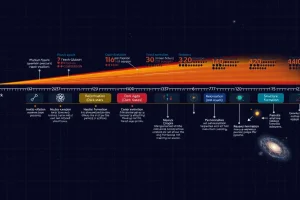
For a complete picture of the universe’s evolution, see the timeline of cosmic epochs from the Planck epoch to structure formation. The hadron epoch is a brief but essential chapter in that story.
Last Reviewed / Updated: September 4, 2026
FAQ
How long did the hadron epoch last?
The hadron epoch began about 20 microseconds after the Big Bang and lasted until roughly 1 second after the Big Bang, though some sources give a start as early as 10⁻⁶ seconds. The exact duration depends on the specific model of the quark-hadron transition.
What happened to the antimatter during the hadron epoch?
During the hadron epoch, hadrons and anti-hadrons were created in pairs and annihilated each other. Due to a tiny asymmetry (about one part per billion), a small excess of matter survived, which is why the universe today is made of matter rather than antimatter.
Why is the hadron epoch important for modern cosmology?
The hadron epoch set the stage for nucleosynthesis and the formation of atoms. It also produced the baryon asymmetry that determines the amount of ordinary matter in the universe. Observations of cosmic microwave background and light element abundances depend on this epoch.
Can we observe the hadron epoch directly?
No, we cannot observe it directly because it occurred so early that any radiation has been massively redshifted and obscured. However, particle accelerators like the LHC recreate quark-gluon plasma conditions, and cosmological observations of element abundances and the CMB provide indirect evidence.

Leave a Reply