
Short Answer
Main Explanation
The cosmic microwave background is the oldest light in the universe, a relic of the hot, dense state that existed about 380,000 years after the Big Bang. As this radiation travels across the cosmos, it passes through the clumpy distribution of matter—both luminous and dark—that has grown under gravity over billions of years. According to general relativity, massive objects bend the path of light. This gravitational lensing effect imprints a subtle but measurable distortion on the CMB’s temperature and polarization maps.
Dark matter, which makes up about 27% of the universe’s energy budget, does not emit or absorb light, but it does exert gravity. CMB lensing therefore offers a unique way to “see” dark matter by its gravitational influence on the CMB. Unlike galaxy lensing, which uses distant galaxies as background sources, the CMB is an ideal backlight: it is extended across the entire sky, partially polarized, and located at a well-known distance (z ≈ 1100). This makes CMB lensing a powerful probe of the dark matter distribution over a wide range of redshifts, from the surface of last scattering to the present.
The lensing effect is weak—the typical deflection angle is only a few arcminutes—but it is coherent over degree scales. By statistically combining the lensed CMB temperature and polarization patterns, cosmologists can reconstruct the projected gravitational potential along each line of sight. This potential is directly related to the integrated matter distribution, providing a map of dark matter on the sky.

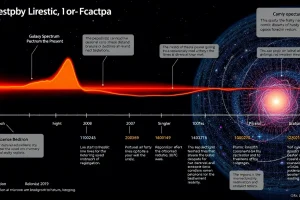
CMB lensing also connects to the broader cosmic timeline. The CMB itself was released during recombination, when electrons and protons combined to form neutral hydrogen. Before that, the universe went through a series of epochs—the Planck epoch, Grand Unification, Inflation, Electroweak, Quark, Hadron, Lepton, and Photon epochs—each governed by different physical processes. After recombination, the universe entered the Dark Ages, followed by Reionization and the formation of stars and galaxies. The large-scale structure that lenses the CMB is the product of these later epochs, shaped by the gravitational collapse of dark matter and baryons. Thus, CMB lensing not only maps dark matter but also tests our understanding of structure formation from the early universe to today.
Concept
Definition
CMB lensing is the gravitational deflection of cosmic microwave background photons by the matter distribution between the observer and the surface of last scattering. The effect is described by a deflection field that remaps the primordial CMB temperature and polarization anisotropies.
How It Works
As CMB photons travel, they encounter overdensities and underdensities of matter. Overdensities (like galaxy clusters) focus the light, while underdensities defocus it. The net effect is a remapping of the CMB sky: the observed temperature at a given direction is the primordial temperature at a slightly different direction, shifted by the deflection angle. Because the deflection is small (typically a few arcminutes), the lensing signal is dominated by the cumulative effect of all matter along the line of sight, weighted by a geometric factor that peaks around z ≈ 1–2. The lensing convergence κ is a weighted projection of the matter density, and it can be reconstructed from the CMB maps using quadratic estimators that exploit the non-Gaussian correlations introduced by lensing.
Equation
The lensing deflection field is related to the gravitational potential Φ along the line of sight. The convergence κ is given by a weighted integral of the matter overdensity δ:
κ(n̂) = ∫ dχ W(χ) δ(χ n̂, χ),
where χ is the comoving distance and W(χ) is a lensing efficiency kernel that depends on the source redshift distribution (for the CMB, the source is at z ≈ 1100). The deflection angle α is the gradient of the lensing potential ψ, where ψ is related to the gravitational potential via a line-of-sight integral.
Example
The Planck satellite’s 2013 data release provided the first high-significance detection of CMB lensing, mapping the convergence field over the full sky. The reconstructed map shows large-scale structures—filaments and clusters—that correlate with galaxy surveys and the cosmic infrared background. This map is a direct visualisation of dark matter’s gravitational imprint on the CMB.
Observable Consequences
Lensing affects the CMB power spectra: it smooths the acoustic peaks, transfers power from large to small scales, and generates B-mode polarization from E-modes. It also introduces non-Gaussian correlations that can be used to reconstruct the lensing potential. The lensing power spectrum itself is a sensitive probe of the amplitude and growth of structure, constraining parameters such as σ₈ (the amplitude of matter fluctuations) and the sum of neutrino masses.
Common Misconceptions
One misconception is that CMB lensing is the same as strong lensing by individual galaxies. In reality, it is weak lensing by the entire large-scale structure, with deflections of only a few arcminutes. Another is that lensing only affects temperature, but it also affects polarization, and the polarization signal is crucial for separating lensing from other effects. Finally, some think that lensing “distorts” the CMB in a way that obscures the primordial signal, but in fact lensing is a signal itself that can be used to map dark matter.
Why It Matters
CMB lensing provides a direct, unbiased probe of the dark matter distribution, complementing galaxy surveys and cluster counts. It tests the predictions of the Lambda-CDM model, especially the growth of structure and the geometry of the universe. By measuring the lensing power spectrum, cosmologists can constrain the sum of neutrino masses, the dark energy equation of state, and the primordial non-Gaussianity. Moreover, CMB lensing helps to “delens” the CMB, recovering the primordial B-mode signal that could reveal gravitational waves from inflation. As next-generation experiments like Simons Observatory and CMB-S4 come online, CMB lensing will become even more precise, offering a deeper view of the cosmic web and the nature of dark matter.
Evidence / Sources
The theoretical framework for CMB lensing was established in the early 2000s, with Wayne Hu’s 2001 paper introducing an optimal algorithm for mass reconstruction from the damping tail. The Planck 2013 results (Planck Collaboration et al., 2013) provided the first robust detection of the lensing signal, with a signal-to-noise ratio above 25. Subsequent analyses by ACT and SPT confirmed and refined the measurements. Numerical simulations (e.g., Amblard et al., 2004) have explored systematic biases, including contamination from the kinetic Sunyaev-Zel’dovich effect. Reviews by Hanson et al. (2009) summarize the methods and challenges.
Related Registry Entries
FAQ
What exactly does CMB lensing measure?
CMB lensing measures the gravitational deflection of cosmic microwave background photons by all matter (dark and baryonic) along the line of sight. This deflection is used to reconstruct the projected dark matter distribution, known as the lensing convergence map.
How is CMB lensing different from galaxy lensing?
Galaxy lensing uses distant galaxies as background sources, which are point-like and often noisy. CMB lensing uses the CMB, which is extended across the entire sky, partially polarized, and has well-known statistical properties, making it a cleaner and more uniform backlight.
Why is CMB lensing important for cosmology?
CMB lensing provides a direct probe of the dark matter distribution and the growth of cosmic structure. It helps constrain cosmological parameters such as the sum of neutrino masses, the amplitude of matter fluctuations (σ₈), and the nature of dark energy.

Leave a Reply