
Short Answer
Main Explanation
The universe began with a hot, dense state — the Big Bang. In the first few minutes, nuclear reactions fused protons and neutrons into light elements: hydrogen, helium, and trace amounts of deuterium and lithium. This process, called Big Bang nucleosynthesis (BBN), proceeded until the universe cooled enough to stop nuclear fusion. The resulting primordial abundances depend sensitively on the baryon-to-photon ratio, which in turn sets the cosmic baryon density. Measuring the primordial deuterium abundance is one of the most powerful tests of this theory because deuterium is only destroyed in stars, never created in significant amounts after BBN. Thus, the lowest measured D/H values in the most pristine gas trace the primordial value.
Why Quasar Absorption Systems?
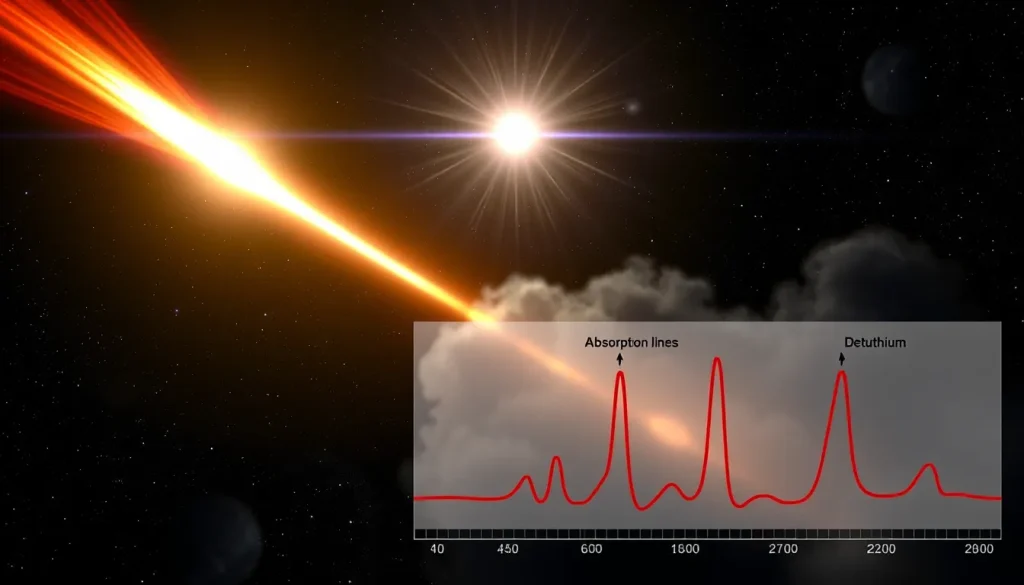
Quasars are extremely luminous active galactic nuclei. Their light travels billions of years, passing through intervening gas clouds. These clouds absorb specific wavelengths, imprinting absorption lines on the quasar spectrum. The hydrogen Lyman-alpha line at 121.6 nm is the strongest. Deuterium, being a heavier isotope of hydrogen, has a slightly shifted Lyman-alpha wavelength (by ~0.033 nm). By measuring the relative absorption of these two lines, astronomers derive the D/H ratio in the cloud. The best systems are those with simple velocity structure and low metal content, indicating minimal stellar processing.
The Cosmic Epochs
The measurement of primordial deuterium is tied to the cosmic timeline. The universe underwent a series of epochs, each leaving imprints we can observe today:

| Epoch | Time After Big Bang | Key Events |
|---|---|---|
| Planck epoch | < 10−43 s | Quantum gravity era; physics unknown |
| Grand Unification epoch | 10−43 – 10−36 s | Unified forces begin to separate |
| Inflationary epoch | 10−36 – 10−32 s | Exponential expansion; seeds of structure |
| Electroweak epoch | 10−32 – 10−12 s | Electromagnetic and weak forces separate |
| Quark epoch | 10−12 – 10−6 s | Quarks and gluons form quark-gluon plasma |
| Hadron epoch | 10−6 – 1 s | Protons and neutrons form; annihilation of antimatter |
| Lepton epoch | 1 – 10 s | Leptons dominate; neutrino decoupling |
| Photon epoch | 10 s – 380,000 yr | Photons dominate; BBN occurs in first ~20 min |
| Recombination | ~380,000 yr | Electrons combine with nuclei; CMB released |
| Dark Ages | 380,000 yr – ~150 Myr | No stars; neutral hydrogen pervades |
| Reionization | ~150 Myr – 1 Gyr | First stars and galaxies ionize hydrogen |
| Structure Formation | 1 Gyr – present | Galaxies cluster; large-scale structure evolves |
Deuterium was synthesized during the photon epoch, specifically in the first ~20 minutes after the Big Bang. The primordial D/H ratio is a direct output of BBN, which depends on the baryon density. By measuring D/H in quasar absorption systems, we effectively measure the baryon density at early times, which must match the value derived from the CMB if the standard model is correct.
Measurement Technique
High-resolution spectroscopy of bright quasars in the ultraviolet (UV) region is required, because the Lyman-alpha lines are redshifted into the optical or near-infrared for z > 2. The Hubble Space Telescope (HST) and ground-based 8–10 m telescopes (like Keck and VLT) have been used. The analysis involves modeling the absorption profile, accounting for the velocity structure of the cloud, and separating deuterium from hydrogen and other contaminants (e.g., Ly-alpha forest lines).
Measurement Details
Value
The primordial deuterium-to-hydrogen ratio is approximately 2.5 × 10⁻⁵. The most precise measurements from quasar absorbers give D/H = (2.527 ± 0.030) × 10−5 (as of 2024, combining multiple systems).
Units
Dimensionless ratio (number density of deuterium to hydrogen).
Instrument
High-resolution echelle spectrographs on HST (e.g., STIS, COS) and ground-based telescopes (e.g., Keck/HIRES, VLT/UVES).
Method
Measure the equivalent widths or column densities of D I and H I Lyman-alpha absorption lines in a metal-poor, simple-velocity DLA or sub-DLA. The ratio of column densities gives D/H.
Uncertainty
Statistical and systematic errors arise from continuum placement, velocity structure, contamination by intervening absorption, and the possibility of local deuterium depletion. Modern analyses achieve ~1–2% precision.
Dataset
Key systems include: Q1937−1009 (z=3.572) with D/H = (2.3 ± 0.3 ± 0.3) × 10−5 (Burles & Tytler 1998); Q1009+2956 (z=2.504) (Zavarygin et al. 2018); J1332+0052 (z=3.42) (Kislitsyn et al. 2024); Q2206−199 (z=2.076) with D/H = (1.65 ± 0.35) × 10−5 (Pettini & Bowen 2001).
Latest/Reference Measurement
The 2024 measurement toward J1332+0052 by Kislitsyn et al. provides one of the most precise determinations, converging with the CMB-derived baryon density.
Why Measurements Differ
Variations in D/H among systems can arise from local deuterium destruction in stars, contamination by hydrogen interlopers, or systematic errors in modeling the velocity structure. The lowest values are considered closest to primordial, and the spread is now consistent within uncertainties.
Why It Matters
The primordial deuterium abundance is a cornerstone of modern cosmology. It provides a direct, independent measurement of the baryon density of the universe, which must agree with the value inferred from the CMB anisotropies measured by Planck. This agreement validates the standard ΛCDM model and the theory of BBN. Moreover, deuterium measurements constrain the number of neutrino families and other physics beyond the Standard Model. They also help understand the chemical evolution of galaxies, since deuterium is only destroyed in stars, making it a sensitive probe of stellar processing.
Evidence / Sources
- Burles, S., & Tytler, D. (1998). The Deuterium Abundance toward Q1937−1009. ApJ, 499, 699. doi:10.1086/305667
- Pettini, M., & Bowen, D. V. (2001). A New Measurement of the Primordial Abundance of Deuterium. ApJ, 560, 41. doi:10.1086/322510
- Zavarygin, E. O., et al. (2018). The primordial deuterium abundance at z_abs = 2.504. MNRAS, 477, 4606. doi:10.1093/mnras/sty1003
- Kislitsyn, P. A., et al. (2024). A new precise determination of the primordial abundance of deuterium. MNRAS, 528, 4068. doi:10.1093/mnras/stae248
Related Registry Entries
- Big Bang Nucleosynthesis
- Cosmic Microwave Background
- Lyman-alpha Forest
- Damped Lyman-alpha Systems
- Baryon Acoustic Oscillations
FAQ
Why is deuterium a good tracer of primordial abundance?
Deuterium is only produced in significant amounts during Big Bang nucleosynthesis. Stars destroy deuterium in their interiors, so any deuterium we see in gas clouds must have been produced in the Big Bang and preserved if the gas has not been processed through stars. Measuring the lowest D/H ratios in the most metal-poor gas gives the primordial value.
What is the role of quasars?
Quasars are extremely bright, distant sources of light. Their spectra pass through intervening gas clouds, which absorb specific wavelengths. By analyzing the absorption lines, astronomers can measure the composition, temperature, and density of those clouds, including the deuterium abundance.
How do quasar measurements compare with CMB results?
The CMB provides an independent measurement of the baryon density from the damping tail and peak ratios. The Planck mission gives a baryon density Ω_b h² = 0.0224 ± 0.0001, which predicts a primordial D/H = (2.53 ± 0.04) × 10⁻⁵. Quasar absorption measurements now agree within ~1%, confirming the standard model.


Leave a Reply