
Short Answer
Short Answer / Definition
The Sunyaev-Zel’dovich (SZ) effect is a spectral distortion of the cosmic microwave background (CMB) caused by the scattering of CMB photons off high-energy electrons in the hot gas that permeates galaxy clusters. As the CMB photons pass through a cluster, they gain energy through inverse Compton scattering, creating a characteristic frequency-dependent signal: a slight deficit of photons at low radio frequencies and an excess at high frequencies. This effect is independent of the cluster’s distance, making it an invaluable tool for detecting galaxy clusters and studying the large-scale structure of the universe.
Main Explanation
The cosmic microwave background is the oldest light in the universe, emitted about 380,000 years after the Big Bang. As this radiation travels toward us, it passes through the large-scale structure of the universe, including galaxy clusters. These clusters are the most massive gravitationally bound structures, containing hundreds or thousands of galaxies, dark matter, and a diffuse hot gas called the intracluster medium, with temperatures reaching tens of millions of degrees.
When a CMB photon encounters a free electron in this hot gas, it can be scattered to a higher energy, a process known as inverse Compton scattering. The photon gains energy at the expense of the electron’s thermal motion. Because the gas is hot, the electrons are moving rapidly, and the net effect is that a fraction of CMB photons are shifted to higher frequencies. This creates a distortion in the CMB spectrum that is characteristic of the cluster’s electron pressure.
The thermal SZ effect (tSZ) produces a frequency-dependent change in the CMB brightness: at frequencies below about 217 GHz, the effect appears as a decrement (cold spot), while above 217 GHz it appears as an increment (hot spot). The kinetic SZ effect (kSZ) arises from the bulk motion of the cluster relative to the CMB frame, causing a Doppler shift that is independent of frequency. The tSZ signal is generally stronger and is the primary observable.
The SZ effect is remarkable because its surface brightness does not depend on the cluster’s redshift. The CMB photons are always present, and the scattering probability depends on the integrated electron pressure along the line of sight, not on the distance to the cluster. This makes the SZ effect a nearly redshift-independent probe, allowing astronomers to find clusters at very large distances, even those that are too faint to be seen in optical or X-ray surveys.
Cosmic Context: From the Planck Epoch to Structure Formation
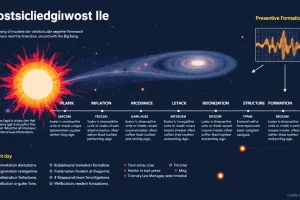
To appreciate the SZ effect, it helps to understand the cosmic timeline that produced the structures we see today. The universe began in the Planck epoch (before 10-43 seconds), where quantum gravity effects dominated. Then came the Grand Unification epoch, the inflationary epoch (~10-36 to 10-32 seconds), which stretched quantum fluctuations to cosmic scales. The electroweak epoch, quark epoch, hadron epoch, and lepton epoch followed, leading to the photon epoch when the universe was a hot plasma of photons, electrons, and nuclei. About 380,000 years after the Big Bang, recombination occurred: electrons and protons combined to form neutral hydrogen, and the universe became transparent to radiation, releasing the CMB. The Dark Ages followed, until gravity gathered matter into the first stars and galaxies during reionization and structure formation. Galaxy clusters formed from the largest overdensities, and it is these clusters that produce the SZ effect we observe today.
| Epoch | Time After Big Bang | Key Events |
|---|---|---|
| Planck Epoch | <10-43 s | Quantum gravity era |
| Inflation | ~10-36 s | Rapid expansion |
| Recombination | ~380,000 yr | CMB released |
| Dark Ages | ~380,000 yr – 1 billion yr | No stars yet |
| Reionization | ~1 billion yr | First stars and galaxies |
| Structure Formation | ~1 billion yr – present | Clusters and superclusters |
Concept
Definition
The SZ effect is the distortion of the CMB spectrum by the scattering of CMB photons off hot electrons in the intracluster medium of galaxy clusters. The effect is named after Rashid Sunyaev and Yakov Zel’dovich, who predicted it in the early 1970s.
How It Works
CMB photons travel from the surface of last scattering to our detectors. When they pass through a galaxy cluster, they encounter free electrons in the hot gas. Through inverse Compton scattering, the photons gain energy, shifting from the Rayleigh-Jeans part of the CMB spectrum to the Wien part. The magnitude of the distortion is characterized by the Compton y parameter, which is the integral of the electron pressure along the line of sight.
Equation
The thermal SZ effect produces a temperature change in the CMB given by:
ΔT/T = y · f(x),
where y = (kBσT/mec2) ∫ neTe dl, and f(x) is the frequency dependence (x = hν/kBTCMB). At low frequencies, f(x) ≈ -2; at high frequencies, f(x) becomes positive, crossing zero at 217 GHz.
Example
A well-known example is the detection of the SZ effect in the Coma cluster. Observations at 30 GHz show a decrement in the CMB temperature toward the cluster, while at 150 GHz the signal is near zero, and at 350 GHz it becomes a positive increment. This frequency signature confirms the thermal SZ interpretation.
Observable Consequences
- Frequency-dependent distortion of the CMB spectrum toward galaxy clusters.
- Ability to detect clusters regardless of redshift, enabling surveys of distant clusters.
- Combined with X-ray observations, the SZ effect provides a way to measure the cluster’s gas density and temperature, and to estimate its mass.
- Statistical studies of SZ-selected clusters constrain cosmological parameters like σ8 (the amplitude of matter fluctuations) and the Hubble constant.
Common Misconceptions
- The SZ effect is not a Doppler shift from the cluster’s motion (that’s the kinetic SZ effect). The thermal SZ effect is due to the random thermal motion of electrons.
- The SZ effect does not change the total number of CMB photons; it redistributes them in frequency, conserving total energy.
- The SZ effect is not absorption; it is scattering. The CMB photons are not lost but are scattered to higher energies.
Why It Matters
The SZ effect is a cornerstone of modern cosmology. It allows astronomers to find galaxy clusters across the universe, from the local neighborhood to redshifts beyond 1, providing a census of the most massive structures. The abundance of clusters as a function of mass and redshift is highly sensitive to the growth of structure, which in turn depends on dark matter and dark energy. SZ surveys, such as those with the Planck satellite and the South Pole Telescope, have produced large cluster catalogs that are used to measure cosmological parameters. The effect also offers an independent way to measure the Hubble constant by combining SZ and X-ray observations of clusters, a method that provides a cross-check on other probes. Furthermore, the SZ effect is a direct probe of the hot gas that constitutes a significant fraction of the baryons in clusters, informing our understanding of gas physics and feedback from galaxies.
Evidence / Sources
The SZ effect is both predicted and observed. The theoretical framework was developed by Sunyaev and Zel’dovich in the 1970s, and the first unambiguous detections came in the 1980s. The Cosmic Background Explorer (COBE) and later the Wilkinson Microwave Anisotropy Probe (WMAP) and Planck missions have mapped the CMB with high precision, and Planck’s full-sky survey detected hundreds of cluster candidates via the SZ effect. The Planck Collaboration released a catalog of SZ sources, confirming the effect’s utility. The effect is now a standard tool in extragalactic astronomy and cosmology.
Related Registry Entries
FAQ
What is the difference between thermal and kinetic SZ effects?
The thermal SZ effect is caused by the random thermal motion of electrons in the hot cluster gas, producing a frequency-dependent distortion. The kinetic SZ effect is caused by the bulk motion of the cluster relative to the CMB frame, producing a Doppler shift that is independent of frequency.
Why is the SZ effect useful for finding distant clusters?
Because the SZ signal does not depend on the cluster's distance, it can be detected at any redshift as long as the cluster is massive enough. This makes it complementary to X-ray and optical surveys, which suffer from surface-brightness dimming at high redshift.
What do observations of the SZ effect tell us about cosmology?
By counting clusters detected via the SZ effect and measuring their masses, astronomers can infer the growth rate of structure, which is sensitive to the nature of dark energy and the amplitude of primordial fluctuations. SZ cluster counts have been used to constrain parameters like σ8 and the Hubble constant.


Leave a Reply