
Short Answer
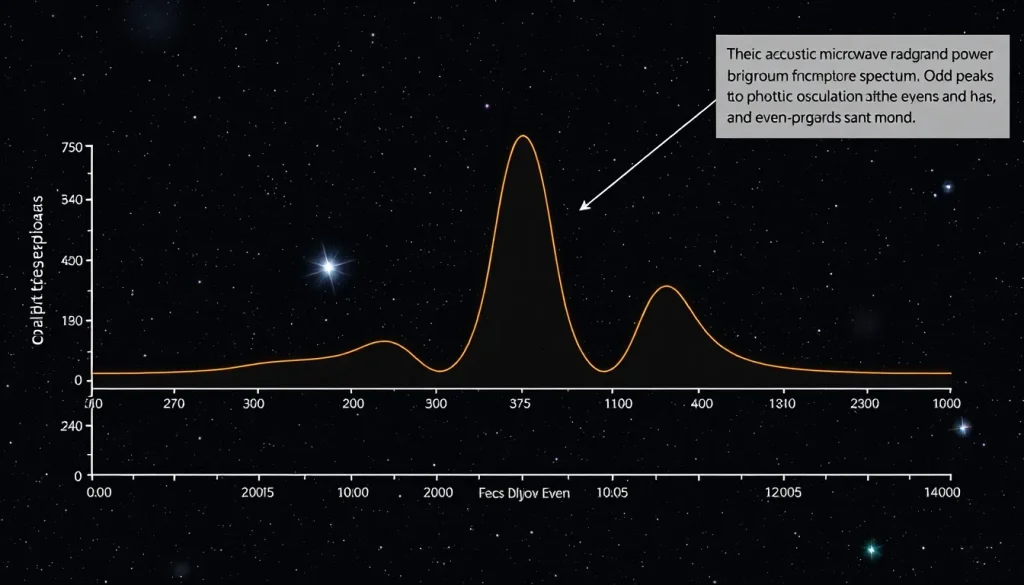
Short Answer: The odd acoustic peaks in the cosmic microwave background (CMB) power spectrum are higher than the even peaks because the initial density perturbations were adiabatic (in phase) and because baryons add inertia to the compression phase, enhancing odd peaks while suppressing even ones.
| Property | Value |
|---|---|
| CMB temperature today | 2.725 K |
| Redshift of recombination | z ≈ 1100 |
| Age of universe at recombination | ~380,000 years |
| First acoustic peak angular scale | ~1° (ℓ ≈ 220) |
| Key missions | COBE, WMAP, Planck |
| Consensus model | ΛCDM (Lambda Cold Dark Matter) |
Main Explanation
The cosmic microwave background is a relic of the hot, dense early universe. Tiny fluctuations in the primordial plasma—quantum seeds amplified by inflation—grew into acoustic oscillations. These oscillations left an imprint on the CMB temperature map, which is analyzed via the angular power spectrum. The spectrum shows a series of peaks and troughs. The odd peaks (first, third, fifth) are systematically higher than the even peaks (second, fourth). This asymmetry is a powerful diagnostic of the universe’s composition and initial conditions.
To understand why, we must consider the physics of the photon-baryon fluid before recombination. Gravity compresses the fluid, while radiation pressure resists compression, setting up standing waves. The peaks correspond to modes that have reached maximum compression (odd peaks) or maximum rarefaction (even peaks) at the moment of last scattering. If the initial perturbations were purely adiabatic—meaning that density and temperature fluctuations are in phase—then compression peaks are enhanced relative to rarefaction peaks. Additionally, baryons (protons and neutrons) contribute inertia to the fluid. This inertia makes compression more effective, further boosting odd peaks and suppressing even peaks. The result is a characteristic odd-even asymmetry that matches observations from WMAP and Planck.
This asymmetry also encodes the baryon density. A higher baryon fraction increases the odd-even contrast. The measured contrast agrees with the baryon density inferred from Big Bang nucleosynthesis, providing a consistent picture of the universe’s matter content.
The acoustic peaks are not just a curiosity; they are a cornerstone of precision cosmology. They allow us to measure the geometry of the universe (via the peak positions), the dark matter density (via the peak heights), and the nature of the initial fluctuations (via the peak ratios). The odd-even asymmetry is a direct confirmation of the adiabatic, nearly scale-invariant perturbations predicted by inflation.
What We Know
The standard model of cosmology, ΛCDM, explains the acoustic peaks with remarkable accuracy. The initial conditions are set by inflation, which stretched quantum fluctuations to cosmic scales. These fluctuations were adiabatic, meaning that all species (photons, neutrinos, baryons, dark matter) shared the same local temperature perturbation. As the universe expanded and cooled, the photon-baryon fluid underwent acoustic oscillations. The dark matter, being collisionless, did not participate in the oscillations but provided gravitational potential wells that influenced the fluid.
The cosmic timeline from the Planck epoch to today is well understood:
| Epoch | Time | Redshift | Key Events |
|---|---|---|---|
| Planck epoch | <10⁻⁴³ s | >10³² | Quantum gravity effects dominate |
| Grand Unification epoch | 10⁻⁴³–10⁻³⁶ s | ~10³²–10²⁸ | Strong and electroweak forces unify |
| Inflationary epoch | 10⁻³⁶–10⁻³² s | ~10²⁸–10²⁵ | Exponential expansion, seeds of structure |
| Electroweak epoch | 10⁻³²–10⁻¹² s | ~10²⁵–10¹⁵ | Electromagnetic and weak forces separate |
| Quark epoch | 10⁻¹²–10⁻⁶ s | ~10¹⁵–10¹² | Quarks and gluons in quark-gluon plasma |
| Hadron epoch | 10⁻⁶–1 s | ~10¹²–10¹⁰ | Protons and neutrons form |
| Lepton epoch | 1–10 s | ~10¹⁰–10⁹ | Leptons dominate, neutrinos decouple |
| Photon epoch | 10 s–380,000 yr | ~10⁹–1100 | Photons dominate, nucleosynthesis occurs |
| Recombination | ~380,000 yr | ~1100 | Electrons combine with nuclei, CMB released |
| Dark Ages | 380,000 yr–150 Myr | 1100–20 | No stars yet, neutral hydrogen |
| Reionization | 150 Myr–1 Gyr | 20–6 | First stars and galaxies ionize hydrogen |
| Structure Formation | 1 Gyr–present | 6–0 | Galaxies, clusters, large-scale structure |
The CMB we observe today is a snapshot of the universe at recombination. The acoustic peaks in its power spectrum are the fossilized oscillations of the photon-baryon fluid. The odd-even asymmetry is a direct consequence of the adiabatic initial conditions and the baryon loading, both of which are predicted by inflation and confirmed by observations.
What We Don’t Know
While the ΛCDM model fits the CMB data extremely well, some questions remain. The exact nature of dark matter and dark energy is unknown. The inflationary mechanism itself is not fully understood—what field drove inflation, and why did it end? The odd-even asymmetry is well measured, but its precise amplitude depends on the baryon density, which is known to about 1% accuracy. Future experiments, such as the Simons Observatory and CMB-S4, will measure the peaks with even higher precision, potentially revealing deviations from the standard model.
Evidence
The odd-even peak asymmetry was first clearly detected by the WMAP satellite (2003–2013) and then with high precision by the Planck mission (2009–2013). The Planck 2018 results show that the first peak is about 1.7 times higher than the second, matching the prediction from adiabatic initial conditions with a baryon density Ωbh² ≈ 0.022. The COBE mission (1989–1993) first measured the CMB spectrum and large-scale anisotropy, laying the groundwork. The James Webb Space Telescope (JWST) is now probing the epoch of reionization, connecting the early universe to the structure we see today.
The acoustic peaks are also consistent with the predictions of Big Bang nucleosynthesis, which independently determines the baryon density from the primordial abundances of light elements. The agreement between these two very different measurements is a triumph of the standard cosmology.
Competing Explanations
Alternative models, such as isocurvature initial conditions (where density and temperature fluctuations are out of phase), would produce a different peak pattern—specifically, even peaks would be higher or comparable to odd peaks. The observed odd-even asymmetry rules out pure isocurvature models. Some modified gravity theories or exotic dark matter models could also alter the peak heights, but none have matched the data as well as ΛCDM. The current consensus is that the standard model, with adiabatic fluctuations and a cosmological constant, is the best description.
Current Research
Ongoing and future experiments are measuring the CMB polarization and the damping tail of the power spectrum to extract more information. The Atacama Cosmology Telescope (ACT) and the South Pole Telescope (SPT) have already provided high-resolution maps. The Simons Observatory and CMB-S4 will push to even smaller scales, probing the physics of inflation and the neutrino mass. The odd-even asymmetry will be measured with sub-percent precision, testing the consistency of the ΛCDM model.
Why It Matters
The odd-even acoustic peak asymmetry is not just a technical detail; it is a direct window into the initial conditions of the universe. It confirms that the seeds of cosmic structure were laid down by inflation, that the universe is composed of about 5% ordinary matter, 27% dark matter, and 68% dark energy, and that the geometry of space is nearly flat. Understanding this asymmetry helps us answer the most fundamental questions: How did the universe begin? What is it made of? And how will it evolve?
Evidence / Sources
The physics of odd and even harmonics in oscillating systems is well established. In acoustics, an odd transfer function produces only odd harmonics, while an even transfer function produces even harmonics (Smyth, 2019). In the CMB, the analogous effect arises from the phase of the initial perturbations. The baryon loading effect is analogous to the inertia of a mass on a spring, which shifts the oscillation phase. The observational evidence comes from the CMB power spectrum measured by COBE, WMAP, and Planck. For a detailed review, see the Planck Collaboration’s 2018 results.
Related Registry Entries
This article is part of a series on the cosmic microwave background and the early universe. Related entries include: Cosmic Microwave Background, Acoustic Peaks, Inflation, Recombination, and the Planck Mission.
FAQ
Why are odd acoustic peaks higher than even ones?
Odd peaks correspond to maximum compression of the photon-baryon fluid, which is enhanced by adiabatic initial conditions and baryon inertia. Even peaks correspond to rarefaction, which is suppressed.
What do the acoustic peaks tell us about the universe?
The peak positions give the geometry (flat universe), the peak heights give the baryon and dark matter densities, and the odd-even asymmetry confirms adiabatic initial conditions from inflation.
How do we measure the acoustic peaks?
By mapping the tiny temperature fluctuations of the CMB with satellites like COBE, WMAP, and Planck, and analyzing the angular power spectrum.
Leave a Reply