
Short Answer
Main Explanation
The universe began in a hot, dense state and expanded through a series of epochs, each defined by dominant particles and physical processes. After recombination (z ≈ 1100) the cosmic microwave background (CMB) was released, and the universe entered the Dark Ages—a period with no luminous sources. Gravity slowly amplified tiny density fluctuations, eventually collapsing gas clouds into the first stars.
The First Stars
Population III stars formed from pristine hydrogen and helium, with no metals to cool the gas efficiently. As a result, they were likely massive—tens to hundreds of solar masses—and short-lived. These stars ended their lives in powerful supernovae, including pair-instability explosions for the most massive ones (e.g., 200 solar masses, as simulated by Greif et al. 2007).
Supernova Explosions and Enrichment
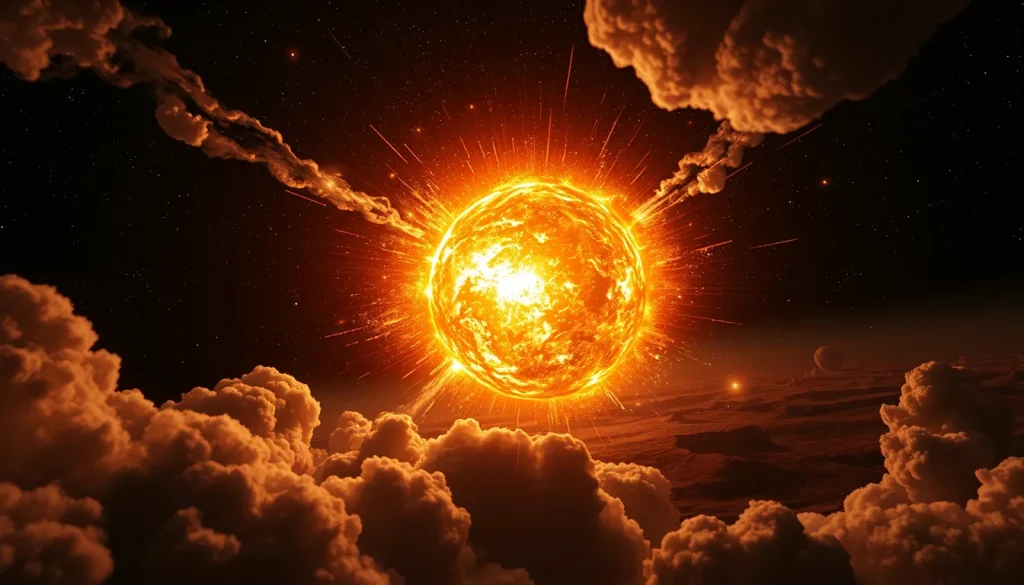
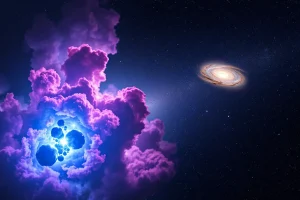
When a Population III star exploded, it expelled newly synthesized elements—carbon, oxygen, silicon, iron, and more—at velocities up to thousands of kilometers per second. The supernova remnant (SNR) expanded into the surrounding minihalo and beyond, sweeping up gas and mixing metals with the intergalactic medium (IGM). Simulations by Greif et al. (2007) show that a 200 M☉ pair-instability supernova at z ≈ 20 propagates to a final shock radius of about 2.5 kpc (proper) after a Hubble time, sweeping up ~2.5 × 10⁵ M☉ of gas.
The morphology of the shock becomes anisotropic as it encounters filaments and neighboring minihalos, often compressing their cores and triggering secondary star formation—a positive feedback effect. In other cases, the blast can strip gas and suppress star formation for hundreds of millions of years.
Cosmic Epochs Timeline
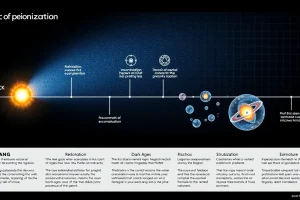
The enrichment process is embedded in the broader cosmic history. Below is a table of the major epochs from the Planck epoch to structure formation.
| Epoch | Time after Big Bang | Redshift | Key Events |
|---|---|---|---|
| Planck epoch | < 10⁻⁴³ s | > 10³² | Quantum gravity era; all forces unified |
| Grand Unification epoch | 10⁻⁴³–10⁻³⁶ s | ~10²⁸–10³² | Strong force separates |
| Inflationary epoch | 10⁻³⁶–10⁻³² s | ~10²⁶–10²⁸ | Exponential expansion; seeds for structure |
| Electroweak epoch | 10⁻³²–10⁻¹² s | ~10¹⁵–10²⁶ | Electromagnetic and weak forces separate |
| Quark epoch | 10⁻¹²–10⁻⁶ s | ~10¹²–10¹⁵ | Quarks and gluons form plasma |
| Hadron epoch | 10⁻⁶–1 s | ~10¹⁰–10¹² | Protons and neutrons form |
| Lepton epoch | 1–10 s | ~10⁹–10¹⁰ | Leptons dominate; neutrinos decouple |
| Photon epoch | 10 s–380,000 yr | ~10³–10⁹ | Photons dominate; Big Bang nucleosynthesis |
| Recombination | ~380,000 yr | ~1100 | Atoms form; CMB released |
| Dark Ages | 380,000 yr–~200 Myr | ~20–1100 | No stars; hydrogen and helium gas |
| Reionization | ~200 Myr–1 Gyr | ~6–20 | First stars and supernovae; reionization of hydrogen |
| Structure Formation | > 1 Gyr | < 6 | Galaxies, clusters, and large-scale structure assemble |
The Role of the CMB
The cosmic microwave background is the relic radiation from recombination. Its temperature anisotropies, measured by COBE, WMAP, and Planck, encode the initial density fluctuations that later seeded the first stars and galaxies. The CMB also provides a backdrop against which the first supernovae’s effects can be studied, though direct detection remains challenging.
Key Missions and Instruments
- COBE (1989): Confirmed the CMB’s blackbody spectrum and found tiny anisotropies.
- WMAP (2001): Measured the CMB power spectrum with high precision, constraining cosmological parameters.
- Planck (2009): Improved measurements of CMB polarization and lensing, refining the ΛCDM model.
- JWST (2021): Observes the first galaxies and potentially the remnants of Population III supernovae at high redshift.
What We Know
Simulations show that Population III supernovae are powerful sources of metal enrichment. The first stars formed in minihalos of ~10⁶ M☉ at z ≈ 20–30. Their explosions expelled metals into the IGM, raising the metallicity to ~10⁻⁴–10⁻² solar in the vicinity. This enrichment allowed subsequent star formation to produce lower-mass stars, as metals enable efficient cooling.
What We Don’t Know
The exact mass distribution of Population III stars remains uncertain. The frequency of pair-instability supernovae versus core-collapse explosions is not fully constrained. The efficiency of metal mixing over large scales is also debated, as some models predict inhomogeneous enrichment.
Evidence
Observations of ancient, extremely metal-poor stars in the Milky Way’s halo show abundance patterns consistent with enrichment by a single Population III supernova. The presence of elements like carbon and iron in these stars provides fossil evidence of the first explosions. Additionally, high-redshift galaxy surveys with JWST are beginning to probe the era of reionization where these supernovae occurred.
Competing Explanations
Alternative scenarios include direct collapse black holes that might skip supernovae, or primordial magnetic fields that could alter star formation. However, the standard ΛCDM model with Population III stars and supernovae remains the consensus explanation for early metal enrichment.
Current Research
Ongoing simulations (e.g., Chen et al. 2024) investigate how Population III supernova remnants drive the properties of the first galaxies. The JWST is searching for high-redshift supernovae and their host galaxies. Future missions like SPHEREx will map large-scale structure and possibly detect the imprint of early enrichment.
Why It Matters
The first supernovae fundamentally altered the chemistry of the cosmos. Without them, the universe would have remained hydrogen and helium, and the formation of planets, life, and even the Sun would have been impossible. Understanding this process connects the Big Bang to our own existence, revealing the chain of events that turned primordial gas into the rich, structured universe we see today.
Evidence / Sources
- Greif, T. H., Johnson, J. L., Bromm, V., & Klessen, R. S. (2007). The First Supernova Explosions: Energetics, Feedback, and Chemical Enrichment. ApJ, 670, 1. Link
- Chen, K.-J., Tang, C.-Y., Whalen, D. J., Ho, M.-Y., Tsai, S.-H., Ou, P.-S., & Ono, M. (2024). How Population III Supernovae Determined the Properties of the First Galaxies. ApJ, 964, 91. Link
- Chen, K.-J., Whalen, D. J., Wollenberg, K. M. J., Glover, S. C. O., & Klessen, R. S. (2017). How the First Stars Regulated Star Formation. II. Enrichment by Nearby Supernovae. ApJ, 844, 111. Link
- Whalen, D. J., van Veelen, B., O’Shea, B. W., & Norman, M. L. (2008). Primordial Supernovae and the Assembly of the First Galaxies. IAU Symposium, 255. Link
Related Registry Entries
Last Reviewed: September 5, 2026
FAQ
What are Population III stars?
Population III stars are the first stars in the universe, formed from primordial hydrogen and helium with no metals. They were likely very massive (tens to hundreds of solar masses) and lived only a few million years before exploding as supernovae.
How do supernovae enrich the early universe?
Supernovae eject heavy elements like carbon, oxygen, and iron into the surrounding gas. These metals mix with the intergalactic medium, raising its metallicity and allowing later gas clouds to cool more efficiently, which leads to the formation of lower-mass stars and galaxies.
What evidence do we have for the first supernovae?
Extremely metal-poor stars in the Milky Way's halo show abundance patterns that match predictions from single Population III supernovae. Additionally, simulations and high-redshift observations with JWST are probing the era of reionization where these explosions occurred.
Leave a Reply