Skip to content
BigBangRegistry.com
  • Big Bang
  • Cosmic
  • Cosmic Timeline
  • Cosmology
  • Early Universe
  • Observations
  • Experiments
  • Tools
    • Universe Age at Redshift Calculator
    • Interactive Cosmic Timeline
    • Cosmological Distance Calculator

Recent Posts

  • What Is the Eddington Limit and Why Does It Matter for Black Hole Growth?
  • How Did Matter–Antimatter Asymmetry Arise? (Baryogenesis)
  • What Are Primordial Black Holes?
  • What Are Redshift Surveys and What Do They Reveal About the Universe?
  • What Is the BICEP/Keck Experiment and What Did It Reveal About Primordial Gravitational Waves?

Recent Comments

No comments to show.

Archives

  • November 2026
  • October 2026
  • September 2026
  • August 2026

Categories

  • Acoustic Peaks
  • Anisotropies
  • BAO
  • BBN
  • Big Bang
  • CMB
  • CMB Explained
  • CMB Maps
  • COBE Mission
  • Cosmic horizon
  • Cosmic Microwave Background
  • Cosmic Timeline
  • Cosmological principle
  • Cosmology Concepts
  • Critical density
  • Curvature
  • Dark Ages
  • Discovery of CMB
  • Early Universe
  • Evidence & Observations
  • Expansion
  • First Stars & Galaxies
  • Hadron Epoch
  • Hubble constant
  • Hubble–Lemaître law
  • Inflation
  • JWST
  • Large-scale structure
  • Lepton Epoch
  • Misconceptions
  • Missions & Experiments
  • Nucleosynthesis
  • Observable universe
  • Particle Physics
  • Photon Epoch
  • Planck
  • Planck Epoch
  • Planck Mission
  • Polarization
  • Power Spectrum
  • Quark Epoch
  • Questions
  • Recombination
  • Redshift
  • Reionization
  • Scale factor
  • Simons Observatory
  • SPHEREx
  • Supernova evidence
  • Temperature of CMB
  • Theory
  • Uncategorized
  • ΛCDM

Cosmology Concepts

An interactive guide to the fundamental concepts underlying the origin and evolution of the universe.

What Is the Tensor-to-Scalar Ratio and Why Does It Matter for Inflation?

What Is the Tensor-to-Scalar Ratio and Why Does It Matter for Inflation?

October 12, 2026 | Cosmology Concepts | Earnest S. Carroll

The tensor-to-scalar ratio (r) measures the relative strength of primordial gravitational waves versus density fluctuations in the early universe. It is a key observable for testing cosmic inflation and is probed through the B-mode polarization of the cosmic microwave background.
Read More →
What Is the Deceleration Parameter?

What Is the Deceleration Parameter?

October 10, 2026 | Cosmology Concepts | Earnest S. Carroll

The deceleration parameter q measures how the expansion of the universe changes over time. A negative q today indicates cosmic acceleration, a discovery that reshaped modern cosmology.

Read More →
What Is Conformal Time? A Cosmic Clock for an Expanding Universe

What Is Conformal Time? A Cosmic Clock for an Expanding Universe

October 9, 2026 | Cosmology Concepts | Earnest S. Carroll

Conformal time is a coordinate that factors out cosmic expansion, letting light travel in straight lines on a comoving grid. It underlies the particle horizon and provides a natural timeline for the universe’s major epochs, from the Planck era to structure formation.

Read More →
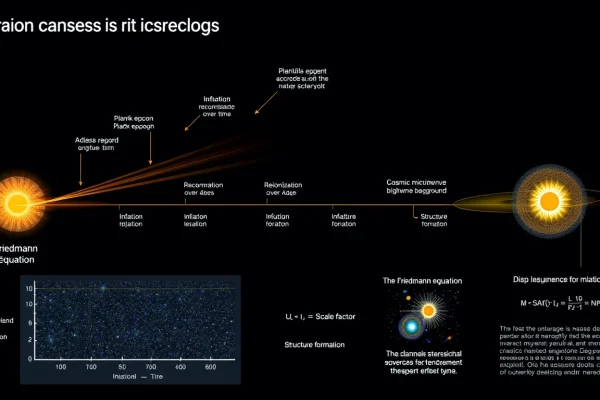
What Is the Friedmann Equation? The Mathematical Foundation of Cosmic Expansion

What Is the Friedmann Equation? The Mathematical Foundation of Cosmic Expansion

October 3, 2026 | Cosmology Concepts | Earnest S. Carroll

The Friedmann equation is a set of equations in physical cosmology that govern the expansion of a homogeneous, isotropic universe. Derived from Einstein’s field equations, it forms the backbone of the standard Big Bang model and the ΛCDM paradigm, describing how the scale factor evolves with time.

Read More →
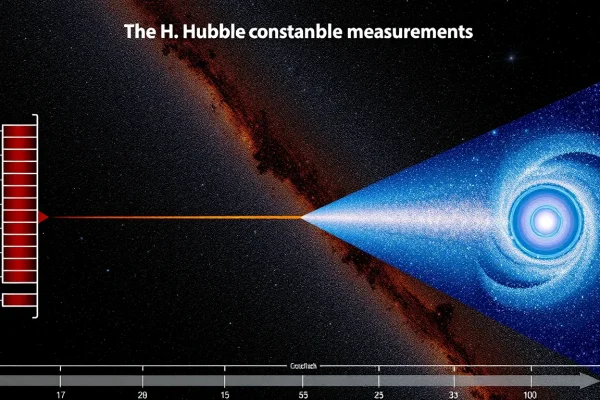
What Is the Hubble Tension? A Guide to the Cosmic Expansion Crisis

What Is the Hubble Tension? A Guide to the Cosmic Expansion Crisis

October 1, 2026 | Cosmology Concepts | Earnest S. Carroll

The Hubble tension is a growing discrepancy between two precise measurements of the universe’s expansion rate. This article explains the conflict, its implications for cosmology, and places it within the full story of cosmic evolution from the Planck epoch to today.

Read More →
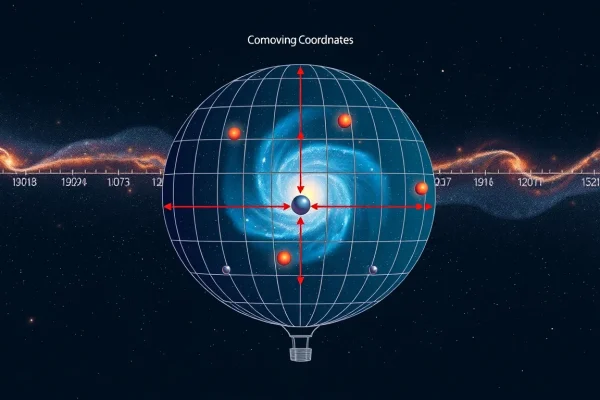
What Is Comoving Distance and How Does It Relate to Redshift?

What Is Comoving Distance and How Does It Relate to Redshift?

September 26, 2026 | Cosmology Concepts | Earnest S. Carroll

Comoving distance is a fundamental measure in cosmology that factors out the expansion of the universe, providing a stable ruler for cosmic scales. This guide explains how comoving distance relates to redshift, traces the major epochs of cosmic evolution, and shows how modern missions have mapped our universe’s history.

Read More →
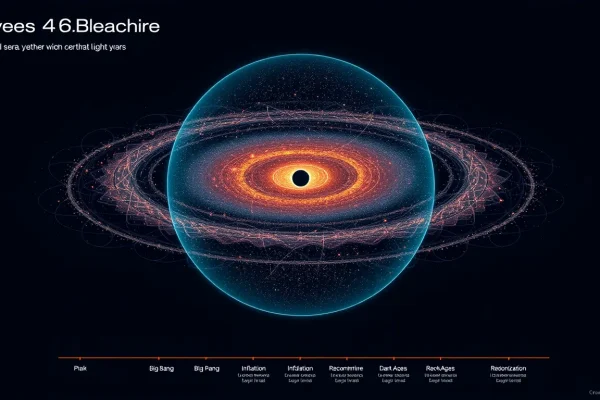
Why Is the Observable Universe 46.5 Billion Light-Years Across?

Why Is the Observable Universe 46.5 Billion Light-Years Across?

September 22, 2026 | Cosmology Concepts | Earnest S. Carroll

The observable universe spans 46.5 billion light-years in radius despite being 13.8 billion years old because space itself has expanded. This article explains the cosmic epochs, the role of inflation, and the evidence from the cosmic microwave background.

Read More →
What Role Does Dark Matter Play in the Formation of the First Stars?

What Role Does Dark Matter Play in the Formation of the First Stars?

September 22, 2026 | Cosmology Concepts | Earnest S. Carroll

Dark matter provided the gravitational scaffolding for the first stars, gathering gas into halos where molecular hydrogen cooling could trigger collapse. Without dark matter, the first stars could not have formed so early in cosmic history, and their properties would be drastically different.

Read More →

How Does Omega Evolve Over Time? A Cosmic Epoch Guide

September 20, 2026 | Cosmology Concepts | Earnest S. Carroll

Explore the evolution of the universe from the Planck epoch to the present day. This guide covers cosmic inflation, the cosmic microwave background, the first atoms, the dark ages, reionization, and the formation of stars and galaxies within the standard Lambda-CDM model.

Read More →
What Is the Copernican Principle? How It Differs from the Cosmological Principle

What Is the Copernican Principle? How It Differs from the Cosmological Principle

September 19, 2026 | Cosmology Concepts | Earnest S. Carroll

The Copernican principle states that Earth is not a privileged observer, while the cosmological principle extends this to say the universe is homogeneous and isotropic on large scales. Together they underpin modern cosmology, from the Big Bang to the cosmic microwave background.

Read More →

Posts pagination

← Previous 1 2 3 4 Next →

About This Site

Recent Articles

  • What Is the Eddington Limit and Why Does It Matter for Black Hole Growth?
  • How Did Matter–Antimatter Asymmetry Arise? (Baryogenesis)
  • What Are Primordial Black Holes?
  • What Are Redshift Surveys and What Do They Reveal About the Universe?
  • What Is the BICEP/Keck Experiment and What Did It Reveal About Primordial Gravitational Waves?
  • Home
  • Privacy Policy
  • About Us
  • Contact Us
  • Disclaimer
  • Terms of Service
© 2026 BigBangRegistry.com. All rights reserved. Powered by WordPress