
Short Answer
Main Explanation
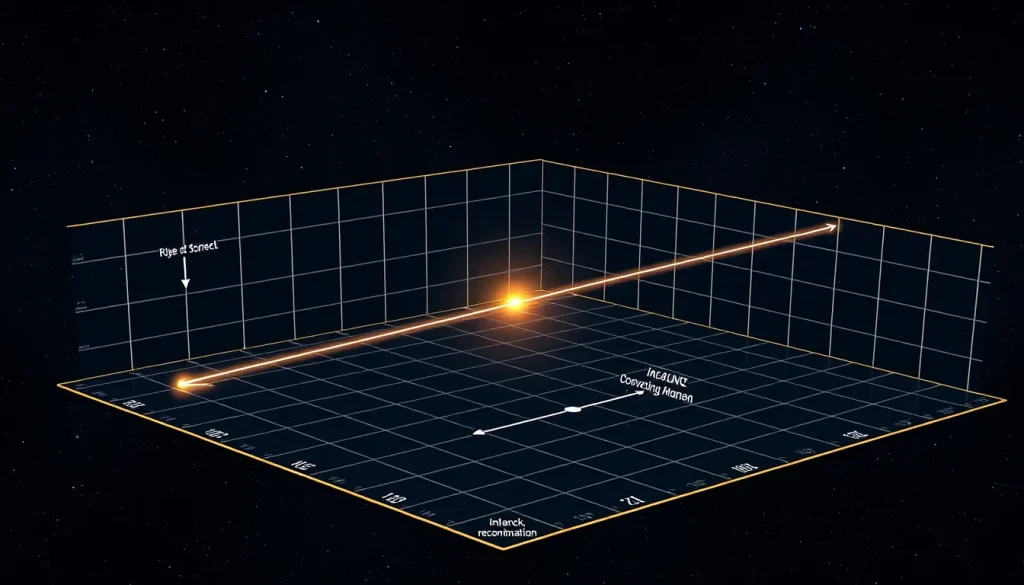
In an expanding universe, cosmic time t (the time measured by a comoving observer since the Big Bang) does not directly tell us how far light has traveled. Because space itself stretches, a photon’s path is continually elongated, so the distance light covers depends on the entire expansion history. Conformal time, often denoted η, solves this by rescaling time so that light travels at a constant rate in comoving coordinates. It is defined as
η = ∫₀ᵗ (1/a(t’)) dt’
where a(t) is the scale factor (with a₀ = 1 today) and t is cosmic time. This integral accumulates the “light‐travel distance per unit scale factor,” effectively converting the expanding grid into a static one. In terms of comoving distance, the particle horizon (the maximum distance light has traveled since the Big Bang) is simply cη, as noted in the Wikipedia definition quoted in [1].
Conformal time is not just a mathematical trick; it appears naturally in the FRW metric and in the propagation of photons. For a radially traveling photon, the null condition ds² = 0 gives dχ = dη (in units where c = 1), so photons move along straight lines in the (η, χ) plane [3]. This makes conformal time the natural coordinate for causal diagrams and for computing distances to the last scattering surface.
Cosmic Epochs: A Conformal Timeline
Using conformal time, we can lay out the major events of cosmic history on a single, expansion‐independent clock. The table below summarizes the key epochs, their approximate cosmic times, redshifts, temperatures, and dominant physics. (Values are approximate and based on the standard ΛCDM model.)
| Epoch | Cosmic Time | Redshift z | Temperature | Dominant Physics / Key Events |
|---|---|---|---|---|
| Planck Epoch | < 10⁻⁴³ s | > 10³² | > 10³² K | Quantum gravity effects; all four forces unified; no classical description. |
| Grand Unification Epoch | 10⁻⁴³ – 10⁻³⁶ s | ~10²⁸ – 10³² | 10²⁷ – 10³² K | Strong force separates from electroweak; possible inflation begins. |
| Inflationary Epoch | 10⁻³⁶ – 10⁻³² s | ~10²⁴ – 10²⁸ | ~10²⁷ K (during reheating) | Exponential expansion; quantum fluctuations seeded; horizon and flatness problems solved. |
| Electroweak Epoch | 10⁻³² – 10⁻¹² s | ~10¹⁵ – 10²⁴ | 10¹⁵ – 10²⁷ K | Electromagnetic and weak forces separate; W, Z bosons acquire mass; baryogenesis may occur. |
| Quark Epoch | 10⁻¹² – 10⁻⁶ s | ~10¹² – 10¹⁵ | 10¹² – 10¹⁵ K | Quarks and gluons form a quark–gluon plasma; no bound hadrons yet. |
| Hadron Epoch | 10⁻⁶ – 1 s | ~10¹⁰ – 10¹² | 10¹⁰ – 10¹² K | Quarks combine into protons and neutrons; matter–antimatter annihilation. |
| Lepton Epoch | 1 – 10 s | ~10⁹ – 10¹⁰ | 10⁹ – 10¹⁰ K | Leptons and antileptons dominate; neutrinos decouple; electron–positron annihilation. |
| Photon Epoch | 10 s – 380,000 yr | ~10⁹ → 1100 | 10⁹ K → 3000 K | Photons, baryons, and dark matter coupled; primordial nucleosynthesis (BBN) occurs at ~3 min. |
| Recombination | ~380,000 yr | ~1100 | ~3000 K | Electrons combine with nuclei to form neutral atoms; photons decouple → CMB released. |
| Dark Ages | ~380,000 – 150 million yr | ~1100 → ~20 | 3000 K → ~60 K | No luminous sources; neutral hydrogen pervades; gravitational collapse begins. |
| Reionization | ~150 million – 1 billion yr | ~20 → ~6 | ~60 K → ~20 K | First stars and galaxies form; UV radiation reionizes hydrogen; cosmic dawn. |
| Structure Formation | 1 billion yr – present | ~6 → 0 | ~20 K → 2.7 K | Galaxies cluster; dark energy accelerates expansion; large‐scale structure evolves. |
How Conformal Time Illuminates These Epochs
Conformal time is especially useful for tracing light and causal horizons. For example, the last scattering surface (the source of the CMB) lies at a comoving distance of about cη with η ≈ 45.5 Gyr (in units where c = 1). The fact that the CMB is nearly isotropic across the sky—even though regions separated by more than the horizon at decoupling should never have been in causal contact—is explained by inflation, which pushed conformal time far enough back to allow causal connection before expansion stretched the universe.
Conformal time also simplifies the geodesic equation for photons. In the FRW metric, the photon energy redshifts as E ∝ 1/a, and the comoving distance traveled between emission and observation is simply Δχ = Δη [3]. This linear relation is why conformal time appears in the definition of the particle horizon and in the calculation of angular diameter distances.
Why It Matters
Conformal time is not just a technical convenience; it is the clock that makes the universe’s history intelligible. By removing the expansion factor, it allows us to compare events on a level playing field. It underlies the causal structure of the universe, the interpretation of CMB anisotropies, and the calculation of distances to galaxies and quasars. Moreover, it is a key ingredient in inflationary theory: during inflation, conformal time runs from negative values (before reheating) to zero at the Big Bang, providing a natural way to describe how quantum fluctuations are stretched to cosmological scales.
For anyone exploring the universe’s timeline, conformal time offers a coordinate system that turns the complicated, accelerating expansion into a simple straight line for light. It is the hidden foundation of many cosmological measurements, from the Hubble constant to the acoustic peaks in the CMB power spectrum.
Evidence / Sources
The definition and use of conformal time are standard results in cosmology, supported by decades of observations. Key evidence includes:
- The existence and blackbody spectrum of the cosmic microwave background, measured by COBE, WMAP, and Planck, which confirm the hot, dense early universe and the recombination epoch.
- The angular power spectrum of CMB anisotropies, which shows acoustic peaks that match predictions based on conformal time and the ΛCDM model.
- Hubble–Lemaître law and the expansion history from supernovae and BAO, which determine the scale factor a(t) and hence the integral for conformal time.
- The observed large‐scale structure and the distribution of galaxies, which reflect the growth of perturbations seeded during inflation and processed through the epochs listed above.
These observations are consistent with the standard model, as detailed in references [1]–[4] and the many surveys that use conformal time as a coordinate.
Related Registry Entries
For further exploration, see the entries on Cosmic Microwave Background, Inflation, Recombination, and Particle Horizon in this registry. Each provides deeper context on how conformal time connects to observable phenomena.
FAQ
Why can't we just multiply the age of the universe by the speed of light to get the particle horizon?
Because space expands while light travels. The comoving distance to the horizon is c times the integral of dt/a(t), which equals cη. The age of the universe (t₀) is not enough; the expansion history matters.
Is conformal time the same as the age of the universe?
No. Cosmic time t measures proper time since the Big Bang, while conformal time η accounts for expansion. They are related by dη = dt/a(t). For a static universe they would be identical, but in our expanding universe η is larger than t.
How does conformal time help explain the CMB's uniformity?
Inflation stretches a tiny, causally connected region to cosmic scales. In conformal time, inflation occurs at negative η, allowing distant CMB regions to have overlapping past light cones, solving the horizon problem.

Leave a Reply