
Short Answer
Main Explanation
The observable universe is overwhelmingly made of matter. Every object we have studied—from the Moon to distant galaxies—is composed of protons, neutrons, and electrons, not their antiparticles. Cosmic rays show protons outnumber antiprotons by a factor of 10,000 to 1, and the absence of gamma-ray emission from matter–antimatter annihilation in galaxy clusters indicates that even on large scales the universe is matter-dominated. This imbalance is puzzling because particles and antiparticles are produced in equal amounts in high-energy processes, and the early universe was unimaginably hot and dense.
The baryon asymmetry problem asks: where did the extra matter come from? In 1967, Andrei Sakharov identified three conditions that any baryogenesis mechanism must satisfy:
- Baryon number violation — the interaction must change the number of baryons.
- C and CP violation — the interaction must distinguish matter from antimatter.
- Departure from thermal equilibrium — the universe must not be in equilibrium, otherwise any asymmetry would be washed out.
The Standard Model contains processes that violate baryon number (sphalerons) and CP violation via the CKM matrix, but the resulting asymmetry is far too small to explain observations. Electroweak baryogenesis at the electroweak phase transition is ruled out by the Higgs boson mass and LHC results. More plausible scenarios include leptogenesis (where an asymmetry in leptons is converted to baryons) and Grand Unified Theory (GUT) baryogenesis.
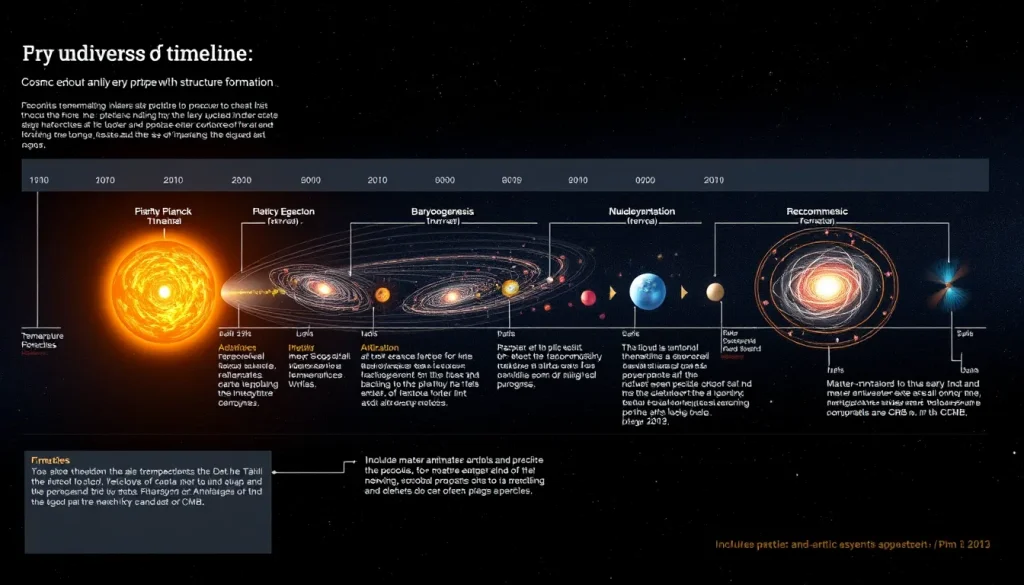
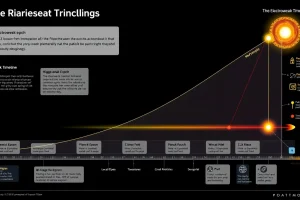
The early universe underwent a series of epochs, each governed by different physics. The following table summarizes the major cosmic epochs from the Planck epoch to structure formation.
| Epoch | Time after Big Bang | Temperature | Key Events |
|---|---|---|---|
| Planck epoch | <10⁻⁴³ s | >10³² K | Quantum gravity effects dominate; no known physics. |
| Grand Unification epoch | 10⁻⁴³ to 10⁻³⁶ s | 10²⁷ to 10³² K | Unified forces separate; possible GUT baryogenesis. |
| Inflationary epoch | 10⁻³⁶ to 10⁻³² s | Cooling rapidly | Exponential expansion; seeds for structure. |
| Electroweak epoch | 10⁻³² to 10⁻¹² s | 10¹⁵ to 10²⁷ K | Electroweak symmetry breaking; sphalerons active; potential baryogenesis. |
| Quark epoch | 10⁻¹² to 10⁻⁶ s | 10¹² to 10¹⁵ K | Quarks and gluons form quark-gluon plasma. |
| Hadron epoch | 10⁻⁶ to 1 s | 10¹⁰ to 10¹² K | Protons and neutrons form; annihilation of baryon-antibaryon pairs. |
| Lepton epoch | 1 to 10 s | 10⁹ to 10¹⁰ K | Leptons and antileptons annihilate; neutrinos decouple. |
| Photon epoch | 10 s to 380,000 yr | 10⁴ to 10⁹ K | Photons dominate; nuclei form (BBN). |
| Recombination | ~380,000 yr | ~3000 K | Electrons combine with nuclei; CMB released. |
| Dark Ages | 380,000 yr to ~100 million yr | Cooling from 3000 K | No stars yet; neutral hydrogen fills space. |
| Reionization | ~100 million to 1 billion yr | ~10 to 100 K | First stars and galaxies emit UV; reionize hydrogen. |
| Structure Formation | 1 billion yr to present | 2.7 K today | Galaxies, clusters, and large-scale structure form. |
The cosmic microwave background (CMB) is a relic of recombination, providing a snapshot of the universe at 380,000 years. Missions like COBE, WMAP, and Planck have measured its temperature anisotropies with exquisite precision, confirming the Lambda-CDM model and the inflationary paradigm. The James Webb Space Telescope (JWST) is now probing the epoch of reionization and the first galaxies.
Cosmic Epoch: Electroweak Epoch (Baryogenesis Context)
When It Happened
Approximately 10⁻³² to 10⁻¹² seconds after the Big Bang.
Temperature
Between 10¹⁵ and 10²⁷ K (corresponding to energies of 100 GeV to 10¹⁵ GeV).
Approximate Redshift
Far beyond observable redshifts; z > 10²⁸ (effectively infinite).
Dominant Particles/Physics
Electroweak force unified; Higgs field; quarks, leptons, and gauge bosons; sphalerons (baryon-number-violating processes) active.
What Happened
Electroweak symmetry breaking occurred as the universe cooled. Sphaleron processes could convert quark-antiquark asymmetries into baryon asymmetries. If CP violation and out-of-equilibrium conditions existed, baryogenesis could have taken place here. However, the Standard Model’s CP violation is insufficient, so new physics is required.
What Came Before
The inflationary epoch, during which the universe expanded exponentially, diluting any pre-existing asymmetry and setting initial conditions.
What Came Next
The quark epoch, where quarks and gluons formed a plasma, and later hadrons formed as the universe cooled.
Evidence
No direct evidence for electroweak baryogenesis exists; the observed asymmetry is indirect evidence that baryogenesis occurred. The success of Big Bang nucleosynthesis (BBN) predicts primordial abundances that depend on the baryon density, which matches the CMB measurements—implying a specific baryon asymmetry.
Why It Matters
Understanding baryogenesis is central to explaining why the universe contains matter at all. Without a matter–antimatter asymmetry, all particles and antiparticles would have annihilated in the early universe, leaving a cosmos filled only with radiation and no stars, planets, or life. The study of baryogenesis also probes physics beyond the Standard Model, including CP violation, particle physics at extreme energies, and the conditions of the first moments after the Big Bang.
Evidence / Sources
- Cosmic microwave background anisotropies measured by COBE, WMAP, and Planck confirm the Lambda-CDM model and constrain baryon density.
- Big Bang nucleosynthesis predictions of light element abundances (hydrogen, helium, lithium) match observations, requiring a specific baryon-to-photon ratio.
- Absence of gamma rays from matter–antimatter annihilation in galaxy clusters indicates matter dominance on large scales.
- Cosmic ray measurements show protons vastly outnumber antiprotons.
Related Registry Entries
- Baryon Asymmetry
- Cosmic Microwave Background
- Electroweak Epoch
- Sakharov Conditions
FAQ
What is baryogenesis?
Baryogenesis is the hypothetical process that produced the observed excess of matter over antimatter in the early universe, satisfying Sakharov's conditions.
Why is there more matter than antimatter?
The exact reason is unknown. The Standard Model cannot explain the magnitude of the asymmetry, so new physics beyond the Standard Model is required.
What evidence supports baryogenesis?
The existence of matter itself, the baryon-to-photon ratio inferred from BBN and CMB, and the absence of antimatter regions in the observable universe.

Leave a Reply