Short Answer
Main Explanation
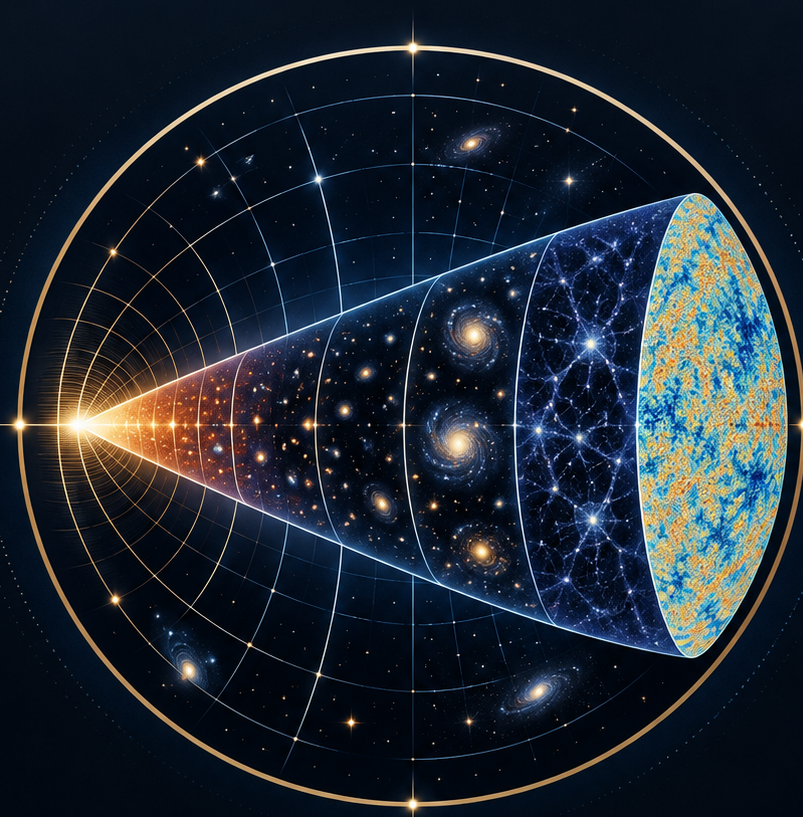
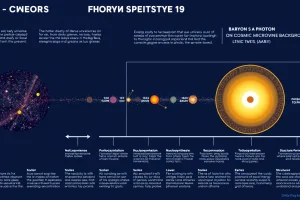
The universe began 13.8 billion years ago in an extremely hot, dense state and has been expanding and cooling ever since. The standard cosmological model, known as Lambda-CDM (ΛCDM), describes this evolution as a sequence of distinct epochs governed by changing particle physics, energy densities, and expansion rates. This interactive reference traces that journey from the Planck epoch to the present day, highlighting the cosmic microwave background (CMB), the formation of the first atoms, and the emergence of stars and galaxies.
The Standard Model: Lambda-CDM
ΛCDM is the consensus model of cosmology. It combines a cosmological constant (Λ) associated with dark energy, cold dark matter (CDM), and ordinary baryonic matter. The model successfully explains the large-scale structure of the universe, the cosmic microwave background anisotropies, the accelerating expansion, and the observed abundances of light elements. In this framework, the universe evolves through a series of epochs, each characterized by the dominant form of energy and the physical processes at work.
Cosmic Epochs: A Guided Timeline
| Epoch | Time After Big Bang | Temperature | Approx. Redshift | Key Events |
|---|---|---|---|---|
| Planck epoch | < 10⁻⁴³ s | > 10³² K | — | Quantum gravity; all forces possibly unified |
| Grand Unification epoch | 10⁻⁴³ – 10⁻³⁶ s | ~10²⁹ K | — | Strong and electroweak forces may unify |
| Inflationary epoch | 10⁻³⁶ – 10⁻³² s | Drops drastically | ~10²⁶ | Exponential expansion; seeds of structure |
| Electroweak epoch | 10⁻³² – 10⁻¹² s | ~10¹⁵ K | — | Electroweak symmetry breaking; W/Z bosons |
| Quark epoch | 10⁻¹² – 10⁻⁶ s | ~10¹² K | — | Quark-gluon plasma |
| Hadron epoch | 10⁻⁶ – 1 s | ~10¹⁰ K | — | Protons and neutrons form; baryon asymmetry |
| Lepton epoch | 1 – 10 s | ~10⁹ K | — | Leptons dominate; neutrino decoupling |
| Photon epoch | 10 s – 380,000 yr | 10⁹ – 3000 K | — | Big Bang nucleosynthesis; light elements |
| Recombination | ~380,000 yr | ~3000 K | ~1100 | First atoms form; CMB released |
| Dark Ages | 380,000 yr – ~150 Myr | 3000 – 60 K | 1100 – 20 | Neutral hydrogen; no stars |
| Reionization | ~150 Myr – 1 Gyr | 60 – 20 K | 20 – 6 | First stars and galaxies ionize the IGM |
| Structure Formation | ~150 Myr – present | 20 – 2.7 K | 6 – 0 | Galaxies, clusters, large-scale structure; dark energy dominates |
Planck Epoch
When It Happened: The first 10⁻⁴³ seconds after the Big Bang. Temperature: Above 10³² K. Dominant Physics: Quantum gravity; all four fundamental forces may have been unified. What Happened: At these extreme conditions, our current understanding of physics breaks down. General relativity and quantum mechanics must be combined into a theory of quantum gravity, which does not yet exist. The universe was smaller than the Planck length (~1.6 × 10⁻³⁵ m), and spacetime itself may have been quantized. What Came Before: The Big Bang singularity, if it existed, is not directly accessible. What Came Next: As the universe expanded and cooled below the Planck temperature, gravity separated from the other forces, entering the Grand Unification epoch. Evidence: No direct observational evidence exists for this epoch; it is inferred from theoretical extrapolations of known physics.
Grand Unification Epoch
When It Happened: From about 10⁻⁴³ to 10⁻³⁶ seconds. Temperature: Around 10²⁹ K. Dominant Physics: The strong nuclear force and the electroweak force may have been unified into a single force. What Happened: As the universe cooled, the strong force separated from the electroweak force. This symmetry breaking may have produced an excess of matter over antimatter through baryogenesis, though the exact mechanism remains uncertain. What Came Before: Planck epoch. What Came Next: The inflationary epoch, triggered by a hypothetical scalar field called the inflaton. Evidence: The observed matter-antimatter asymmetry requires some form of baryogenesis, but direct evidence for grand unification is lacking.
Inflationary Epoch
When It Happened: Approximately 10⁻³⁶ to 10⁻³² seconds after the Big Bang. Temperature: Dropped dramatically during exponential expansion. Approximate Redshift: The scale factor increased by at least a factor of 10²⁶, corresponding to an enormous redshift. Dominant Physics: A scalar field (inflaton) with negative pressure drove accelerated expansion. What Happened: The universe expanded exponentially, smoothing out any initial curvature and inhomogeneities. Quantum fluctuations in the inflaton field were stretched to cosmic scales, seeding the density perturbations that later grew into galaxies and large-scale structure. What Came Before: Grand Unification epoch. What Came Next: Reheating: the inflaton field decayed into particles, repopulating the universe with a hot plasma and beginning the standard hot Big Bang phase. Evidence: Inflation explains the observed flatness, homogeneity, and the nearly scale-invariant spectrum of CMB anisotropies measured by COBE, WMAP, and Planck.
Electroweak Epoch
When It Happened: From about 10⁻³² to 10⁻¹² seconds. Temperature: Around 10¹⁵ K. Dominant Physics: The electromagnetic and weak nuclear forces were unified. What Happened: At around 10⁻¹² seconds, the universe cooled below the electroweak symmetry breaking scale (~100 GeV). The Higgs field acquired a non-zero vacuum expectation value, giving mass to the W and Z bosons while leaving the photon massless. What Came Before: Inflation and reheating. What Came Next: The quark epoch, where quarks and gluons existed freely. Evidence: The existence of the Higgs boson, discovered at the LHC in 2012, confirms the mechanism of electroweak symmetry breaking.
Quark Epoch
When It Happened: From about 10⁻¹² to 10⁻⁶ seconds. Temperature: Around 10¹² K. Dominant Physics: Quarks, gluons, leptons, and photons formed a quark-gluon plasma. What Happened: The universe was too hot for quarks to bind into hadrons. The strong force, though present, could not confine quarks at these temperatures. What Came Before: Electroweak epoch. What Came Next: As the universe cooled below about 10¹² K, quarks combined to form hadrons, entering the hadron epoch. Evidence: Quark-gluon plasma has been recreated in heavy-ion collisions at RHIC and the LHC, confirming the expected behavior of matter at these temperatures.
Hadron Epoch
When It Happened: From about 10⁻⁶ to 1 second. Temperature: Around 10¹⁰ K. Dominant Physics: Hadrons (protons, neutrons, pions) dominated. What Happened: Quarks became confined within hadrons. A slight excess of matter over antimatter (about one part in a billion) led to the survival of a small number of baryons after annihilation. This baryon asymmetry is why the universe contains matter today. What Came Before: Quark epoch. What Came Next: As the universe cooled further, leptons became the dominant component, entering the lepton epoch. Evidence: The observed baryon-to-photon ratio (~6 × 10⁻¹⁰) is a key parameter of Big Bang nucleosynthesis and is consistent with CMB measurements.
Lepton Epoch
When It Happened: From about 1 to 10 seconds. Temperature: Around 10⁹ K. Dominant Physics: Leptons (electrons, positrons, neutrinos) and photons dominated. What Happened: Neutrinos decoupled from the thermal bath when the weak interaction rate fell below the expansion rate. Shortly after, electrons and positrons annihilated, heating the photons but not the decoupled neutrinos. This created a temperature difference between the cosmic neutrino background and the CMB. What Came Before: Hadron epoch. What Came Next: The photon epoch, where photons dominated the energy density. Evidence: The effective number of neutrino species (N_eff ≈ 3) inferred from CMB and Big Bang nucleosynthesis supports this decoupling scenario.
Photon Epoch and Big Bang Nucleosynthesis
When It Happened: From about 10 seconds to 380,000 years. Temperature: From 10⁹ K down to about 3000 K. Dominant Physics: Photons dominated the energy density of the universe. What Happened: During the first few minutes, protons and neutrons fused to form light nuclei—primarily helium-4, with smaller amounts of deuterium, helium-3, and lithium-7. This process, called Big Bang nucleosynthesis (BBN), set the primordial abundances of the light elements. After BBN, the universe remained a hot plasma of nuclei, electrons, and photons. What Came Before: Lepton epoch. What Came Next: Recombination, when electrons combined with nuclei to form neutral atoms. Evidence: The observed primordial abundances of deuterium and helium match BBN predictions, providing strong evidence for the hot Big Bang model.
Recombination and the Cosmic Microwave Background
When It Happened: About 380,000 years after the Big Bang. Temperature: Approximately 3000 K. Approximate Redshift: z ≈ 1100. Dominant Physics: Electromagnetic interactions; photons decoupled from matter. What Happened: As the universe cooled below about 3000 K, protons and electrons combined to form neutral hydrogen. This process, called recombination, made the universe transparent to photons. The photons that decoupled at this time have been traveling ever since, redshifted by the expansion of space to become the cosmic microwave background (CMB) we observe today at 2.725 K. What Came Before: Photon epoch. What Came Next: The Dark Ages, a period with no luminous sources. Evidence: The CMB is a nearly perfect blackbody spectrum, discovered by Penzias and Wilson in 1965 and precisely measured by COBE, WMAP, and Planck. Its tiny temperature anisotropies encode information about the early universe.
Dark Ages
When It Happened: From about 380,000 years to roughly 150 million years after the Big Bang. Temperature: Cooled from 3000 K to about 60 K. Approximate Redshift: z ≈ 1100 to 20. Dominant Physics: Neutral hydrogen and dark matter; no stars or galaxies. What Happened: The universe was filled with neutral hydrogen and helium, but no luminous objects had yet formed. Dark matter density perturbations grew slowly under gravity, creating potential wells into which baryonic matter could later fall. What Came Before: Recombination. What Came Next: The formation of the first stars and galaxies, which initiated reionization. Evidence: The absence of CMB spectral distortions and the detection of the 21-cm hydrogen line (ongoing experiments) probe this era.
Reionization and the First Stars
When It Happened: From about 150 million to 1 billion years after the Big Bang. Temperature: Cooled from about 60 K to 20 K. Approximate Redshift: z ≈ 20 to 6. Dominant Physics: Ultraviolet radiation from the first stars and galaxies. What Happened: The first generation of stars (Population III) formed from pristine hydrogen and helium. These massive, short-lived stars emitted intense UV radiation that ionized the surrounding intergalactic medium, clearing the fog of neutral hydrogen. This process, called reionization, made the universe transparent to UV light. What Came Before: Dark Ages. What Came Next: Continued structure formation and the emergence of galaxies as we see them today. Evidence: Observations of high-redshift quasars show absorption by neutral hydrogen decreasing after z ~ 6, indicating reionization. JWST is now directly imaging galaxies in this epoch.
Structure Formation and the Present Universe
When It Happened: From about 150 million years after the Big Bang to the present. Temperature: Cooled from about 20 K to 2.725 K. Approximate Redshift: z ≈ 6 to 0. Dominant Physics: Dark matter, gravity, and later dark energy. What Happened: Dark matter halos grew by gravitational instability, pulling in baryonic gas that cooled and formed stars and galaxies. Galaxies assembled into clusters and filaments, creating the cosmic web. About 5 billion years ago, dark energy began to dominate the energy density, causing the expansion of the universe to accelerate. What Came Before: Reionization. What Came Next: The future evolution depends on the nature of dark energy; current data favor continued accelerated expansion. Evidence: Galaxy surveys (e.g., SDSS, DESI) map the large-scale structure, while supernova observations and BAO measurements confirm dark energy.
Key Missions and Instruments
Several space missions have been pivotal in testing the ΛCDM model and mapping the cosmic epochs:
- COBE (Cosmic Background Explorer): Launched in 1989, COBE measured the CMB blackbody spectrum and discovered the first temperature anisotropies, earning the 2006 Nobel Prize in Physics.
- WMAP (Wilkinson Microwave Anisotropy Probe): Launched in 2001, WMAP produced high-resolution full-sky maps of CMB anisotropies, pinning down the age of the universe (13.77 billion years) and the baryon density.
- Planck: Launched in 2009, Planck measured CMB temperature and polarization anisotropies with unprecedented precision, refining cosmological parameters and constraining inflation models.
- JWST (James Webb Space Telescope): Launched in 2021, JWST observes the first galaxies and stars, directly probing the epoch of reionization and cosmic dawn.
Why It Matters
Understanding how the universe evolved from a hot, dense plasma to the rich structure we see today is one of the greatest achievements of modern science. The cosmic epochs provide a framework for testing fundamental physics—from quantum gravity and particle physics to general relativity and dark energy. The CMB serves as a fossil record of the early universe, while observations of distant galaxies allow us to look back in time. This knowledge not only satisfies human curiosity about our origins but also drives technological innovation and deepens our understanding of the laws of nature.
Evidence / Sources
The standard ΛCDM model is supported by multiple independent lines of evidence: the blackbody spectrum and anisotropies of the CMB, the primordial abundances of light elements from Big Bang nucleosynthesis, the large-scale distribution of galaxies, the accelerating expansion measured by Type Ia supernovae, and the baryon acoustic oscillations imprinted in galaxy clustering. Key datasets come from COBE, WMAP, Planck, and ground-based surveys such as the Sloan Digital Sky Survey and the Dark Energy Survey.
Related Registry Entries
Explore related topics in the cosmic timeline registry: Cosmic Timeline, Planck Epoch, Inflation, Recombination, Dark Ages, Reionization, Cosmic Microwave Background, First Stars & Galaxies, ΛCDM Model.
FAQ
What is the Planck epoch?
The Planck epoch is the first 10⁻⁴³ seconds after the Big Bang, when the universe was at temperatures above 10³² K. At these conditions, quantum gravity effects dominate and our current physics cannot describe the universe.
What caused cosmic inflation?
Cosmic inflation is hypothesized to be driven by a scalar field called the inflaton, which had negative pressure and caused the universe to expand exponentially by a factor of at least 10²⁶ in a tiny fraction of a second. This smoothed the universe and generated the seeds of structure.
What is the cosmic microwave background?
The cosmic microwave background (CMB) is the relic radiation from the epoch of recombination, about 380,000 years after the Big Bang. It is a nearly perfect blackbody at 2.725 K and provides a snapshot of the early universe.
When did the first stars form?
The first stars, known as Population III stars, are thought to have formed around 150 million years after the Big Bang, during the epoch of reionization. They were massive, hot, and made of only hydrogen and helium.
What is dark energy?
Dark energy is a form of energy that makes up about 68% of the total energy density of the universe and causes its expansion to accelerate. Its exact nature is unknown, but it is often modeled as a cosmological constant.
Leave a Reply