Short Answer
Main Explanation
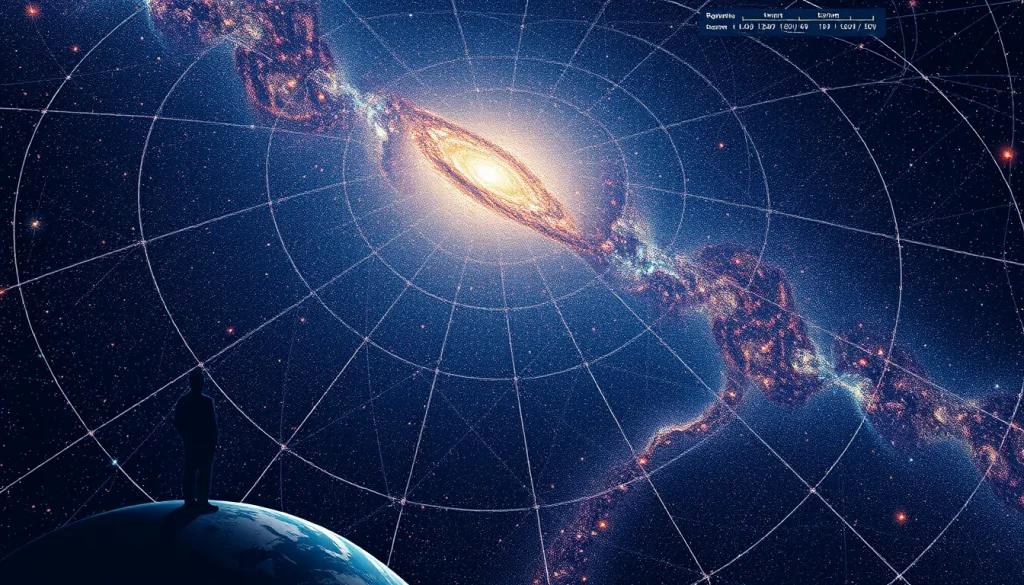
The Copernican principle and the cosmological principle are twin pillars of modern cosmology. They answer a deceptively simple question: is our place in the universe special? The Copernican principle says no — we are not privileged observers. The cosmological principle goes further, asserting that on sufficiently large scales, the universe looks the same everywhere and in every direction. These ideas are not just philosophical curiosities; they are testable assumptions that underpin the Big Bang model and our entire picture of cosmic evolution.
Comparison: Copernican vs. Cosmological Principle
Quick Comparison
Both principles reject the idea of a special location or direction in the cosmos. The Copernican principle is the more general statement about the lack of a privileged observer; the cosmological principle is its concrete application to the large-scale structure of the universe. In practice, the cosmological principle is what allows us to extrapolate local physics to the entire cosmos.
Table
| Aspect | Copernican Principle | Cosmological Principle |
|---|---|---|
| Core claim | Humans are not privileged observers; Earth is not central. | The universe is homogeneous and isotropic on large scales. |
| Scope | Applies to any observer’s viewpoint. | Applies to spatial distribution of matter. |
| Origin | Named after Copernicus, rooted in the 16th–17th century shift from geocentrism. | Formalized in the 20th century as a working assumption of cosmology. |
| Observational basis | Planetary motion explained by heliocentrism. | Uniformity of the cosmic microwave background and galaxy distribution. |
| Consequences | No special reference frame. | Leads to the Friedmann–Lemaître–Robertson–Walker metric. |
Similarities
Both principles assert that there is no preferred location in the universe. They are both philosophical assumptions that have been validated by observations. They also both imply that the laws of physics we measure locally apply everywhere.
Differences
The Copernican principle is broader — it says no observer is special. The cosmological principle is a specific statistical statement about the large-scale distribution of matter: homogeneity (same density everywhere) and isotropy (same in every direction). The cosmological principle is stronger because it assumes a particular geometric property of space.
Historical Context
Copernicus’s heliocentric model removed Earth from the center of the solar system, a radical shift in human perspective. The cosmological principle emerged in the 20th century as cosmologists sought to simplify Einstein’s equations. Hermann Bondi named the Copernican principle in the mid-20th century, while the cosmological principle was popularized by figures like Edward Milne and Willem de Sitter.
Which Model Is Accepted Today?
Both are accepted as working assumptions in the standard Lambda-CDM model. Observations of the cosmic microwave background (CMB) show temperature fluctuations of only one part in 100,000, confirming isotropy. Galaxy surveys, such as the Sloan Digital Sky Survey, confirm homogeneity on scales larger than about 300 million light-years. No credible evidence contradicts these principles on large scales.
The Cosmic Epochs
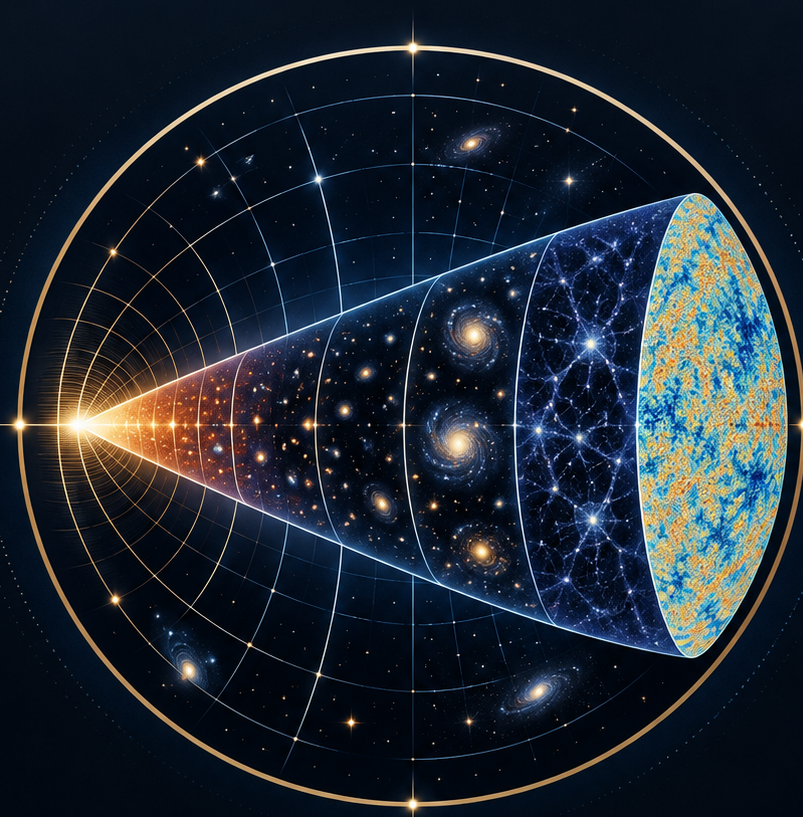
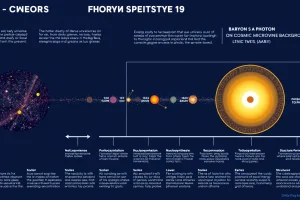
The cosmological principle allows us to describe the entire universe with a single evolving scale factor. This leads to the standard Big Bang timeline, from the Planck epoch to the present. Each epoch is characterized by a dominant physical process and a specific temperature and redshift.
When It Happened
The cosmic timeline spans from the Planck epoch (t < 10⁻⁴³ seconds) to the present (13.8 billion years). Key epochs include the Grand Unification epoch, Inflation, Electroweak, Quark, Hadron, Lepton, Photon, Recombination, Dark Ages, Reionization, and Structure Formation.
Temperature
Temperatures range from the Planck temperature (~10³² K) down to the current CMB temperature of 2.725 K. During inflation, the universe cooled dramatically, and after recombination, it cooled to about 3000 K, allowing atoms to form.
Approximate Redshift
Redshift z decreases from essentially infinite at the Big Bang to z=0 today. Recombination occurred at z≈1100, and the CMB we observe today is a relic from that epoch. Reionization began around z≈10–20, and structure formation has continued ever since.
Dominant Particles/Physics
In the earliest epochs, the universe was a hot soup of quarks, leptons, and bosons. As it cooled, quarks combined into protons and neutrons (Hadron epoch), then leptons dominated, and finally photons became the dominant energy density. After recombination, neutral atoms formed and gravity took over, leading to the formation of stars and galaxies.
What Happened
Here is a brief timeline:
| Epoch | Time | Temperature | Key Events |
|---|---|---|---|
| Planck | < 10⁻⁴³ s | > 10³² K | Quantum gravity effects; no current theory. |
| Grand Unification | 10⁻⁴³ – 10⁻³⁶ s | 10²⁷ – 10³² K | Fundamental forces unify; inflation begins. |
| Inflation | 10⁻³⁶ – 10⁻³² s | ~10²⁷ K | Exponential expansion; seeds for structure. |
| Electroweak | 10⁻³² – 10⁻¹² s | 10¹⁵ – 10²⁷ K | Electromagnetic and weak forces separate. |
| Quark | 10⁻¹² – 10⁻⁶ s | 10¹² – 10¹⁵ K | Quarks and gluons form a plasma. |
| Hadron | 10⁻⁶ – 1 s | 10¹⁰ – 10¹² K | Protons and neutrons form; matter-antimatter asymmetry. |
| Lepton | 1 – 10 s | 10⁹ – 10¹⁰ K | Leptons dominate; neutrinos decouple. |
| Photon | 10 s – 380,000 yr | 3000 – 10⁹ K | Photons dominate; nucleosynthesis occurs. |
| Recombination | ~380,000 yr | ~3000 K | Electrons combine with protons; CMB released. |
| Dark Ages | 380,000 – 150 million yr | ~10 – 3000 K | No stars yet; universe filled with neutral hydrogen. |
| Reionization | 150 million – 1 billion yr | ~10 – 100 K | First stars and galaxies ionize hydrogen. |
| Structure Formation | 1 billion yr – present | 2.725 K today | Galaxies, clusters, and large-scale structure form. |
What Came Before
Before the Planck epoch, our current physics breaks down. The Big Bang model does not describe the initial singularity; it simply starts from that point. Inflation is thought to have occurred just after the Planck epoch, smoothing and flattening the universe.
What Came Next
After Recombination, the universe became transparent. The CMB is the oldest light we can observe, and it provides a snapshot of the universe at that time. The Dark Ages followed, and then the first stars ignited, leading to Reionization and eventually the rich structure we see today.
Evidence
The cosmic microwave background, measured by COBE, WMAP, and Planck, matches the predicted blackbody spectrum and temperature anisotropies. Big Bang nucleosynthesis correctly predicts the abundances of light elements (hydrogen, helium, lithium). Large-scale galaxy surveys confirm the growth of structure. The James Webb Space Telescope is now probing the epoch of Reionization, revealing the first galaxies.
Why It Matters
The Copernican and cosmological principles are not just abstract ideas — they are the foundation of the standard model of cosmology. Without them, we could not extrapolate local physics to the entire universe. They allow us to interpret the CMB as a relic of the Big Bang, to calculate the expansion rate, and to model the formation of galaxies. They also carry a profound philosophical message: we are not the center of the cosmos, but we are part of a universe that is knowable and governed by universal laws.
Evidence / Sources
The evidence for these principles comes from multiple independent observations. The isotropy of the CMB, measured to one part in 100,000, is the strongest proof of the cosmological principle. The homogeneity of galaxy distribution on large scales, as seen in surveys like SDSS, confirms that no special direction or location exists. The Copernican principle is also supported by the success of the standard model in explaining everything from nucleosynthesis to the acoustic peaks in the CMB power spectrum.
Related Registry Entries
This article is part of a series on the foundations of cosmology. Explore related entries on the Big Bang, cosmic inflation, recombination, and the cosmic microwave background to deepen your understanding.
FAQ
Is the Copernican principle the same as the cosmological principle?
No. The Copernican principle is broader: it states that humans are not privileged observers. The cosmological principle is a specific application that says the universe looks the same everywhere and in every direction on large scales.
Why is the cosmological principle important for the Big Bang model?
It allows us to use the same physical laws everywhere and to describe the universe with a single expanding scale factor. Without it, we could not interpret the cosmic microwave background or the expansion of galaxies as evidence for the Big Bang.
What evidence supports the cosmological principle?
The cosmic microwave background is highly isotropic (fluctuations of only 1 part in 100,000), and galaxy surveys show that matter is uniformly distributed on scales larger than about 300 million light-years.
Leave a Reply