
Short Answer
Main Explanation
In the first few seconds after the Big Bang, the universe was an incredibly hot and dense soup of fundamental particles. Among these were protons and neutrons, the building blocks of atomic nuclei. Their relative abundance—the neutron-to-proton ratio—was not arbitrary; it was dictated by the laws of physics and the expanding, cooling universe. This ratio plays a pivotal role in Big Bang nucleosynthesis (BBN), the process that forged the first light elements. Understanding it is essential for explaining why the universe today is composed of roughly 75% hydrogen and 25% helium by mass, with only trace amounts of other elements.
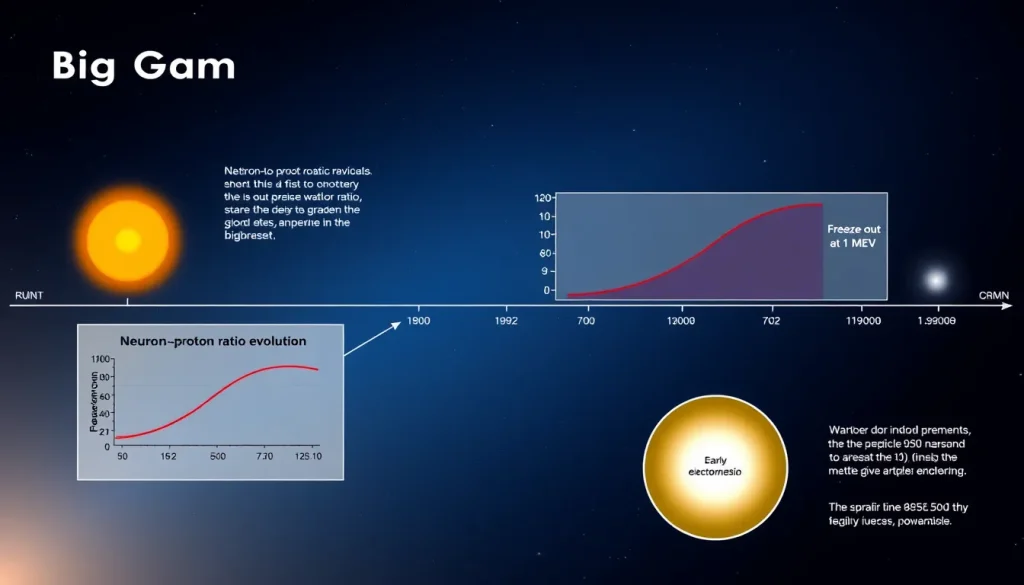
As the universe expanded and cooled, interactions among particles changed. At temperatures above a few MeV (million electron volts), weak nuclear forces kept neutrons and protons in thermal equilibrium, converting one into the other through reactions such as n + e⁺ ⇌ p + ν̄ₑ and p + e⁻ ⇌ n + νₑ. The balance between these reactions depended on the tiny mass difference between the neutron and proton—about 1.29 MeV—which slightly favored the lighter proton. When the temperature dropped below roughly 1 MeV, these weak interactions became too slow to keep pace with the expansion, and the neutron-to-proton ratio “froze out” at a value of about 1/6. From that moment, free neutrons began to decay (with a half-life of about 880 seconds), further lowering the ratio before nucleosynthesis could begin.
The frozen-out ratio directly determines how much helium-4 is produced. Because nearly all neutrons are incorporated into helium-4 nuclei during BBN, the helium mass fraction is approximately twice the neutron-to-proton ratio at the time of nucleosynthesis. This simple relationship makes the neutron-to-proton ratio a critical parameter for predicting the primordial abundances of light elements, which can be compared with observations to validate our cosmological model.
The Neutron-to-Proton Ratio: A Cosmic Yardstick
Definition
The neutron-to-proton ratio, denoted n/p, is the number density of free neutrons divided by that of free protons in the early universe. It is a dimensionless quantity that evolves with temperature and time, and its value at the onset of nucleosynthesis sets the stage for element formation.
How It Works
In the radiation-dominated era (tens of milliseconds to a few seconds), the universe was filled with photons, neutrinos, electrons, positrons, and nucleons. Charged-current weak interactions—n + e⁺ ⇌ p + ν̄ₑ, p + e⁻ ⇌ n + νₑ, and n ⇌ p + e⁻ + ν̄ₑ—kept neutrons and protons in chemical equilibrium. As long as these reactions occurred rapidly, the relative abundances followed a Boltzmann distribution based on the mass difference Δm = (mₙ − mₚ) = 1.29 MeV. The equilibrium ratio is given by n/p = exp(−Δm c² / kT) = exp(−1.5 / T₁₀), where T₁₀ is the temperature in units of 10¹⁰ K.
As the universe expanded, the temperature fell. The weak interaction rate (Γ) scales as T⁵, while the expansion rate (H) scales as T². When Γ dropped below H—around a temperature of ~1 MeV (approximately 1.2 × 10¹⁰ K)—the reactions could no longer maintain equilibrium. This “freeze-out” occurred at a temperature where the neutron-to-proton ratio was about 1/6. After freeze-out, the ratio evolved only through neutron β-decay, which reduced it to roughly 1/7 by the time nucleosynthesis began at t ≈ 100–200 seconds.
Equation
The equilibrium neutron-to-proton ratio is:
n/p = exp(−Δm c² / kT) = exp(−1.5 / T₁₀)
where T₁₀ = T / 10¹⁰ K. At freeze-out (T ~ 1 MeV, T₁₀ ~ 1.2), this gives n/p ≈ 0.27 (about 1/4). After neutron decay for ~100 seconds, the effective ratio at the start of nucleosynthesis is closer to 1/7.
Example
Suppose the temperature of the universe is 10¹⁰ K (T₁₀ = 1). The equilibrium ratio is exp(−1.5) ≈ 0.22, meaning there are roughly four protons for every neutron. If the temperature drops to 0.5 × 10¹⁰ K (T₁₀ = 0.5), the ratio becomes exp(−3) ≈ 0.05, heavily favoring protons. This exponential sensitivity explains why the freeze-out temperature is so crucial.
Observable Consequences
The neutron-to-proton ratio directly controls the primordial helium-4 abundance. In standard BBN, essentially all neutrons that survive to nucleosynthesis are incorporated into ⁴He, so the helium mass fraction Yₚ ≈ 2(n/p) / (1 + n/p). With n/p ≈ 1/7 at nucleosynthesis, Yₚ ≈ 0.25, matching observations of extremely metal-poor gas clouds. The ratio also affects the production of deuterium (D), ³He, and ⁷Li, albeit in more complex ways. These predicted abundances form a powerful consistency test: the same cosmic baryon density that fits the cosmic microwave background (CMB) also predicts the observed light-element abundances.
Common Misconceptions
- Misconception: The neutron-to-proton ratio is constant throughout the early universe.
Fact: It evolves with temperature and time, freezing out at ~1 MeV and then declining due to neutron decay. - Misconception: The ratio is determined by the strong nuclear force.
Fact: It is set by the weak force, which governs the interconversion of neutrons and protons. - Misconception: The ratio is irrelevant for elements heavier than helium.
Fact: While heavier elements are mostly made in stars, the neutron-to-proton ratio sets the initial conditions for all primordial nuclei.
Timeline of Cosmic Epochs
The neutron-to-proton ratio is intimately tied to the sequence of cosmic epochs. The table below summarizes the key stages from the Planck epoch to structure formation, with approximate times, temperatures, and dominant physics.
| Epoch | Time | Temperature | Key Events |
|---|---|---|---|
| Planck epoch | < 10⁻⁴³ s | > 10³² K | Quantum gravity regime; no current physics |
| Grand Unification epoch | 10⁻⁴³ – 10⁻³⁶ s | 10³² – 10²⁸ K | Unified forces; possible inflation trigger |
| Inflationary epoch | 10⁻³⁶ – 10⁻³² s | ~10²⁸ K | Exponential expansion; seeds for structure |
| Electroweak epoch | 10⁻³² – 10⁻¹² s | 10²⁸ – 10¹⁵ K | Electromagnetic and weak forces separate |
| Quark epoch | 10⁻¹² – 10⁻⁶ s | 10¹⁵ – 10¹² K | Quarks and gluons; no free quarks yet |
| Hadron epoch | 10⁻⁶ – 1 s | 10¹² – 10¹⁰ K | Protons and neutrons form; annihilation of baryons |
| Lepton epoch | 1 – 10 s | 10¹⁰ – 10⁹ K | Neutrinos decouple; neutron/proton ratio freezes |
| Photon epoch | 10 s – 380,000 yr | 10⁹ – 3000 K | Nucleosynthesis; photons dominate |
| Recombination | ~380,000 yr | ~3000 K | Electrons bind to nuclei; CMB released |
| Dark Ages | 380,000 – ~150 million yr | 3000 – ~50 K | No stars yet; neutral hydrogen |
| Reionization | ~150 million – 1 billion yr | ~50 – 20 K | First stars and galaxies ionize hydrogen |
| Structure Formation | 1 billion yr – present | < 20 K | Galaxies, clusters, large-scale structure |
Why It Matters
The neutron-to-proton ratio is not just a historical curiosity; it is a cornerstone of modern cosmology. Its value, set by weak interactions and freeze-out, determines the primordial helium abundance, which in turn affects the evolution of stars, galaxies, and the intergalactic medium. Moreover, BBN provides one of the earliest and most precise probes of the universe’s baryon density. The agreement between the baryon density inferred from the CMB (by missions like COBE, WMAP, and Planck) and that required to match primordial deuterium and helium abundances is a major triumph of the ΛCDM model. Any discrepancy would signal new physics—such as additional neutrino species, a varying gravitational constant, or non-standard expansion history.
Furthermore, the neutron-to-proton ratio is a beautiful example of how microphysics (weak interactions) and cosmology (expansion rate) intertwine. It demonstrates that the universe’s large-scale composition—the very atoms that form us—was set in the first few minutes after the Big Bang. Understanding this ratio helps us appreciate the fine-tuning that made life possible, as a slightly different ratio would have led to a universe dominated by hydrogen or helium, with radically different astrophysics.
Evidence / Sources
The predictions of BBN, based on the neutron-to-proton ratio, are confirmed by observations of primordial light-element abundances. Astronomers measure the helium and deuterium fractions in metal-poor dwarf galaxies and high-redshift quasar absorption systems, finding values consistent with the standard model. The cosmic microwave background, first detected by Penzias and Wilson (1965) and mapped with increasing precision by COBE (1989), WMAP (2001), and Planck (2009), provides an independent measurement of the baryon density. The consistency between the CMB-derived baryon density and that required by BBN is a key piece of evidence for the hot Big Bang model.
Sources used in this article:
- Pettini, M. “Introduction to Cosmology — Lecture 8: Primordial Nucleosynthesis.” University of Cambridge. Link
- Langer, N. “Nucleosynthesis.” Bonn University, 2012. Link
- Steigman, G. “Primordial Alchemy: From The Big Bang To The Present Universe.” Link
- “Nucleosynthesis and the Early Universe.” Cosmology course notes, Stockholm University. Link
Related Registry Entries
This article is part of a series on the early universe. See also:
- Big Bang Nucleosynthesis: The First Three Minutes
- The Cosmic Microwave Background: A Relic of Recombination
- The Inflationary Universe: Seeds of Structure
- Cosmic Timeline: From Planck to Present
FAQ
Why does the neutron-to-proton ratio freeze out at around 1 MeV?
The weak interaction rate (Γ ≈ T⁵) drops faster than the Hubble expansion rate (H ≈ T²) as the universe cools. When Γ < H, the reactions can no longer maintain equilibrium, and the ratio becomes fixed. This occurs at a temperature of roughly 1 MeV.
How does the neutron-to-proton ratio affect the helium abundance?
Almost all neutrons that survive to nucleosynthesis are incorporated into ⁴He nuclei. The helium mass fraction is approximately 2(n/p)/(1+n/p). With n/p ≈ 1/7, this gives Yₚ ≈ 0.25, matching observations.
What would happen if the neutron-to-proton ratio were different?
A higher ratio would produce more helium and less hydrogen, altering stellar evolution and the CMB. A lower ratio would result in a hydrogen-dominated universe with very little helium, also changing the course of cosmic structure formation.


Leave a Reply