
Short Answer
Main Explanation
Baryogenesis is the collective term for the physical processes that, in the very early universe, produced a net excess of baryons (particles like protons and neutrons) over antibaryons. This asymmetry, known as the baryon asymmetry or matter–antimatter asymmetry, is one of the deepest unsolved problems in cosmology. Observations show that the observable universe is composed almost entirely of matter, with antimatter appearing only in tiny, transient amounts. The standard model of particle physics and general relativity offer no explanation for this imbalance, so cosmologists look to new physics operating in the first instants after the Big Bang.
What Is Baryogenesis?
In physical cosmology, baryogenesis refers to any hypothetical mechanism that generates a net baryon number from an initially symmetric state. The term comes from the Greek barys (heavy) and genesis (origin). The observed ratio of baryons to photons is about 6 × 10⁻¹⁰, meaning that for every billion photons there is roughly one baryon. If the early universe had been perfectly symmetric, matter and antimatter would have annihilated completely, leaving only radiation. The fact that we exist implies that a tiny but crucial asymmetry was created during the first moments of cosmic history.
The Sakharov Conditions
In 1967, the Soviet physicist Andrei Sakharov identified three necessary conditions that any baryon-generating interaction must satisfy:

- Baryon number violation: The process must change the total number of baryons.
- C and CP violation: The process must treat particles and antiparticles differently, and also violate charge-parity symmetry.
- Departure from thermal equilibrium: The universe must not be in perfect thermal equilibrium, otherwise any produced asymmetry would be washed out by inverse processes.
These conditions are necessary but not sufficient; a complete theory must also explain the magnitude of the asymmetry. The standard model of particle physics contains sources of CP violation and baryon-number violation (via sphalerons), but the effects are far too small to account for the observed asymmetry. This is why baryogenesis is considered to require physics beyond the Standard Model.
The Cosmic Epochs
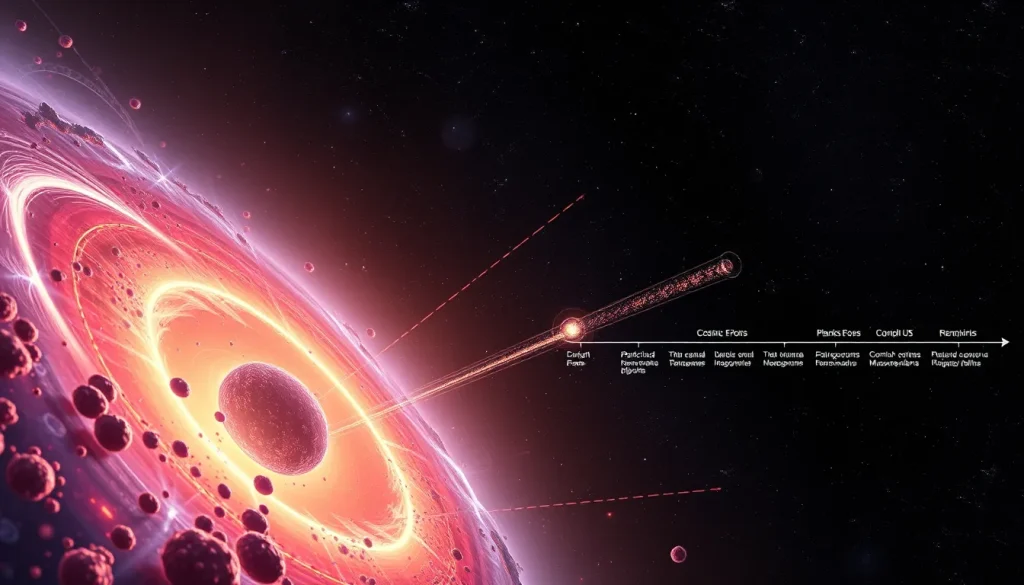
Baryogenesis would have occurred during the earliest moments of the universe, but to understand its context we must survey the full sequence of cosmic epochs, from the Planck epoch to the formation of large-scale structure. The following table summarizes these stages:
| Epoch | Time after Big Bang | Approximate Temperature | Key Events |
|---|---|---|---|
| Planck epoch | < 10−43 s | > 1032 K | Quantum gravity effects dominate; no known physics describes this era. |
| Grand Unification epoch | 10−43 to 10−36 s | 1032 to 1028 K | GUT forces unify; potential baryogenesis via X boson decay. |
| Inflationary epoch | 10−36 to 10−32 s | Dropping rapidly | Exponential expansion smooths and flattens the universe; quantum fluctuations seed structure. |
| Electroweak epoch | 10−32 to 10−12 s | 1028 to 1015 K | Electromagnetic and weak forces separate; sphaleron processes may generate baryon asymmetry. |
| Quark epoch | 10−12 to 10−6 s | 1015 to 1012 K | Quarks and gluons form a quark-gluon plasma; baryogenesis likely completed. |
| Hadron epoch | 10−6 to 1 s | 1012 to 1010 K | Quarks combine into hadrons; protons and neutrons form, annihilating with antiprotons. |
| Lepton epoch | 1 to 10 s | 1010 to 109 K | Leptons and antileptons dominate; neutrinos decouple. |
| Photon epoch | 10 s to 380,000 years | 109 to 3000 K | Photons dominate; nucleosynthesis creates light elements; universe is a hot plasma. |
| Recombination | ~380,000 years | ~3000 K | Electrons combine with nuclei to form neutral atoms; photons decouple, releasing the cosmic microwave background. |
| Dark Ages | 380,000 to ~150 million years | 3000 to ~50 K | No stars yet; universe is dark except for the CMB; density fluctuations grow. |
| Reionization | ~150 million to ~1 billion years | ~50 to ~10 K | First stars and galaxies form; their ultraviolet light reionizes the intergalactic medium. |
| Structure Formation | ~1 billion years to present | Dropping to 2.7 K | Gravity amplifies density fluctuations; galaxies, clusters, and large-scale structure emerge. |
Baryogenesis is most often associated with the Grand Unification epoch or the Electroweak epoch, but the exact timing remains unknown. The success of cosmic inflation and the search for supersymmetry have focused attention on scenarios such as electroweak baryogenesis and leptogenesis, which operate at different energy scales.
The Core Question: Why Matter Dominates
Short Answer
Matter dominates antimatter because a tiny asymmetry was created in the early universe — about one extra baryon per billion antibaryons — and the rest annihilated. The underlying mechanism is baryogenesis, which requires physics beyond the Standard Model.
What We Know
We know from cosmic microwave background measurements and primordial nucleosynthesis that the baryon-to-photon ratio is about 6 × 10⁻¹⁰. We also know that the universe is overwhelmingly matter, not antimatter, based on the absence of annihilation radiation at galaxy-cluster scales. The Sakharov conditions provide the framework for any baryogenesis scenario.
What We Don’t Know
The exact mechanism of baryogenesis remains unknown. The Standard Model does not provide enough CP violation, and its electroweak phase transition is not strongly first-order, so it cannot generate the observed asymmetry. We also do not know whether the asymmetry was produced by decays of heavy particles, by sphaleron processes, or by leptogenesis.
Evidence
Evidence for the asymmetry comes from several independent observations: the cosmic microwave background (CMB) temperature anisotropies measured by COBE, WMAP, and Planck; the primordial abundances of light elements (hydrogen, helium, lithium) predicted by Big Bang nucleosynthesis; and the absence of gamma-ray emission from matter-antimatter annihilation in galaxy clusters. The CMB also provides a snapshot of the universe at recombination, confirming the baryon density.
Competing Explanations
Competing scenarios for baryogenesis include electroweak baryogenesis (using the electroweak phase transition), GUT baryogenesis (from grand unified theories), leptogenesis (where lepton asymmetry is converted to baryon asymmetry), and Affleck–Dine mechanism from supersymmetry. Each has strengths and weaknesses, but none is experimentally confirmed.
Current Research
Current research focuses on searching for new sources of CP violation in particle physics, probing the properties of neutrinos (which could support leptogenesis), and studying the detailed polarization of the CMB. Future missions and experiments, such as the Simons Observatory and SPHEREx, aim to refine measurements of the early universe and test inflationary models that may be connected to baryogenesis.
Why It Matters
Baryogenesis is not merely an academic puzzle; it explains why the universe contains any matter at all. Without a mechanism to create a tiny excess of matter over antimatter, the universe would be a sea of radiation with no stars, planets, or life. Understanding baryogenesis also connects cosmology with particle physics, offering a window into physics at energies far beyond any terrestrial collider. The asymmetry is a fundamental parameter of our universe, and its value is encoded in the cosmic microwave background and the abundances of elements. Solving the mystery would represent a major triumph for fundamental physics.
Evidence / Sources
The observational evidence for the matter–antimatter asymmetry and the baryon density comes from multiple sources. The cosmic microwave background, first detected by Penzias and Wilson in 1965 and mapped with increasing precision by COBE, WMAP, and the Planck satellite, provides the most accurate measurement of the baryon density. Big Bang nucleosynthesis, which predicts the primordial abundances of helium-4, deuterium, and lithium, independently constrains the baryon-to-photon ratio. The absence of annihilation radiation from galaxy clusters rules out large antimatter domains. These observations together support the Lambda-CDM model, which assumes a matter-dominated universe with a small baryon asymmetry.
Related Registry Entries
Explore related topics in our cosmic timeline: Cosmic Inflation, Big Bang Nucleosynthesis, Cosmic Microwave Background, Dark Ages, and Reionization.
FAQ
Why is there more matter than antimatter?
The universe began with equal amounts, but a tiny asymmetry was created during baryogenesis, leaving about one extra baryon per billion antibaryons. The rest annihilated, leaving the matter we see today.
What are the Sakharov conditions?
They are three requirements for baryogenesis: baryon number violation, C and CP violation, and a departure from thermal equilibrium. These were proposed by Andrei Sakharov in 1967.
What is the evidence for baryogenesis?
The primary evidence is the observed baryon-to-photon ratio, measured from the cosmic microwave background and primordial nucleosynthesis. The absence of annihilation radiation also indicates a matter-dominated universe.
Could the Standard Model explain baryogenesis?
No. The Standard Model's CP violation is too small, and its electroweak phase transition is not strongly first-order, so it cannot generate the observed asymmetry.
What are the leading theories for baryogenesis?
Leading scenarios include electroweak baryogenesis, GUT baryogenesis, leptogenesis, and the Affleck-Dine mechanism. None has been confirmed experimentally.


Leave a Reply