
Short Answer
Main Explanation
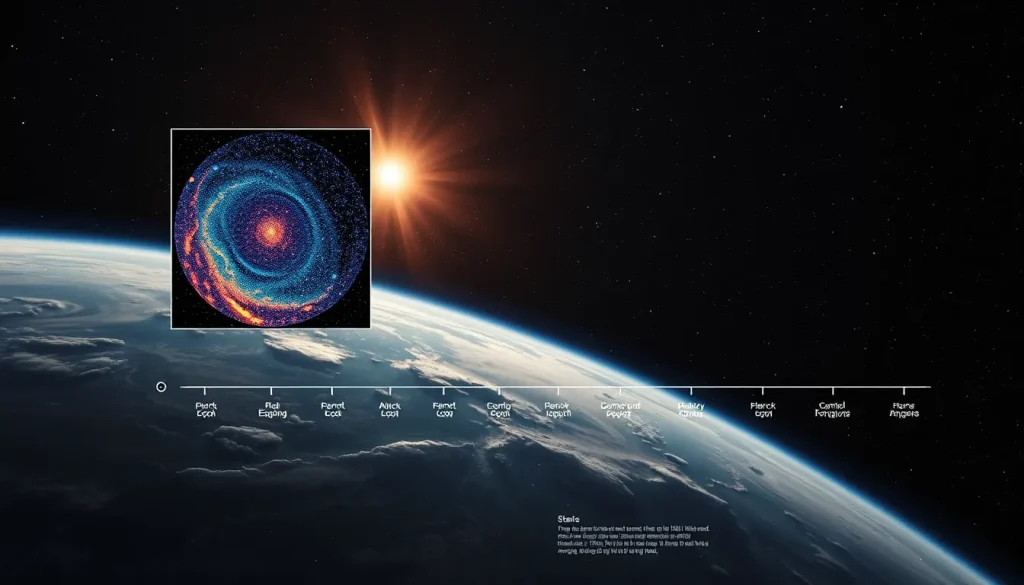
The Planck mission, operated by the European Space Agency (ESA), was one of the most ambitious space observatories ever launched. Its primary goal was to measure the cosmic microwave background (CMB) — the relic radiation from the Big Bang — with extraordinary accuracy. By charting minuscule temperature variations in this ancient light, Planck provided a definitive picture of the universe when it was just 380,000 years old, and revealed the seeds that grew into today’s galaxies and clusters.
The Cosmic Microwave Background: A Fossil of the Big Bang
About 380,000 years after the Big Bang, the universe had cooled enough for protons and electrons to combine into neutral hydrogen. This process, called recombination, allowed photons to travel freely for the first time. Those photons, stretched by the expansion of space over 13.8 billion years, now appear as microwaves with a temperature of about 2.7 K. The CMB is not perfectly uniform; it contains tiny temperature fluctuations (a few parts per million) that correspond to density variations — the seeds of all cosmic structure.
Planck’s detectors were so sensitive that they could distinguish temperature differences of a few millionths of a degree. Its large, smooth telescope and broad wavelength coverage allowed it to produce the most accurate all-sky CMB map ever made, as described in the ESA Planck science highlights.

Planck’s Key Findings
- An almost perfect universe: The CMB fluctuations matched the predictions of the inflationary Lambda-CDM model with remarkable precision, as reported in the ESA announcement from 2013.
- A new cosmic recipe: Planck determined that ordinary matter makes up about 5% of the universe, dark matter about 27%, and dark energy about 68%.
- Age of the universe: Planck pinned down the age as 13.8 billion years (with an uncertainty of about 20 million years).
- Inflation support: The measured pattern of fluctuations is consistent with a brief period of exponential expansion in the first fraction of a second.
The Cosmic Epochs: A Timeline
Planck’s data, combined with other observations, allow us to reconstruct the major phases of cosmic history. The table below summarizes these epochs, from the very beginning to the present.
| Epoch | Time After Big Bang | Temperature | Key Events |
|---|---|---|---|
| Planck epoch | < 10-43 s | > 1032 K | All four fundamental forces unified; quantum gravity dominates. |
| Grand Unification epoch | 10-43 to 10-36 s | 1032 to 1028 K | Strong force separates from electroweak force. |
| Inflationary epoch | 10-36 to 10-32 s | Dropping rapidly | Exponential expansion smooths the universe and seeds density fluctuations. |
| Electroweak epoch | 10-32 to 10-12 s | 1028 to 1015 K | Electromagnetic and weak forces separate. |
| Quark epoch | 10-12 to 10-6 s | 1015 to 1012 K | Quarks and gluons form a quark-gluon plasma. |
| Hadron epoch | 10-6 to 1 s | 1012 to 1010 K | Protons and neutrons form; matter-antimatter annihilation leaves a small excess of matter. |
| Lepton epoch | 1 to 10 s | 1010 to 109 K | Leptons dominate; neutrinos decouple. |
| Photon epoch | 10 s to 380,000 yr | 109 to 3000 K | Photons are tightly coupled to matter; primordial nucleosynthesis creates light elements. |
| Recombination | ~380,000 yr | ~3000 K | Electrons combine with protons to form hydrogen; CMB is released. |
| Dark Ages | 380,000 yr to ~150 million yr | 3000 to ~60 K | No stars yet; neutral hydrogen fills the universe. |
| Reionization | ~150 million to ~1 billion yr | ~60 to ~20 K | First stars and galaxies form, emitting ultraviolet light that reionizes hydrogen. |
| Structure Formation | ~1 billion yr to present | Dropping to 2.7 K | Galaxies, clusters, and large-scale structure grow via gravitational collapse. |
Planck’s measurements of the CMB provide direct evidence for the epochs up to recombination, and its data on the lensing of CMB photons by matter constrain structure formation at later times.
Planck Mission: Key Facts and Legacy
Mission Facts
- Operator: European Space Agency (ESA)
- Launch: 14 May 2009 on an Ariane 5 rocket
- Duration: 4.5 years of scanning the sky
- End of mission: October 2013 (coolant exhausted)
Launch and Orbit
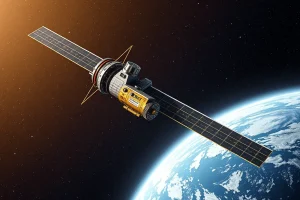
Planck was launched together with the Herschel Space Observatory. It was placed in a Lissajous orbit around the Sun-Earth L2 Lagrange point, about 1.5 million km from Earth, where the thermal environment is stable and the view of the sky is unobstructed.
Telescope and Instruments
Planck carried a 1.5-meter off-axis telescope and two instruments: the Low Frequency Instrument (LFI) covering 30–70 GHz and the High Frequency Instrument (HFI) covering 100–857 GHz. The detectors were cooled to temperatures as low as 0.1 K to achieve extreme sensitivity.
Wavelength Coverage
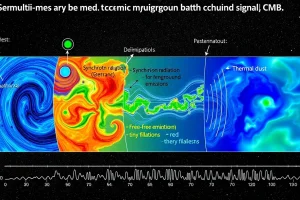
Planck observed in nine frequency bands, from 30 to 857 GHz, spanning microwave to far-infrared wavelengths. This allowed it to separate the CMB from foreground emission from dust and synchrotron radiation in our galaxy.
Objective
The main objective was to measure the fluctuations of the CMB with accuracy set by fundamental astrophysical limits, producing the most precise CMB maps and cosmological parameters.
Major Results
- Most precise CMB temperature and polarization maps to date (2018 release).
- Determined the Hubble constant to be 67.4 km/s/Mpc (with tight uncertainty).
- Confirmed the spectral index of primordial fluctuations, consistent with inflation.
- Measured the optical depth to reionization, constraining the timing of first stars.
- Provided stringent limits on the curvature of the universe (flat within 0.2%).
Dataset
The final data release (Planck 2018) includes maps of temperature and polarization, as well as lensing maps and catalogs of galaxy clusters. The data are publicly available via the Planck Legacy Archive.
Legacy
Planck’s results established the standard model of cosmology with unprecedented precision. Its measurements of the CMB power spectrum and lensing have become the benchmark for cosmological research, complementing later missions like JWST and ground-based observatories.
Why It Matters
The Planck mission transformed our understanding of the universe’s origin and evolution. By providing a near-perfect picture of the early universe, it confirmed the broad strokes of the Big Bang model and the inflationary paradigm. It also sharpened key questions: the nature of dark matter and dark energy, the slight tension in the Hubble constant, and the details of reionization. Planck’s legacy is not just a dataset but a foundation for future cosmology.
Evidence / Sources
The information in this article is based on the following authoritative sources:
- ESA – Planck science highlights
- Planck 2018 results – I. Overview and the cosmological legacy of Planck (A&A 641, A1, 2020)
- ESA – Planck reveals an almost perfect Universe
Related Registry Entries
- Cosmic Microwave Background
- Inflation
- Recombination
- Dark Ages
- Reionization
- Lambda-CDM Model
Last Reviewed: September 5, 2026
FAQ
What did Planck measure exactly?
Planck measured the temperature and polarization of the cosmic microwave background across the entire sky, with sensitivity to variations of a few millionths of a degree. These measurements revealed the density fluctuations that seeded galaxy formation.
How did Planck confirm inflation?
Planck's measurements of the CMB power spectrum matched the predictions of inflationary theory, including the near-scale-invariant spectrum of primordial fluctuations and the flatness of the universe. It also placed limits on non-Gaussianity and tensor modes.
What is the significance of the Planck 2018 results?
The Planck 2018 data release provided the final and most accurate cosmological parameters, including the Hubble constant, matter density, and the optical depth to reionization. It remains the gold standard for CMB cosmology.
Leave a Reply