
Short Answer
Main Explanation
The cosmic microwave background (CMB) is the oldest light in the universe, released when the primordial plasma cooled enough for protons and electrons to combine into neutral hydrogen about 380,000 years after the Big Bang. That light is not perfectly uniform: it carries tiny temperature anisotropies and a faint linear polarization. Polarization arises from Thomson scattering of photons off free electrons just before recombination. The pattern of polarization across the sky can be decomposed into two independent components, called E-modes and B-modes. E-modes are the gradient-like, curl-free part; B-modes are the curl-like part. This decomposition is the spin-2 analog of splitting a vector field into a gradient and a curl.
B-modes occupy a special place in cosmology because scalar density perturbations—the dominant source of CMB temperature fluctuations—produce only E-modes at linear order. A primordial B-mode signal would therefore be a relatively clean signature of tensor perturbations, or gravitational waves, generated during cosmic inflation. Gravitational lensing by large-scale structure can also convert E-modes into B-modes, creating a secondary signal that must be carefully separated from any primordial contribution.
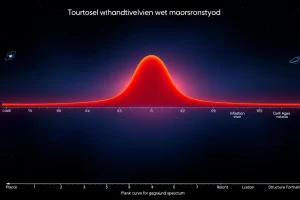
To place B-modes in context, the standard ΛCDM model describes a universe that passed through a sequence of epochs from the Planck era to the present. The table below summarizes the major cosmic epochs and their approximate times, temperatures, and redshifts.

| Epoch | Time after Big Bang | Temperature | Redshift | Key physics |
|---|---|---|---|---|
| Planck epoch | <10⁻⁴³ s | >10³² K | — | Quantum gravity; all forces possibly unified |
| Grand unification epoch | 10⁻⁴³–10⁻³⁶ s | ~10²⁹–10²⁷ K | — | Strong and electroweak forces may unify; inflation begins near end |
| Inflationary epoch | ~10⁻³⁶–10⁻³² s | ~10²⁷ K | ~10²⁸ | Rapid exponential expansion; quantum fluctuations stretched to cosmic scales, including tensor modes |
| Electroweak epoch | ~10⁻¹² s | ~10¹⁵ K | ~10¹⁵ | Electromagnetic and weak forces separate |
| Quark epoch | 10⁻¹²–10⁻⁶ s | 10¹⁵–10¹² K | — | Quarks, leptons, gluons form a hot plasma |
| Hadron epoch | 10⁻⁶–1 s | 10¹²–10¹⁰ K | — | Quarks bind into protons and neutrons |
| Lepton epoch | 1–10 s | 10¹⁰–10⁹ K | — | Leptons and antileptons dominate; neutrinos decouple |
| Photon epoch | 10 s–380,000 yr | 10⁹–3000 K | — | Radiation dominates; Big Bang nucleosynthesis creates light elements |
| Recombination | ~380,000 yr | ~3000 K | ~1100 | Protons and electrons combine into neutral hydrogen; CMB released |
| Dark Ages | 380,000 yr–~150 Myr | 3000–~60 K | 1100–~20 | Universe neutral and dark; no stars yet |
| Reionization | ~150 Myr–1 Gyr | ~60–20 K | ~20–6 | First stars and galaxies ionize intergalactic hydrogen |
| Structure formation | ~150 Myr–present | ~60–2.7 K | ~20–0 | Galaxies, clusters, and large-scale structure grow under gravity |
B-modes from inflation are generated by tensor perturbations that stretch across the sky. Because scalar perturbations cannot produce a curl component at linear order, a detection of primordial B-modes would be direct evidence for gravitational waves from the very early universe and would strongly support the inflationary hypothesis.
Definition
In CMB polarization, B-modes are the divergence-free, curl-like component of the linear polarization field. They are named by analogy with magnetic fields, which also have a curl but no divergence. E-modes, by contrast, are the gradient-like, curl-free component, analogous to electric fields.
How It Works
The CMB polarization is described by the Stokes parameters Q and U, which transform under rotation as a spin-2 field. By expanding Q and U in spin-weighted spherical harmonics, the polarization map separates into E-mode and B-mode coefficients. Scalar perturbations generate only E-modes because their polarization pattern has no handedness. Tensor perturbations—gravitational waves—produce both E- and B-modes, with a distinctive B-mode pattern that cannot be mimicked by scalar density fluctuations at linear order. Gravitational lensing by intervening matter shears E-mode patterns, leaking power into B-modes even in the absence of primordial tensor modes.
Equation
The decomposition can be written as:
(Q ± iU)(θ,φ) = Σ (aE,ℓm ± i aB,ℓm) ±2Yℓm(θ,φ)
where aE,ℓm and aB,ℓm are the E-mode and B-mode multipole coefficients, and ±2Yℓm are spin-2 spherical harmonics. The power spectra CℓBB and CℓEE then quantify the variance of each mode as a function of angular scale.
Example
A familiar example of the E/B distinction is a polarization pattern that is purely radial or tangential around a hot or cold spot: that is an E-mode. A pattern that swirls around a point—like a pinwheel—is a B-mode. Primordial gravitational waves would create such swirling patterns on large angular scales, while gravitational lensing creates smaller-scale B-modes by distorting E-modes from density fluctuations.
Observable Consequences
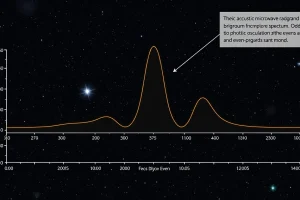
The primary observable consequence of primordial B-modes is a nonzero B-mode power spectrum at large angular scales (low multipoles ℓ). The amplitude is parameterized by the tensor-to-scalar ratio r, which compares the power of tensor perturbations to scalar perturbations. Current upper limits on r from CMB experiments constrain the energy scale of inflation. Lensing B-modes, on the other hand, peak at smaller angular scales and provide a map of the projected matter distribution.
Common Misconceptions
- B-modes are not a separate type of light. They are a pattern in the polarization of the same CMB photons.
- E and B do not stand for electric and magnetic fields. The names are borrowed from the mathematical analogy with curl-free and divergence-free vector fields.
- B-modes do not require magnetic fields. They can be produced by gravitational waves or by lensing, neither of which involves cosmic magnetic fields.
- Primordial B-modes are not the only B-modes. Gravitational lensing also generates B-modes, so a detection must distinguish the two.
Why It Matters
B-modes are one of the most sought-after signals in observational cosmology. A detection of primordial B-modes would be the first direct evidence of gravitational waves from inflation, confirming a key prediction of the inflationary paradigm and providing a window into physics at energy scales far beyond any terrestrial accelerator. The amplitude of the B-mode signal is directly related to the energy scale of inflation, so even upper limits constrain models of the very early universe. Lensing B-modes, meanwhile, offer a complementary probe of dark matter and the growth of large-scale structure. Together, E- and B-mode measurements turn the CMB into a powerful laboratory for testing the ΛCDM model from the Planck epoch to the present.
Evidence / Sources
The first detection of CMB polarization was made by the DASI experiment in 2002, confirming that the CMB is polarized at the level expected from Thomson scattering [3]. Subsequent experiments, including WMAP and Planck, mapped the E-mode polarization with high precision. The search for primordial B-modes has been a major focus of ground-based and space-based experiments. As reviewed by Kamionkowski and Kovetz, the canonical single-field slow-roll model of inflation predicts a nearly scale-invariant spectrum of tensor perturbations that would imprint B-modes on the CMB [2]. The mathematical decomposition of polarization into E and B modes is described in detail by Kwok et al., who emphasize the gradient/curl analogy [1]. Lensing-induced B-modes have been detected by high-resolution experiments, while primordial B-modes remain below current sensitivity limits.
Related Registry Entries
FAQ
What are B-modes in the CMB?
B-modes are the curl-like, divergence-free component of the cosmic microwave background polarization field. They are the spin-2 analog of the curl of a vector field and cannot be produced by scalar density perturbations at linear order.
Why are B-modes important for cosmology?
A detection of primordial B-modes would be direct evidence for gravitational waves generated during cosmic inflation, confirming a key prediction of the inflationary paradigm and constraining the energy scale of inflation.
How do B-modes differ from E-modes?
E-modes are gradient-like and curl-free, produced mainly by scalar density perturbations. B-modes are curl-like and divergence-free, produced by tensor perturbations or by gravitational lensing of E-modes.
Have primordial B-modes been detected?
As of current measurements, primordial B-modes have not been confirmed. Lensing-induced B-modes have been detected, but the primordial signal remains below experimental sensitivity limits.
What is the tensor-to-scalar ratio r?
The tensor-to-scalar ratio r compares the amplitude of primordial gravitational waves (tensor perturbations) to density fluctuations (scalar perturbations). It sets the expected amplitude of primordial B-modes and is tightly constrained by CMB experiments.

Leave a Reply