Short Answer
Main Explanation
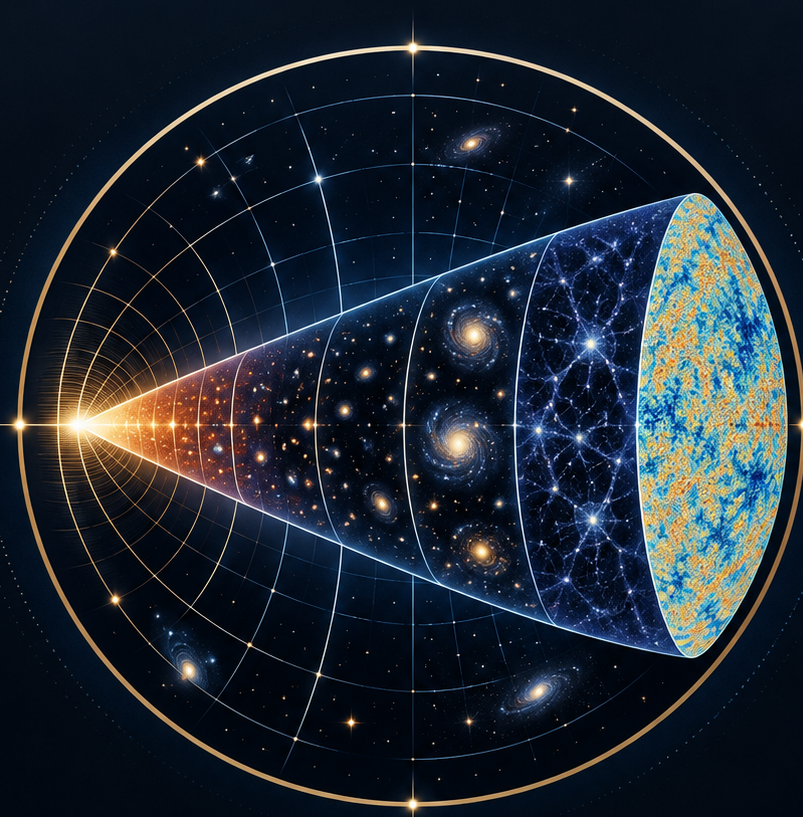
The Big Bang is not an explosion that occurred at a specific location in space. According to cosmological theory, the Big Bang happened everywhere at once. As the whole Universe was created in the Big Bang 13.7 billion years ago, the explosion took place literally everywhere, rather than at any specific place (BBC Science Focus). This is confirmed by the fact that the heat left over from the explosion—the cosmic microwave background (CMB)—is spread evenly over the entire sky, rather than being concentrated in one particular region.
The universe has no center and no edge. The Big Bang was the origin of space and time, not an event in a pre-existing space (New Scientist). If it were a conventional explosion, you could track debris back to a point, but instead the space between galaxies is increasing with time. The universe is isotropic and homogeneous—it looks the same in all directions—and every observer in any galaxy sees the universe expanding away from them, as if they were at the center. This is a consequence of the cosmological principle.
To understand where the Big Bang happened, we must think of space itself expanding. The Big Bang occurred at every point in space simultaneously. This is a difficult concept, but it is the standard model of cosmology.
| Property | Value |
|---|---|
| Age of universe | 13.8 billion years |
| CMB temperature | 2.725 K |
| Expansion rate (Hubble constant) | ~70 km/s/Mpc |
| Composition (ΛCDM) | ~5% ordinary matter, ~27% dark matter, ~68% dark energy |
Cosmic Epochs
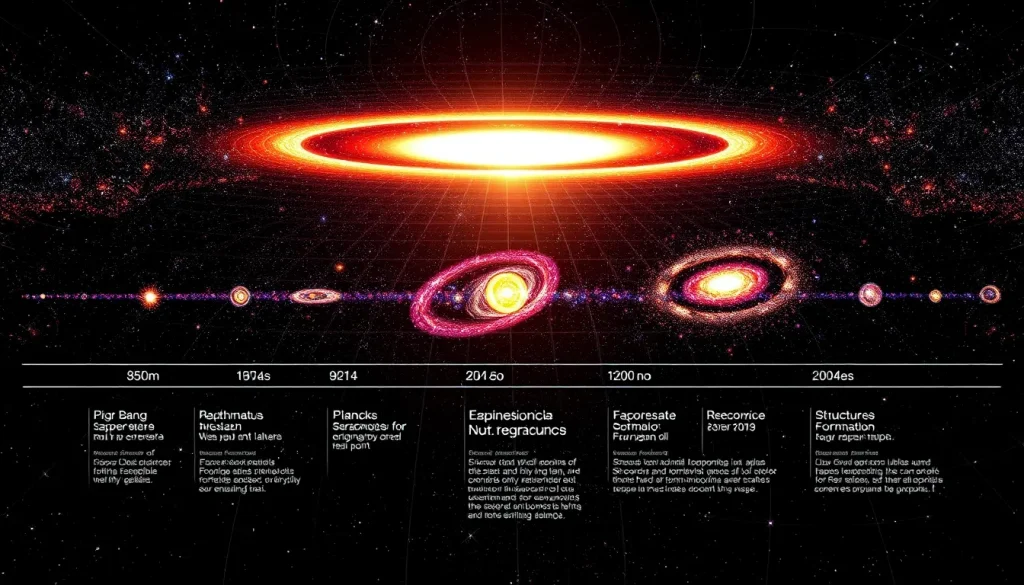
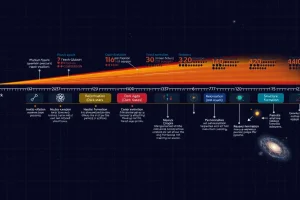
The history of the universe is divided into distinct epochs, each characterized by the dominant physical processes and particles. The following table summarizes the major epochs from the Planck epoch to the present.
| Epoch | Time after Big Bang | Temperature | Key Events |
|---|---|---|---|
| Planck epoch | 0 to 10^-43 s | >10^32 K | Quantum gravity effects dominate; all forces unified. |
| Grand Unification epoch | 10^-43 to 10^-36 s | 10^32 to 10^28 K | Strong force separates from electroweak. |
| Inflationary epoch | 10^-36 to 10^-32 s | ~10^28 K | Exponential expansion; seeds of structure formed. |
| Electroweak epoch | 10^-32 to 10^-12 s | 10^28 to 10^15 K | Electromagnetic and weak forces separate. |
| Quark epoch | 10^-12 to 10^-6 s | 10^15 to 10^12 K | Quarks and gluons form quark-gluon plasma. |
| Hadron epoch | 10^-6 to 1 s | 10^12 to 10^10 K | Protons and neutrons form; matter-antimatter annihilation. |
| Lepton epoch | 1 s to 10 s | 10^10 to 10^9 K | Leptons dominate; neutrinos decouple. |
| Photon epoch | 10 s to 380,000 years | 10^9 to 3000 K | Photons dominate; nucleosynthesis occurs. |
| Recombination | ~380,000 years | ~3000 K | Electrons combine with nuclei to form neutral atoms; CMB released. |
| Dark Ages | 380,000 to ~150 million years | 3000 to ~50 K | No stars yet; universe is dark and neutral. |
| Reionization | ~150 million to 1 billion years | ~50 to ~10 K | First stars and galaxies ionize hydrogen. |
| Structure Formation | 1 billion years to present | ~10 K to 2.7 K | Galaxies, clusters, and large-scale structure form. |
Planck Epoch and Inflation
The earliest moment, the Planck epoch, is beyond our current physics. Inflation, a period of exponential expansion, is thought to have occurred at ~10^-36 seconds, stretching quantum fluctuations to cosmic scales, providing the seeds for galaxies and the CMB’s uniformity.
Recombination and the Cosmic Microwave Background
At about 380,000 years, the universe cooled enough for electrons to combine with protons to form hydrogen atoms. This released the photons that we now observe as the CMB. The CMB is a relic of this epoch, and its near-perfect blackbody spectrum and tiny anisotropies provide strong evidence for the Big Bang model.
Dark Ages and Reionization
After recombination, the universe entered the Dark Ages, with no stars. The first stars and galaxies formed around 150 million years later, emitting ultraviolet light that reionized the intergalactic medium. This epoch is being probed by JWST.
Structure Formation
Over billions of years, gravity amplified the initial density fluctuations, forming galaxies, clusters, and the cosmic web. The large-scale structure of the universe is consistent with the ΛCDM model.
Why It Matters
Understanding where the Big Bang happened is fundamental to cosmology. It clarifies that the universe has no center, which is a common misconception. It also underscores the idea that the Big Bang is not an explosion in space but the origin of space and time. This has profound implications for our place in the cosmos and the ultimate fate of the universe.
Evidence / Sources
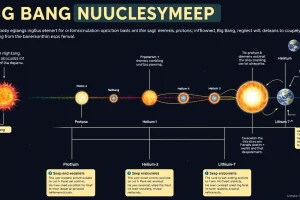
The standard model of cosmology is supported by multiple lines of evidence: the expansion of the universe (Hubble–Lemaître law), the cosmic microwave background (discovered by Penzias and Wilson, mapped by COBE, WMAP, and Planck), the primordial abundances of light elements (Big Bang nucleosynthesis), and the large-scale structure of galaxies. The uniformity of the CMB confirms that the Big Bang happened everywhere, not at a point.
Related Registry Entries
- Cosmic Microwave Background
- Inflation
- Recombination
- Reionization
- ΛCDM Model
Last Reviewed: September 4, 2026
FAQ
Did the Big Bang happen at a single point?
No. The Big Bang happened everywhere at once. It was the origin of space and time, not an explosion in a pre-existing space. The universe has no center or edge.
Why does the cosmic microwave background look the same in all directions?
Because the Big Bang happened everywhere, the heat left over from the explosion is spread evenly across the sky. This uniformity is a key piece of evidence for the standard cosmological model.
What is the Planck epoch?
The Planck epoch is the earliest moment after the Big Bang, from 0 to about 10^-43 seconds, when quantum gravity effects dominated and all fundamental forces were unified. Our current physics cannot describe this period.
How do we know the universe is expanding?
Observations of distant galaxies show that they are receding from us, with their light redshifted. This is described by the Hubble–Lemaître law, and it is a fundamental pillar of the Big Bang model.
Leave a Reply