Short Answer
Main Explanation
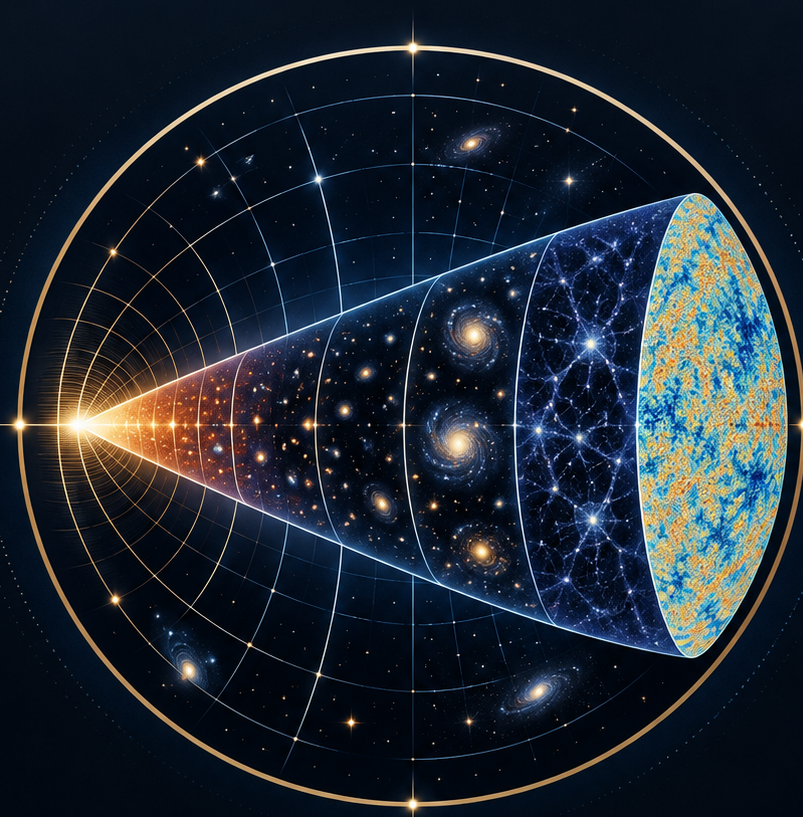
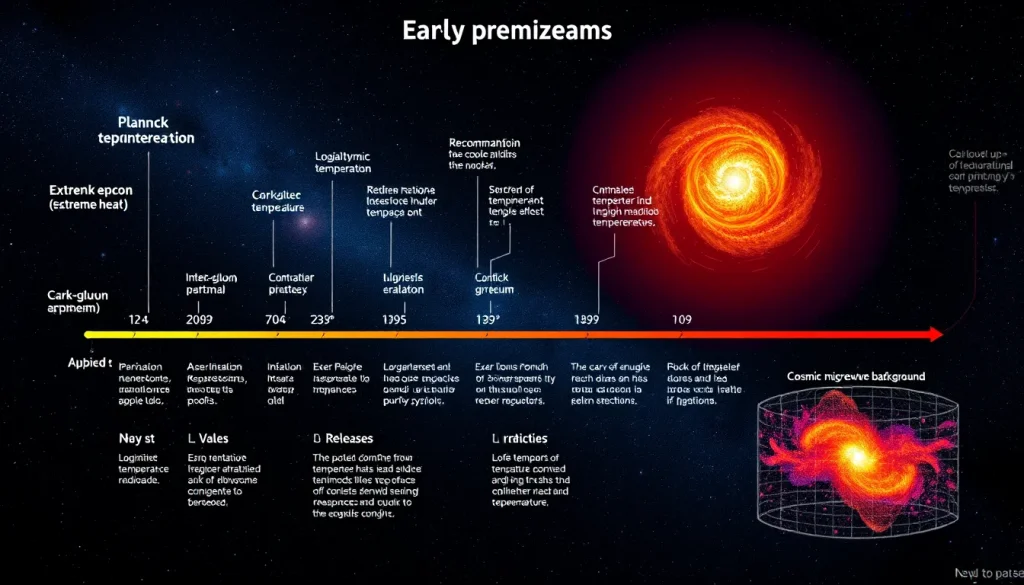
The early universe was extraordinarily hot and dense. As it expanded, it cooled, allowing fundamental forces to separate and particles to form. The temperature at each epoch is a key marker of the physical processes that governed the cosmos. This guide walks through the major epochs, from the Planck epoch to the formation of the first atoms.
Cosmic Epochs and Their Temperatures
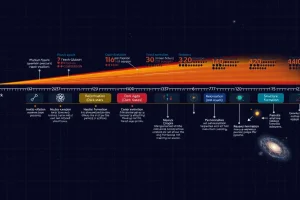
The table below summarizes the major epochs, their approximate times, temperatures, and key events. Temperatures are given in electronvolts (eV) and Kelvin (K) for context.
| Epoch | Time After Big Bang | Temperature (approx.) | Key Events |
|---|---|---|---|
| Planck epoch | 0 to 10−43 s | >1032 K | All four forces unified; quantum gravity effects dominate. |
| Grand Unification epoch | 10−43 to 10−36 s | 1027–1029 K | Strong force separates from electroweak force. |
| Inflationary epoch | 10−36 to 10−32 s | Dropping rapidly | Exponential expansion; seeds of structure formed. |
| Electroweak epoch | 10−32 to 10−12 s | 1015–1016 K | Electromagnetic and weak forces separate; W and Z bosons acquire mass. |
| Quark epoch | 10−12 to 10−6 s | 1012–1015 K | Quarks and gluons form a quark-gluon plasma. |
| Hadron epoch | 10−6 to 1 s | 1012 K down to 1010 K | Quarks combine into protons and neutrons; hadrons form. |
| Lepton epoch | 1 to 10 s | 1010 to 109 K | Leptons dominate; neutrinos decouple. |
| Photon epoch | 10 s to 380,000 years | 109 K down to 3000 K | Photons dominate; nucleosynthesis occurs; matter and radiation decouple. |
| Recombination | ~380,000 years | ~3000 K | Electrons combine with nuclei to form neutral atoms; CMB released. |
| Dark Ages | 380,000 to ~150 million years | 3000 K down to ~50 K | No stars yet; universe is dark and neutral. |
| Reionization | ~150 million to 1 billion years | ~50 K to ~20 K | First stars and galaxies ionize hydrogen. |
| Structure Formation | 1 billion years to present | Cooling to 2.7 K | Galaxies, clusters, and large-scale structure form. |
Planck Epoch and the Maximum Temperature
The Planck epoch is the earliest moment in cosmic history, lasting from time zero to about 10−43 seconds. At this point, the universe was at its absolute hottest. The maximum temperature ever reached is estimated to be around 1032 K, corresponding to the Planck energy scale of ~1019 GeV. This is the temperature at which quantum gravitational effects become as strong as the other forces, and our current physical theories break down. According to a 2025 presentation by Simona Procacci and colleagues, the maximal temperature of the universe is constrained to lie between 10−2 and 1018 GeV, with the upper bound set by the Planck scale [1].
Inflation and the Rapid Cooling
Inflation, a period of exponential expansion, occurred around 10−36 to 10−32 seconds after the Big Bang. During inflation, the universe expanded by a factor of at least 1026, causing a dramatic drop in temperature. This rapid cooling set the stage for the subsequent epochs. The inflationary model is supported by observations of the cosmic microwave background’s near-uniformity and the flatness of space [4].
From Quarks to Atoms: The First Seconds
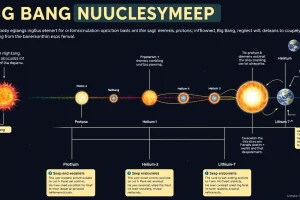
After inflation, the universe was a hot soup of quarks, gluons, and leptons. During the quark epoch (10−12 to 10−6 s), temperatures were high enough to keep quarks unbound. As the universe cooled to about 1012 K, quarks combined into protons and neutrons during the hadron epoch. The lepton epoch followed, during which neutrinos decoupled, leaving a cosmic neutrino background. By the time the universe was about one second old, the temperature had fallen to ~1010 K, allowing the first nuclei to form during Big Bang nucleosynthesis (BBN) [3].
Recombination and the Cosmic Microwave Background
About 380,000 years after the Big Bang, the universe had cooled to roughly 3000 K. At this temperature, electrons combined with protons and helium nuclei to form neutral atoms—a process called recombination. This released the photons that had been trapped in the plasma, creating the cosmic microwave background (CMB). The CMB is a near-perfect blackbody spectrum with a temperature of 2.725 K today, as measured by COBE, WMAP, and Planck [2][4]. The CMB provides a snapshot of the universe at recombination and is a cornerstone of the Lambda-CDM model.
Dark Ages, Reionization, and Structure Formation
After recombination, the universe entered the Dark Ages—a period with no luminous sources. Gravity slowly amplified density fluctuations, leading to the formation of the first stars and galaxies around 150 million years later. These first objects emitted ultraviolet radiation that reionized the neutral hydrogen, a process known as reionization. Over billions of years, structure formation continued, producing the galaxies and clusters we observe today. The James Webb Space Telescope (JWST) is now probing this era, revealing galaxies that existed just a few hundred million years after the Big Bang.
Why It Matters
Understanding the temperature history of the early universe is not just an exercise in curiosity. It underpins our entire model of cosmic evolution. The temperature at each epoch determined which particles could exist, which forces were unified, and how matter and radiation interacted. The CMB, a relic of the hot early universe, carries information about the initial conditions that led to the large-scale structure we see today. By measuring the CMB’s temperature and anisotropies, missions like COBE, WMAP, and Planck have confirmed the predictions of the Big Bang model and placed tight constraints on cosmological parameters [2][4].
Evidence / Sources
The evidence for the early universe’s temperature comes from multiple independent lines: the CMB’s blackbody spectrum, the abundance of light elements (BBN), and particle accelerator experiments that recreate quark-gluon plasma conditions. The CMB was first detected in 1965, and its spectrum was precisely measured by COBE in the 1990s, earning a Nobel Prize. WMAP and Planck subsequently mapped the CMB’s anisotropies, confirming the predictions of inflation and the Lambda-CDM model. The sources used for this article include a 2025 presentation on the maximum temperature of the universe [1], a Forbes article on the hottest era [2], a review of the first second of the universe [3], and a cosmology primer [4].
Related Registry Entries
For further exploration, see the entries on the Cosmic Microwave Background, Inflation, Big Bang Nucleosynthesis, and the Planck Mission.
FAQ
What was the hottest temperature in the universe?
The hottest temperature occurred during the Planck epoch, about 10^-43 seconds after the Big Bang, reaching approximately 10^32 K (the Planck temperature). This is the highest temperature allowed by quantum gravity.
How do we know the early universe was hot?
The cosmic microwave background is a direct relic of the hot, dense early universe. Its blackbody spectrum and temperature (2.725 K today) match predictions from the Big Bang model. Additionally, the observed abundances of light elements (hydrogen, helium, lithium) agree with Big Bang nucleosynthesis calculations that require high temperatures.
What is the temperature of the cosmic microwave background?
The CMB has a nearly perfect blackbody spectrum with a current temperature of 2.725 K. This was precisely measured by the COBE satellite and confirmed by WMAP and Planck.

Leave a Reply