Short Answer
Main Explanation
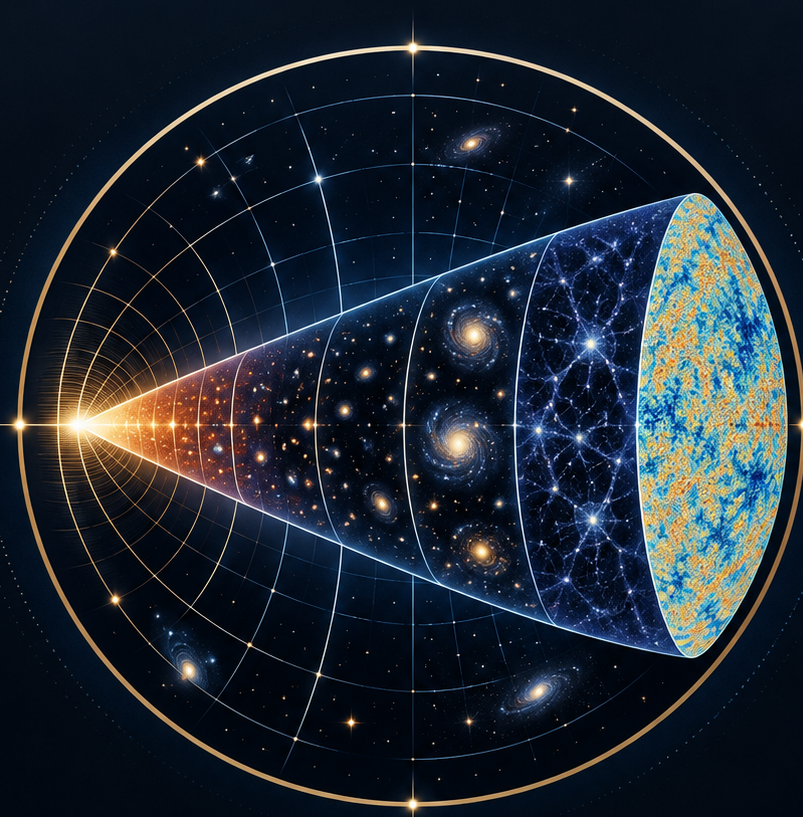
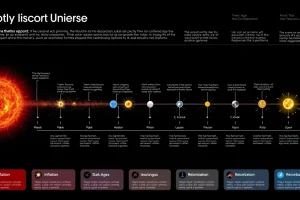
The cosmic microwave background is a relic of the hot, dense state of the early universe. As the universe expanded and cooled, it passed through a series of distinct epochs—from the Planck epoch (the first 10−43 seconds) through inflation, the quark epoch, hadron epoch, lepton epoch, photon epoch, and finally recombination, when protons and electrons combined to form neutral hydrogen and the universe became transparent. The CMB we observe today is the light that last scattered during recombination, and its properties—temperature, anisotropy, and polarization—preserve a snapshot of that era.
Cosmic Timeline
| Epoch | Time after Big Bang | Temperature | Key Events |
|---|---|---|---|
| Planck epoch | 0 – 10−43 s | >1032 K | Quantum gravity effects dominate |
| Grand Unification epoch | 10−43 – 10−36 s | 1028 – 1032 K | Fundamental forces unify |
| Inflationary epoch | 10−36 – 10−32 s | ~1028 K | Exponential expansion; seeds of structure |
| Electroweak epoch | 10−32 – 10−12 s | 1015 – 1028 K | Electromagnetic and weak forces separate |
| Quark epoch | 10−12 – 10−6 s | 1012 – 1015 K | Quarks and gluons form quark-gluon plasma |
| Hadron epoch | 10−6 – 1 s | 1010 – 1012 K | Protons and neutrons form |
| Lepton epoch | 1 – 10 s | 109 – 1010 K | Leptons dominate; neutrinos decouple |
| Photon epoch | 10 s – 380,000 yr | 104 – 109 K | Photons tightly coupled to matter |
| Recombination | ~380,000 yr | ~3000 K | Electrons and protons form hydrogen; CMB released |
| Dark Ages | 380,000 – ~150 million yr | ~3000 – 60 K | No light sources; universe dark |
| Reionization | ~150 million – 1 billion yr | ~60 – 20 K | First stars and galaxies ionize hydrogen |
| Structure Formation | ~1 billion yr – present | <20 K | Galaxies, clusters, large-scale structure form |
The CMB is the oldest light we can see, and its temperature is remarkably uniform at 2.725 K, but it contains tiny anisotropies—fluctuations of about one part in 100,000. These anisotropies are the seeds of cosmic structure. Polarization of the CMB is a more subtle signal, first detected by the DASI experiment in 2002 (Rahimi & Reichardt, 2024). It arises because Thomson scattering of radiation off free electrons at the last scattering surface generates a linear polarization pattern that depends on the quadrupole component of the local radiation field (Hu & White, 1997).
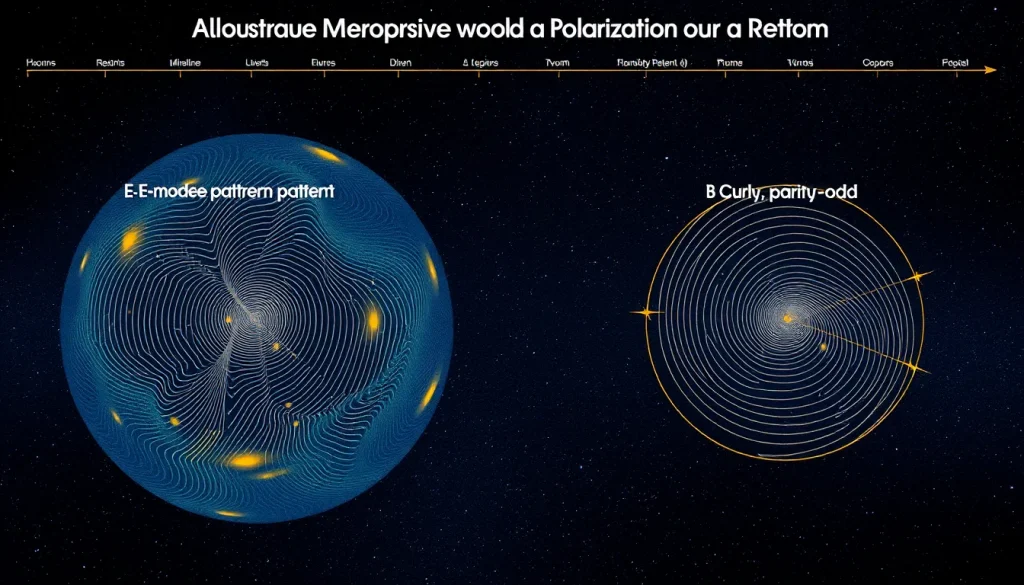
Polarization can be decomposed into two geometric modes: E-modes (gradient-like, parity even) and B-modes (curl-like, parity odd). Scalar density perturbations produce only E-modes, while tensor perturbations (gravitational waves) produce both E- and B-modes. The detection of primordial B-modes would be a smoking gun for inflation, which predicts a stochastic background of gravitational waves (Kosowsky, 1999).
Concept
Definition
CMB polarization is the orientation pattern of the electric field of CMB photons. It is generated by Thomson scattering when the radiation field has a quadrupole anisotropy at the scattering location.
How It Works
In the early universe, before recombination, photons and baryons were tightly coupled. Small density fluctuations caused variations in temperature, and when photons scattered off electrons, the scattered radiation became polarized if the incident radiation field was anisotropic. The quadrupole moment of the temperature distribution around each electron determines the polarization pattern. This polarization is then imprinted on the CMB sky.
Equation
The polarization signal is often quantified by the Stokes parameters Q and U, which can be combined into the E and B modes. The power spectra of these modes, ClEE, ClBB, and cross-correlations with temperature, are the primary observables.
Example
A simple example is a single plane-wave density perturbation. It produces a quadrupole pattern that yields an E-mode polarization with a characteristic spatial pattern. A gravitational wave, on the other hand, produces both E and B modes, with the B-mode having a curl-like pattern.
Observable Consequences
Measurements of E-modes have confirmed the standard model of recombination and provided precise cosmological parameters. B-modes are the focus of ongoing searches, as they would directly probe inflationary gravitational waves. The amplitude of primordial B-modes is parameterized by the tensor-to-scalar ratio r.
Common Misconceptions
One misconception is that CMB polarization is caused by magnetic fields or dust in the Milky Way. While foregrounds do contribute, the primary signal is cosmological. Another is that polarization is a small effect—indeed, it is only a few microkelvin, but it is measurable with sensitive instruments.
Why It Matters
CMB polarization is a unique window into the physics of the early universe. It can distinguish between scalar, vector, and tensor perturbations, test the inflationary paradigm, and help constrain the neutrino mass and other cosmological parameters. It also provides a consistency check for the standard Lambda-CDM model.
Evidence / Sources
The first detection of CMB polarization was by DASI in 2002. Subsequent experiments, including WMAP, Planck, and ground-based telescopes, have measured E-modes with high precision. The search for B-modes continues with BICEP/Keck, SPTpol, ACTPol, and future missions like Simons Observatory and CMB-S4. These observations support the inflationary prediction of a nearly scale-invariant spectrum of primordial perturbations.
Related Registry Entries
FAQ
What causes CMB polarization?
CMB polarization is caused by Thomson scattering of CMB photons off free electrons at the last scattering surface, when the radiation field has a quadrupole anisotropy.
Why are B-modes important?
B-modes are a unique signature of gravitational waves from inflation. Their detection would provide direct evidence for inflation and help identify the energy scale of the early universe.
How is CMB polarization measured?
Polarization is measured using sensitive detectors that can measure the orientation of the electric field of incoming photons, often with polarizing filters or bolometers. Experiments use arrays of detectors with high sensitivity and careful control of systematic effects.
What is the difference between E-modes and B-modes?
E-modes are gradient-like and parity even, produced by scalar density perturbations. B-modes are curl-like and parity odd, produced by tensor perturbations (gravitational waves) and also by gravitational lensing of E-modes.


Leave a Reply