Short Answer
Main Explanation
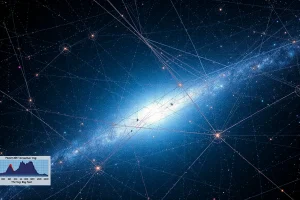
The universe is not uniform. On the largest scales, matter is arranged in a cosmic web of galaxy filaments, clusters, and vast empty regions called cosmic voids. These voids are not simply empty space; they are dynamic, evolving structures that hold crucial information about the universe’s history and composition.
The Cosmic Web and Voids
Cosmic voids are the largest structures in the universe, spanning tens to hundreds of millions of light-years. They contain very few galaxies compared to the dense filaments that surround them. According to the standard model of cosmology (ΛCDM), the cosmic web emerged from tiny quantum fluctuations during cosmic inflation. These fluctuations were amplified by gravity: overdense regions attracted matter and grew into filaments and clusters, while underdense regions lost matter and became voids.
Formation of Voids
Voids form through a combination of expansion and gravitational collapse. In the early universe, regions with slightly lower density expanded more slowly than the average, but as the universe expanded, these underdense regions grew relatively larger because matter flowed away from them toward denser areas. This process, known as void expansion, is driven by the same gravitational dynamics that build galaxy clusters. The result is a hierarchy of voids, with smaller voids merging into larger ones over time, as described by Sheth and van de Weygaert (2004) [3].
Evolution of Voids
Recent simulations and observations show that voids become progressively emptier as the universe ages. A 2026 study using the Magneticum simulations found that voids evolve from z=5.04 to the present, with their inner density decreasing and their size increasing [2]. Another 2026 analysis, based on the Millennium Simulation and SDSS data, confirmed that voids become more underdense and their galaxy populations become fainter over time [4]. This evolution is tied to the accelerated expansion driven by dark energy, which stretches voids and prevents matter from accumulating inside them.
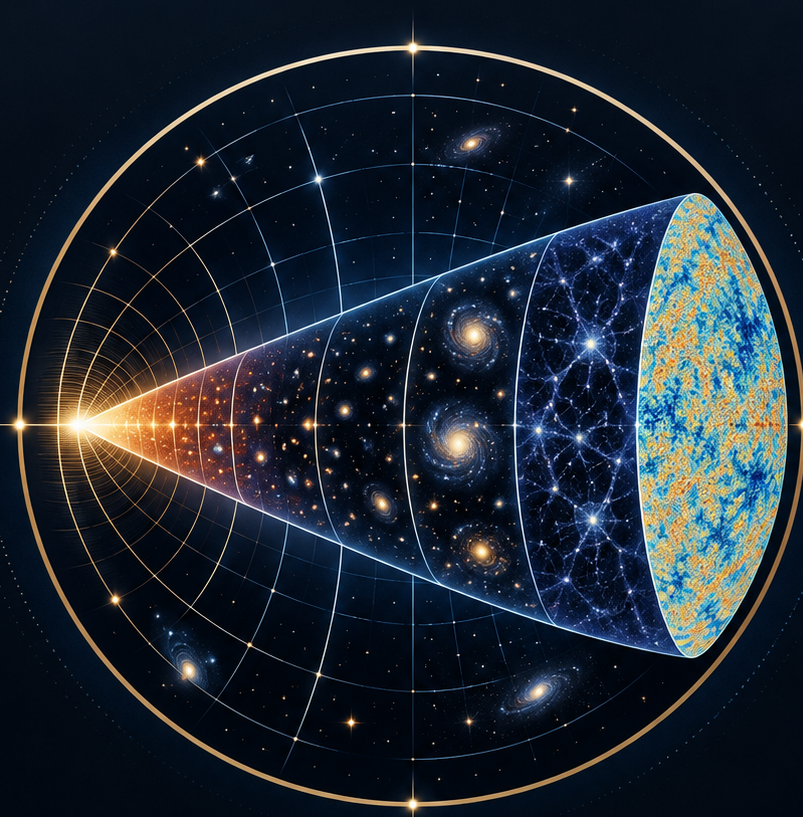
The Cosmic Timeline: From Planck Epoch to Structure Formation
To understand voids, we must place them in the broader context of cosmic history. The standard timeline of the universe includes the following epochs:
| Epoch | Time After Big Bang | Key Events |
|---|---|---|
| Planck Epoch | 0–10⁻⁴³ s | Quantum gravity effects dominate; no known physics |
| Grand Unification Epoch | 10⁻⁴³–10⁻³⁶ s | Strong and electroweak forces unify; inflation begins |
| Inflationary Epoch | 10⁻³⁶–10⁻³² s | Exponential expansion; quantum fluctuations become seeds of structure |
| Electroweak Epoch | 10⁻³²–10⁻¹² s | Electromagnetic and weak forces separate; particles acquire mass |
| Quark Epoch | 10⁻¹²–10⁻⁶ s | Quarks and gluons exist in a quark-gluon plasma |
| Hadron Epoch | 10⁻⁶–1 s | Protons and neutrons form; matter-antimatter asymmetry emerges |
| Lepton Epoch | 1–10 s | Leptons dominate; neutrinos decouple |
| Photon Epoch | 10 s–380,000 yr | Photons dominate; nucleosynthesis forms light elements |
| Recombination | 380,000 yr | Electrons and protons combine to form neutral hydrogen; CMB released |
| Dark Ages | 380,000 yr–~150 million yr | No stars yet; universe is dark and neutral |
| Reionization | ~150 million–1 billion yr | First stars and galaxies ionize hydrogen; cosmic dawn |
| Structure Formation | ~1 billion yr–present | Galaxies cluster into filaments and voids; dark energy accelerates expansion |
The cosmic microwave background (CMB) is the relic radiation from recombination. It encodes the initial density fluctuations that later gave rise to the cosmic web. Missions like COBE, WMAP, and Planck have mapped the CMB with extraordinary precision, confirming the ΛCDM model and measuring key cosmological parameters.
Key Missions and Instruments
- COBE (1989): Discovered the CMB’s blackbody spectrum and its tiny anisotropies.
- WMAP (2001): Produced detailed maps of CMB temperature fluctuations, pinning down the universe’s age and composition.
- Planck (2009): Provided the most precise CMB measurements, refining our understanding of dark matter and dark energy.
- JWST (2021): Observes the first galaxies and stars, shedding light on reionization and early structure formation.
Concept: Understanding Cosmic Voids
Definition
Cosmic voids are large, underdense regions in the intergalactic medium that contain very few galaxies. They are defined by the absence of rich superclusters and typically span 10 to 100 megaparsecs [1]. Despite their emptiness, they contain about 15% of the average matter density, mostly in the form of dark matter.
How It Works
Voids form from the same primordial density fluctuations that create galaxies. In the early universe, quantum fluctuations were stretched by inflation. Over time, gravity amplified these fluctuations: overdense regions collapsed into filaments, while underdense regions expanded and became voids. The expansion of voids is driven by the gravitational pull of surrounding matter and, at late times, by dark energy.
Example
The Boötes Void, discovered in 1981, is one of the largest known voids, spanning about 330 million light-years. It contains only a few dozen galaxies, making it a striking example of the universe’s emptiness.
Observable Consequences
Voids affect the cosmic microwave background through the integrated Sachs-Wolfe effect: photons passing through voids lose energy as the voids expand, creating cold spots in the CMB. Voids also influence galaxy formation; galaxies inside voids are typically smaller, fainter, and less massive than those in filaments.
Common Misconceptions
One misconception is that voids are completely empty. In reality, they contain dark matter and a sparse population of dwarf galaxies. Another is that voids are static; they actually grow and evolve over cosmic time. Finally, voids are not random—they are a key component of the cosmic web, shaped by the same physics that builds galaxies.
Why It Matters
Cosmic voids are more than just empty space. They are sensitive probes of dark energy, which drives their accelerated expansion. They also test our understanding of gravity on large scales, as the behavior of matter in voids differs from that in dense regions. Moreover, voids provide pristine environments to study galaxy evolution in isolation, offering clues about how environment shapes galaxies. As upcoming surveys like DESI and Euclid map millions of voids, they will help refine cosmological parameters and potentially reveal new physics.
Evidence / Sources
The following sources provide authoritative information on cosmic voids:
- Wikipedia: Void (astronomy) — definition, size, discovery [1]
- Schuster et al. 2026, JCAP — Magneticum simulations of void evolution [2]
- Sheth & van de Weygaert 2004, MNRAS — Hierarchy of voids [3]
- Tavasoli 2026, ApJ — Evolution of voids and their galaxy populations [4]
Related Registry Entries
FAQ
Are cosmic voids completely empty?
No. Even the emptiest voids contain about 15% of the average matter density of the universe, mostly in the form of dark matter, plus a sparse population of dwarf galaxies.
How do cosmic voids relate to the Big Bang?
Voids originate from tiny density fluctuations in the early universe, which were amplified by inflation and gravity. They are a natural outcome of the same processes that created galaxies and the cosmic web.
Why are cosmic voids important for cosmology?
Voids are sensitive to dark energy, which drives their accelerated expansion. They also test gravity on large scales and provide pristine environments to study galaxy evolution without interference from dense environments.
Leave a Reply