Short Answer
Main Explanation
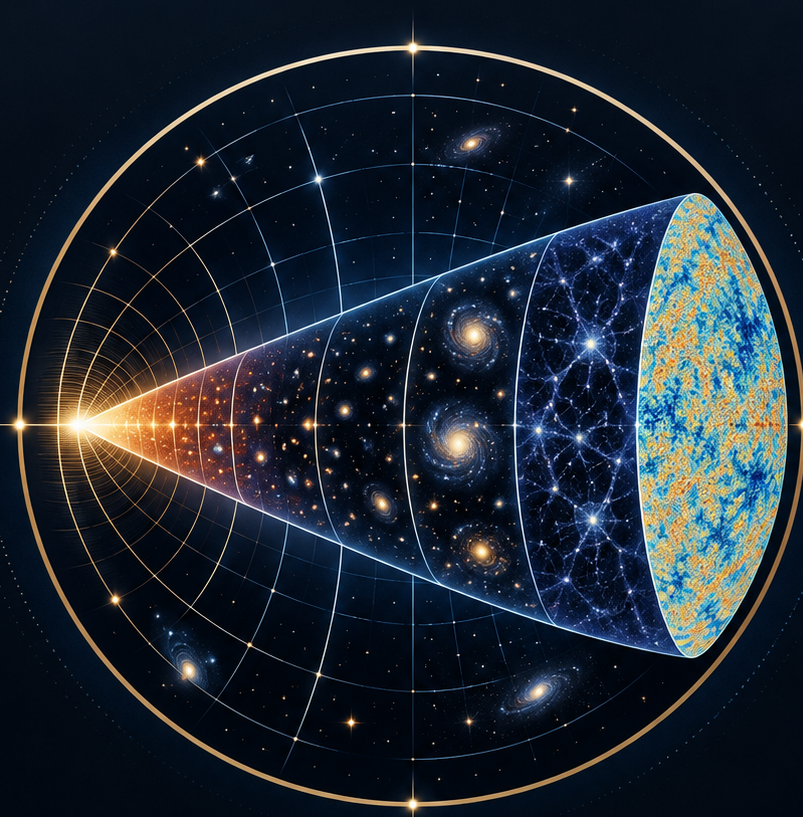
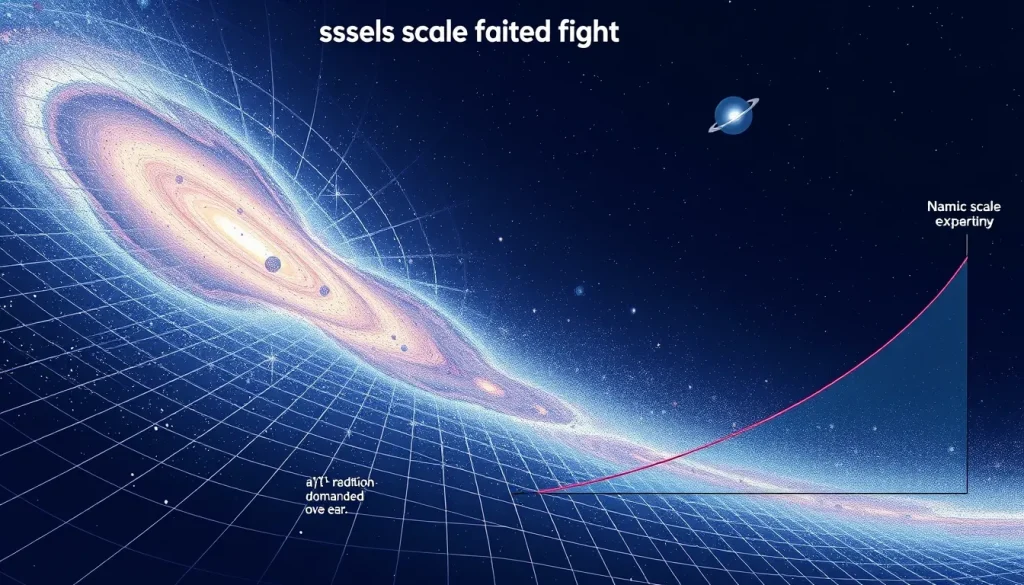
The scale factor, often written as a(t), is a dimensionless function of cosmic time that describes how the spatial distance between any two freely moving points in the universe changes as the universe expands. It is the central parameter in the Friedmann equations, which govern the dynamics of a homogeneous, isotropic universe. If the scale factor doubles, all cosmic distances double; if it halves, distances halve. By convention, the scale factor today is set to 1, so a(t) = 1 at the present epoch. When the universe was half its current size, a(t) = 0.5, and when it was one-tenth, a(t) = 0.1.
The scale factor is not just a bookkeeping device—it directly links to observable quantities. The cosmological redshift of a distant galaxy is related to the scale factor at the time the light was emitted: if light was emitted when the scale factor was ae, the observed redshift z satisfies 1 + z = 1 / ae. This relation allows astronomers to translate measured redshifts into the cosmic epoch at which the light left its source. As the universe expands, the wavelength of light stretches proportionally to the scale factor, producing the redshift we observe.
The scale factor also determines how energy densities evolve. For radiation (photons and relativistic particles), the energy density scales as a-4; for non-relativistic matter (baryons and dark matter), it scales as a-3; and for dark energy (a cosmological constant), it remains constant. These different scaling behaviors drive the sequence of cosmic eras: radiation-dominated, matter-dominated, and dark-energy-dominated. In the early universe, radiation dominated; later matter took over; and since about 4 billion years ago, dark energy has become the dominant component, accelerating the expansion.
Definition
The scale factor a(t) is defined by the Friedmann–Lemaître–Robertson–Walker metric, which describes a spatially homogeneous and isotropic universe. It appears in the metric as a multiplicative factor on the spatial coordinates, encoding how distances expand with time. It is dimensionless and normalized to 1 today.
How It Works
As the universe expands, the scale factor increases. The rate of increase is governed by the Hubble parameter H(t) = (da/dt)/a. The Friedmann equations relate H(t) to the energy content of the universe, including matter, radiation, and dark energy. The scale factor’s evolution determines the age of the universe, the distances to galaxies, and the observable redshift.
Equation
The fundamental equation linking scale factor and redshift is:
1 + z = 1 / a(temit)
where z is the redshift and temit is the time of emission. The proper distance to a source at redshift z is given by an integral over the scale factor:
dp(t0) = c ∫temitt0 dt / a(t)
where c is the speed of light. This integral yields the line-of-sight distance today.
Example
If a galaxy has a measured redshift z = 2, then the scale factor at the time the light was emitted was ae = 1/(1+2) = 1/3. This means the universe was one-third its current size when that light left the galaxy. The light has been traveling for a significant fraction of cosmic history, and the galaxy is now far more distant than it was then.
Observable Consequences
The scale factor directly influences several observable quantities:
- Redshift: As described, 1+z = 1/a.
- Luminosity distance: Determined by integrating the scale factor, used to measure cosmic distances.
- Angular diameter distance: Also derived from the scale factor, affecting apparent sizes.
- Cosmic microwave background: The CMB temperature scales as T ∝ 1/a, so the observed 2.725 K today corresponds to a much hotter early universe.
Common Misconceptions
A common misconception is that the scale factor describes expansion into a pre-existing space. In fact, the expansion is intrinsic—space itself stretches, and the scale factor applies to the spatial metric. Another misconception is that objects move through space with a velocity; rather, their separation increases because the space between them expands. The scale factor does not apply to gravitationally bound systems like galaxies or clusters, which are held together by gravity and do not expand.
Why It Matters
The scale factor is the backbone of modern cosmology. It allows us to reconstruct the history of the universe from the Planck epoch to the present, to interpret observations of distant supernovae, galaxy surveys, and the cosmic microwave background. Without it, we could not quantify the expansion rate, the age of the universe, or the transition between radiation-, matter-, and dark-energy-dominated eras. The scale factor also underpins the concept of redshift as a distance indicator and is essential for testing the Lambda-CDM model, the current standard model of cosmology.
Evidence / Sources
Multiple independent observations confirm the predictions of the scale-factor framework. The cosmic microwave background, discovered by Penzias and Wilson in 1965, is a relic of the epoch of recombination when the scale factor was about 1/1100 of its present value. Its near-perfect blackbody spectrum and tiny anisotropies, measured by COBE, WMAP, and the Planck satellite, match the predictions of a universe that expanded from a hot, dense state. The observed redshift–distance relation for distant Type Ia supernovae, combined with baryon acoustic oscillations and galaxy surveys, provides strong evidence for the accelerating expansion driven by dark energy. The James Webb Space Telescope is now probing the first galaxies and the epoch of reionization, further testing our understanding of structure formation within the expanding universe.
Related Registry Entries
Explore other cosmic concepts:
- Redshift (z)
- Hubble–Lemaître law
- Cosmic Microwave Background
- Friedmann equations
- Lambda-CDM model
Cosmic Epochs Timeline
| Epoch | Time after Big Bang | Approximate Redshift | Key Events |
|---|---|---|---|
| Planck Epoch | < 10-43 s | > 1032 | Quantum gravity effects dominate; all forces unified. |
| Grand Unification Epoch | 10-43 to 10-36 s | 1032 to 1028 | Strong and electroweak forces separate. |
| Inflationary Epoch | 10-36 to 10-32 s | ~1028 | Exponential expansion; seeds for structure formed. |
| Electroweak Epoch | 10-32 to 10-12 s | 1028 to 1015 | Electromagnetic and weak forces separate; particles acquire mass. |
| Quark Epoch | 10-12 to 10-6 s | 1015 to 1010 | Quarks and gluons form a quark–gluon plasma. |
| Hadron Epoch | 10-6 to 1 s | 1010 to 109 | Protons and neutrons form; matter–antimatter annihilation. |
| Lepton Epoch | 1 s to 10 s | ~109 | Leptons dominate; neutrinos decouple. |
| Photon Epoch | 10 s to 380,000 yr | 109 to 1100 | Photons dominate; primordial nucleosynthesis occurs. |
| Recombination | ~380,000 yr | ~1100 | Electrons combine with protons to form neutral hydrogen; CMB released. |
| Dark Ages | 380,000 yr to ~150 million yr | 1100 to ~20 | No stars; universe filled with neutral hydrogen and helium. |
| Reionization | ~150 million yr to ~1 billion yr | 20 to ~6 | First stars and galaxies ionize hydrogen; universe becomes transparent again. |
| Structure Formation | ~1 billion yr to present | < 6 | Galaxies, clusters, and large-scale structure form; dark energy accelerates expansion. |
FAQ
What is the scale factor in simple terms?
The scale factor is a number that tells you how much the universe has expanded since a given time. If the scale factor is 0.5, the universe was half its current size. It is used to relate redshift to cosmic time.
How does the scale factor relate to the redshift of galaxies?
For a galaxy emitting light at scale factor a_e, the observed redshift z satisfies 1+z = 1/a_e. This means a higher redshift corresponds to a smaller scale factor and thus an earlier cosmic epoch.
Why does the scale factor behave differently for radiation, matter, and dark energy?
The energy density of radiation scales as a⁻⁴, matter as a⁻³, and dark energy is constant. These different scaling laws cause the universe to transition from radiation-dominated to matter-dominated and finally to dark-energy-dominated eras.


Leave a Reply