Short Answer
Main Explanation
The question “Is the universe flat?” is not about whether the cosmos resembles a pancake. In cosmology, flatness is a statement about geometry: on the largest scales, do parallel lines remain parallel, and do the angles of a triangle add up to 180 degrees? If so, space is Euclidean, or flat. If not, the universe has positive curvature (like a sphere) or negative curvature (like a saddle). But geometry alone does not determine shape. A flat universe could be infinite and simply connected, or finite and multiply connected, like a 3-torus. Observational evidence from WMAP, BOOMERanG, and Planck indicates that the observable universe is spatially flat to within a 0.4% margin of error, but its global topology remains unknown.
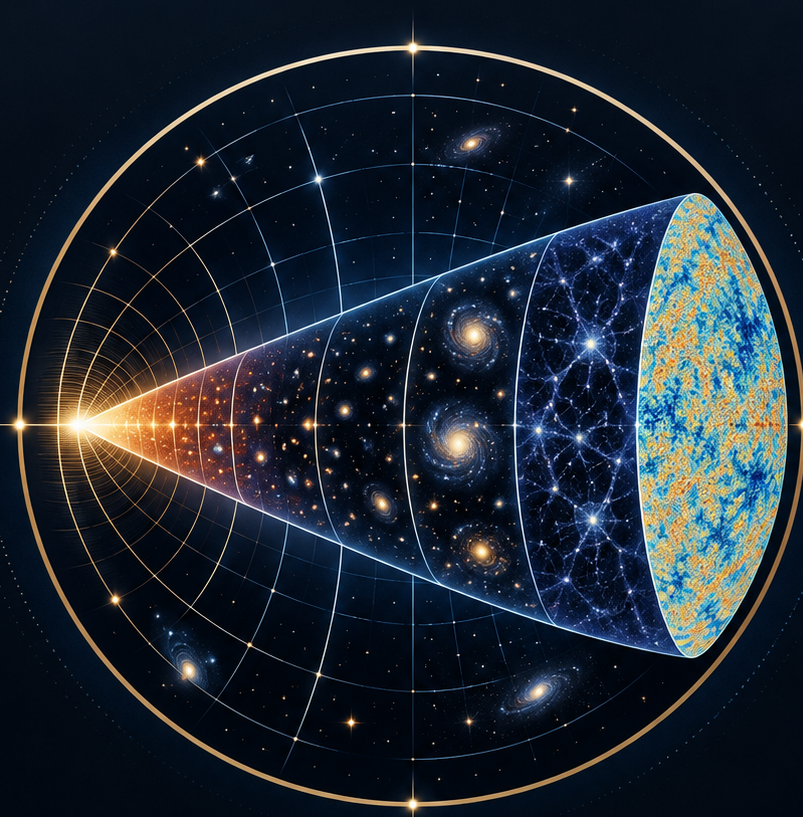
The standard Lambda-CDM model describes a universe that began 13.8 billion years ago in a hot, dense state and has expanded and cooled ever since. Its history is divided into epochs, each defined by the dominant particles and forces.
| Epoch | Time after Big Bang | Approx. Temperature | Key Events |
|---|---|---|---|
| Planck epoch | <10⁻⁴³ s | >10³² K | Quantum gravity dominates; all four fundamental forces may be unified. |
| Grand Unification epoch | 10⁻⁴³–10⁻³⁶ s | ~10²⁷ K | Strong force separates from electroweak force; possible baryogenesis. |
| Inflationary epoch | ~10⁻³⁶–10⁻³² s | ~10²⁷ K | Hypothesized exponential expansion stretches space and smooths curvature. |
| Electroweak epoch | 10⁻³⁶–10⁻¹² s | ~10¹⁵ K | Electromagnetic and weak forces separate; Higgs field gives particles mass. |
| Quark epoch | 10⁻¹²–10⁻⁶ s | ~10¹² K | Quarks, gluons, and leptons form a hot plasma. |
| Hadron epoch | 10⁻⁶–1 s | ~10¹⁰ K | Quarks bind into protons and neutrons. |
| Lepton epoch | 1–10 s | ~10⁹ K | Neutrinos decouple; electrons and positrons annihilate. |
| Photon epoch | 10 s–380,000 yr | ~10⁹–3000 K | Big Bang nucleosynthesis forms light nuclei; universe remains opaque plasma. |
| Recombination | ~380,000 yr | ~3000 K | First atoms form; cosmic microwave background released. |
| Dark Ages | 380,000 yr–~150 million yr | ~3000–60 K | Neutral hydrogen fills space; no stars yet. |
| Reionization | ~150 million–1 billion yr | ~60–20 K | First stars and galaxies ionize intergalactic hydrogen. |
| Structure Formation | ~1 billion yr–present | ~20–2.7 K | Galaxies, clusters, and cosmic web grow under gravity. |
During the Planck epoch, our current physics breaks down. General relativity and quantum mechanics must be unified, but no complete theory of quantum gravity exists. The Grand Unification epoch is when the strong nuclear force may have separated from the electroweak force. The inflationary epoch, though not directly observed, is a leading explanation for why the observable universe is so uniform and so close to flat: a brief burst of exponential expansion would have stretched any initial curvature to near zero, much as inflating a balloon makes its surface look locally flat.
As the universe cooled, quarks combined into protons and neutrons during the hadron epoch. In the first few minutes, Big Bang nucleosynthesis produced hydrogen, helium, and trace amounts of lithium. For about 380,000 years, the universe was a hot, opaque plasma of photons, electrons, and nuclei. Then, at recombination, electrons combined with nuclei to form neutral atoms. The photons decoupled and streamed freely. Today we see them as the cosmic microwave background (CMB), cooled to 2.725 K.
The CMB is a relic of the early universe and one of the strongest pieces of evidence for the Big Bang. The COBE satellite first measured its near-perfect blackbody spectrum and detected tiny temperature fluctuations. WMAP and Planck mapped those fluctuations in detail, revealing acoustic peaks that encode the universe’s composition and curvature. The first stars ended the Dark Ages, and their ultraviolet light reionized the intergalactic medium. The James Webb Space Telescope is now observing some of the earliest galaxies, testing our picture of cosmic dawn.
The Flatness Question
So, is the universe flat? The short answer is that the observable universe is consistent with being spatially flat to within 0.4 percent, but flatness does not tell us whether the whole universe is finite or infinite, simply connected or multiply connected.
What We Know
Measurements of the cosmic microwave background, especially the angular size of its temperature fluctuations, are sensitive to the curvature of space. In a flat universe, the first acoustic peak appears at about one degree on the sky. WMAP, BOOMERanG, and Planck all find a peak position consistent with flatness. The curvature density parameter Ωk is measured to be very close to zero, with an uncertainty of about 0.004. Baryon acoustic oscillations and supernova distances provide independent checks and agree.
What We Don’t Know
Geometry is local; topology is global. A flat universe could be infinite, like Euclidean space, or finite and multiply connected, like a 3-torus. Observations within our observable horizon cannot easily distinguish these possibilities because locally they look identical. The universe could also have a very small positive or negative curvature that is below current sensitivity. Some researchers argue that the simple conclusion of flatness has deep flaws because geometry alone does not determine shape, and a flat universe could wrap around in many ways.
Evidence
The primary evidence comes from the CMB power spectrum. The position and height of the acoustic peaks depend on the total energy density, which includes matter, radiation, and dark energy. A flat universe requires the total density to equal the critical density. Planck’s measurements imply Ωk = 0.0007 ± 0.0019, consistent with zero. Supernova surveys and baryon acoustic oscillations provide complementary constraints. The standard Lambda-CDM model, with about 68% dark energy, 27% dark matter, and 5% ordinary matter, fits a flat universe remarkably well.
Competing Explanations
Inflation is the leading explanation for flatness. It predicts that any initial curvature is driven to near zero. Alternatives include a universe that is exactly flat by initial condition, or a slightly curved universe that is still within observational limits. Some topological models propose a multiply connected flat space, which would produce repeating patterns in the CMB if the fundamental domain is smaller than the observable horizon. No such repeating patterns have been confirmed.
Current Research
Ongoing and future surveys, including DESI, the Simons Observatory, and SPHEREx, are refining measurements of curvature and topology. Model-independent tests of the FLRW metric and curvature using DESI DR2 data are probing whether the assumption of exact flatness holds. The James Webb Space Telescope is also testing the early universe, where any departure from flatness would affect structure formation. For now, the consensus is that the observable universe is flat within measurement precision, but the global shape remains an open question.
Why It Matters
Flatness is not just a geometric curiosity. In general relativity, the curvature of space is tied to the total energy density of the universe. A flat universe has exactly the critical density, which determines its ultimate fate: it will expand forever, but at an ever-decreasing rate if dark energy is a cosmological constant. If the universe were positively curved, it could eventually recollapse; if negatively curved, it would expand forever more rapidly. Flatness also connects to inflation, the horizon problem, and the origin of large-scale structure. Knowing whether the universe is flat—and whether it is finite or infinite—shapes our understanding of the cosmos’s beginning, evolution, and destiny.
Evidence / Sources
- Wikipedia: Shape of the universe — observational evidence for flatness within 0.4% and unknown global topology. https://en.wikipedia.org/wiki/Shape_of_the_universe
- Scientific American: We thought we knew the shape of the universe. We were wrong — discusses flaws in the simple flat conclusion and topology. https://www.scientificamerican.com/article/we-thought-we-knew-the-shape-of-the-universe-we-were-wrong/
- New Scientist: Can we ever know the shape of the universe? — explores size, shape, and observational limits. https://www.newscientist.com/article/2515390-can-we-ever-know-the-shape-of-the-universe/
- IOPscience: Model independent test of the FLRW metric and the curvature in light of DESI DR2 — recent data-driven curvature test. https://iopscience.iop.org/article/10.1088/1475-7516/2026/08/016
Related Registry Entries
- Cosmic Microwave Background — relic radiation from recombination, now at 2.725 K.
- Inflation — hypothesized early exponential expansion that can flatten space.
- Recombination — epoch when first atoms formed and the CMB was released.
- Dark Ages — period before the first stars, filled with neutral hydrogen.
- Reionization — era when first galaxies ionized the intergalactic medium.
- Structure Formation — growth of galaxies and cosmic web under gravity.
- ΛCDM — the standard cosmological model with dark energy and cold dark matter.
FAQ
Is the universe flat?
The observable universe is consistent with being spatially flat to within 0.4 percent, but the global topology is unknown; a flat universe could be infinite or finite and multiply connected.
What does 'flat' mean in cosmology?
It means the rules of Euclidean geometry apply on large scales: parallel lines stay parallel, and the angles of a triangle add to 180 degrees. It does not mean the universe is two-dimensional.
How do we measure the curvature of the universe?
By comparing the apparent size of temperature fluctuations in the cosmic microwave background with theoretical predictions, along with baryon acoustic oscillations and supernova distances.
Could a flat universe still be finite?
Yes. A flat geometry can be wrapped into a finite, multiply connected shape such as a 3-torus, so flatness alone does not determine whether the universe is finite or infinite.
What role did inflation play in flatness?
Inflation would have stretched any initial curvature to near zero, much like inflating a balloon makes its surface appear locally flat.
Leave a Reply