Short Answer
Short Answer: Primordial helium is the helium-4 produced during Big Bang nucleosynthesis (BBN) in the first three minutes after the Big Bang. Its observed abundance—about 25% of the universe’s baryonic mass—matches theoretical predictions with remarkable precision, providing one of the strongest pieces of evidence for the hot Big Bang model.
| Property | Value |
|---|---|
| Production epoch | ~3 minutes after the Big Bang |
| Temperature at production | ~109 K |
| Primordial mass fraction (Yp) | ~0.25 |
| Key nuclear reactions | p + n → d, d + d → 4He, etc. |
| Observational window | Low-metallicity H II regions |
| Main supporting missions | COBE, WMAP, Planck |
Main Explanation
The Big Bang model describes a universe that began in an extremely hot, dense state and has been expanding and cooling ever since. The first moments after the Big Bang set the stage for everything that followed, from the formation of fundamental particles to the emergence of galaxies. Primordial helium is a direct relic of this early phase, and its abundance serves as a powerful confirmation of the entire cosmological framework.
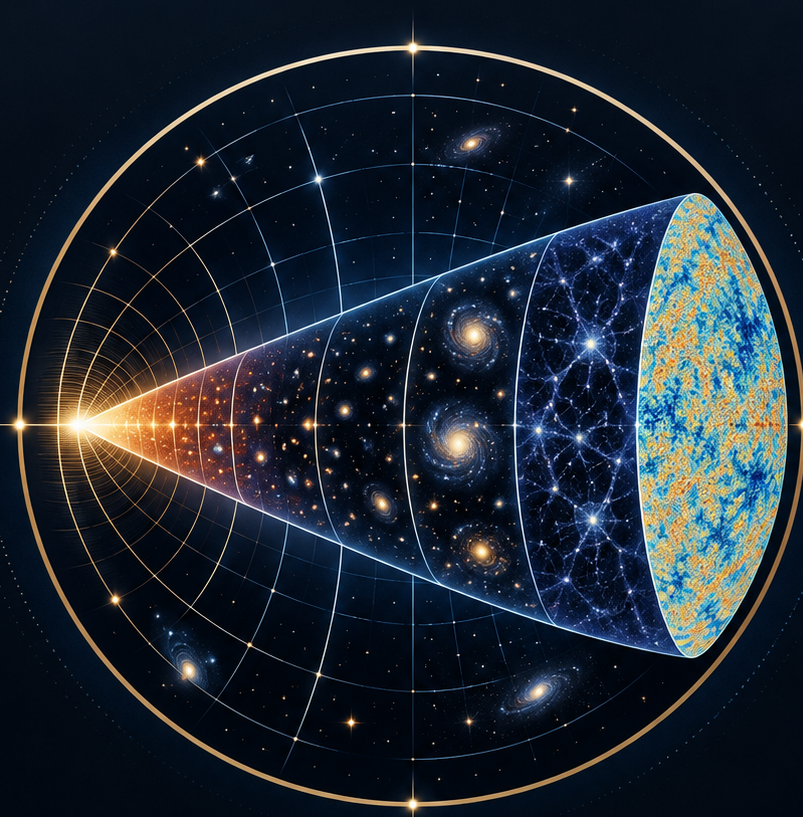
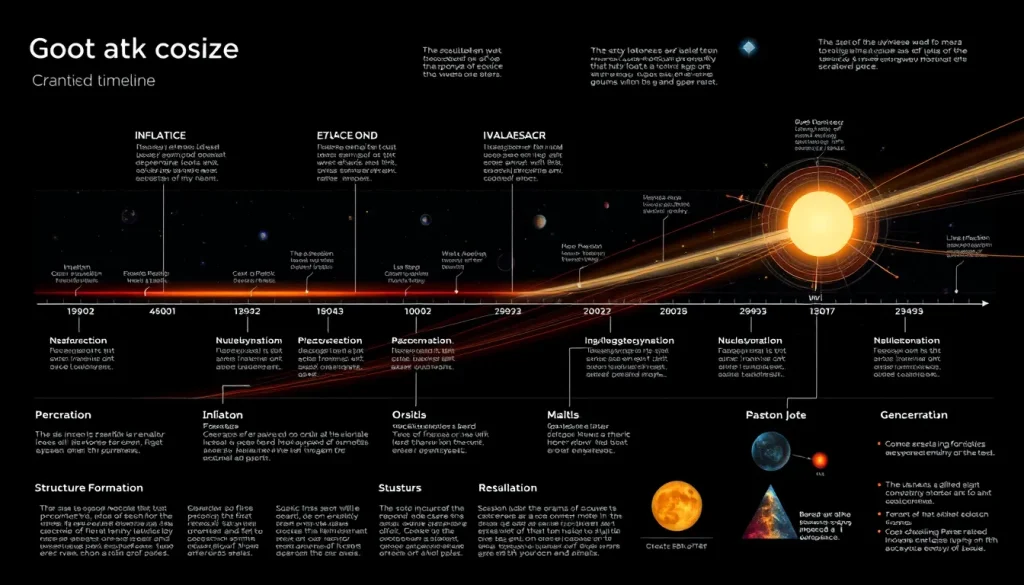
The Cosmic Timeline: From Planck Epoch to Structure Formation
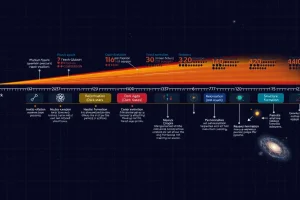
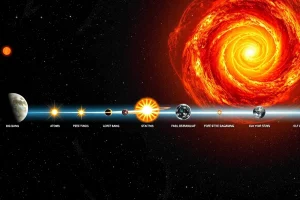
The universe’s history is divided into distinct epochs, each characterized by the dominant physical processes and temperatures. The following table summarizes the major phases:
| Epoch | Time | Temperature | Key Events |
|---|---|---|---|
| Planck epoch | 0 – 10−43 s | >1032 K | Quantum gravity effects dominate; all forces unified. |
| Grand Unification epoch | 10−43 – 10−36 s | 1028 – 1032 K | Strong force separates from electroweak; possible inflation begins. |
| Inflationary epoch | 10−36 – 10−32 s | Dropping rapidly | Exponential expansion; quantum fluctuations seeded large-scale structure. |
| Electroweak epoch | 10−32 – 10−12 s | 1015 – 1028 K | Electromagnetic and weak forces separate; W, Z bosons acquire mass. |
| Quark epoch | 10−12 – 10−6 s | 1012 – 1015 K | Quarks and gluons form a quark–gluon plasma. |
| Hadron epoch | 10−6 – 1 s | 1010 – 1012 K | Protons and neutrons form; matter–antimatter annihilation leaves residual baryons. |
| Lepton epoch | 1 – 10 s | 109 – 1010 K | Leptons dominate; neutrinos decouple. |
| Photon epoch (BBN) | 10 s – 20 min | 109 – 1010 K | Nucleosynthesis of 4He, 2H, 3He, 7Li. |
| Recombination | ~380,000 yr | ~3000 K | Electrons combine with nuclei; CMB released. |
| Dark Ages | 380,000 yr – ~100 million yr | 3000 K – 50 K | No stars yet; universe filled with neutral hydrogen. |
| Reionization | ~100 million – 1 billion yr | ~50 K – 10 K | First stars and galaxies reionize intergalactic hydrogen. |
| Structure Formation | 1 billion yr – present | Cooling to 2.7 K | Galaxies, clusters, and large-scale structure form under gravity. |
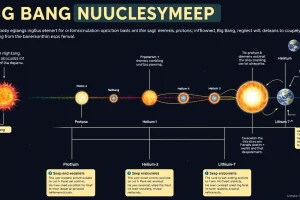
Primordial helium is synthesized during the photon epoch, when the universe is a hot, dense soup of protons, neutrons, electrons, and photons. At temperatures around 109 K, nuclear reactions rapidly build up light elements. Because there are no stable nuclei with mass 5 or 8, the process stops after producing helium-4, with trace amounts of deuterium, helium-3, and lithium-7. The predicted mass fraction of helium-4 is about 25%, a value that depends primarily on the baryon-to-photon ratio.
The Cosmic Microwave Background: A Relic of the Early Universe
About 380,000 years after the Big Bang, the universe cooled enough for electrons and protons to combine into neutral hydrogen—an event called recombination. Photons that had been scattered by free electrons were suddenly free to travel, creating the cosmic microwave background (CMB). The CMB is a near-perfect blackbody at 2.725 K, and its temperature fluctuations encode the seeds of cosmic structure. Missions like COBE, WMAP, and Planck have mapped these fluctuations with exquisite precision, confirming the predictions of the ΛCDM model and providing independent constraints on the baryon density. This baryon density, in turn, is a crucial input for BBN calculations.
How Primordial Helium Acts as a Test
The measured abundance of primordial helium (denoted Yp) is derived from observations of low-metallicity H II regions—ionized gas clouds in dwarf galaxies where stellar processing is minimal. These observations, combined with theoretical predictions, yield Yp ≈ 0.25. The agreement between theory and observation is remarkable: if the universe had not expanded and cooled as the Big Bang model dictates, the helium fraction would be drastically different. For example, a universe without BBN would produce essentially no helium-4, while a steady-state universe would have a different distribution. The observed abundance is a direct fingerprint of the hot, dense conditions that existed minutes after the beginning.
Evidence
Observation
Astronomers measure primordial helium by analyzing the emission lines of H II regions in metal-poor dwarf galaxies. These regions have undergone minimal stellar nucleosynthesis, so their helium content is close to primordial. The standard approach uses optical spectroscopy to measure the intensity of helium and hydrogen recombination lines, from which the helium abundance is derived.
Prediction
Big Bang nucleosynthesis predicts the primordial abundances of light elements as a function of the baryon-to-photon ratio. For a baryon density consistent with CMB measurements (Ωbh² ≈ 0.022), the predicted helium mass fraction is Yp = 0.247–0.252. This prediction is robust because helium production depends only weakly on the baryon density, unlike deuterium or lithium.
Measurement
Recent compilations (e.g., Peimbert 2008) give Yp = 0.2477 ± 0.0029, in excellent agreement with the BBN prediction. The uncertainty arises from systematic effects in the H II region analysis, including temperature fluctuations, collisional excitation, and underlying stellar absorption.
Why It Supports the Model
The success of BBN in predicting helium (and deuterium) abundances provides strong evidence for the hot Big Bang. Helium is the second-most abundant element in the universe, and its existence cannot be explained by stellar nucleosynthesis alone—stars produce helium, but the observed primordial fraction requires a cosmic origin. The fact that the predicted and observed values agree, given independent constraints from the CMB, is a major triumph of the standard cosmological model.
Limitations
Primordial helium is less sensitive to baryon density than deuterium, so it does not tightly constrain Ωb. Also, systematic uncertainties in H II region measurements can be significant. Nevertheless, helium serves as a consistency check for BBN and the CMB.
Alternative Explanations
Could stellar processes have produced the observed helium? Stars do produce helium, but the total mass of stars that have ever formed is insufficient to explain the ~25% universal fraction. A universe without a hot early phase would have a much lower helium abundance. No alternative model has successfully reproduced the observed light-element abundances.
Current Scientific Consensus
The ΛCDM model, incorporating BBN and the CMB, is the consensus framework. It explains the observed abundances of light elements, the CMB anisotropy, and the large-scale structure of the universe. Primordial helium is one of its key pillars.
Why It Matters
Primordial helium is not just a relic—it is a tool. It allows us to probe the universe when it was seconds old, test fundamental physics (e.g., the number of neutrino families), and determine the baryon density. Together with the CMB and dark matter observations, it confirms that ordinary baryonic matter constitutes only about 5% of the universe’s total energy density. The remaining 95% is dark matter and dark energy, whose nature remains one of the greatest mysteries in cosmology.
Evidence / Sources
- Steigman, G. (2010). Primordial helium and the cosmic background radiation. Journal of Cosmology and Astroparticle Physics. doi:10.1088/1475-7516/2010/04/029
- Burles, S., Nollett, K. M., & Turner, M. S. (1999). Big-Bang Nucleosynthesis: Linking Inner Space and Outer Space. arXiv:astro-ph/9903300.
- Peimbert, M. (2008). The Primordial Helium Abundance. arXiv:0811.2980.
- Steigman, G. (2006). Primordial Nucleosynthesis: Successes and Challenges. International Journal of Modern Physics E. doi:10.1142/s0218301306004028
Related Registry Entries
- Big Bang Nucleosynthesis (BBN)
- Cosmic Microwave Background (CMB)
- Recombination
- Reionization
- Inflation
- Dark Ages
FAQ
Why is primordial helium important for Big Bang cosmology?
Primordial helium is produced in the first minutes after the Big Bang via nuclear reactions. Its measured abundance matches theoretical predictions, confirming the hot, dense early universe and the standard model of cosmology.
How is primordial helium measured?
Astronomers measure helium emission lines in low-metallicity H II regions—ionized gas in dwarf galaxies with minimal stellar contamination. The helium-to-hydrogen ratio gives the primordial helium mass fraction.
What does primordial helium tell us about the baryon density?
Helium abundance is only weakly sensitive to baryon density, but it provides a consistency check. Combined with deuterium measurements and CMB data, it helps pin down the baryon density of the universe.

Leave a Reply