Short Answer
Short Answer / Definition
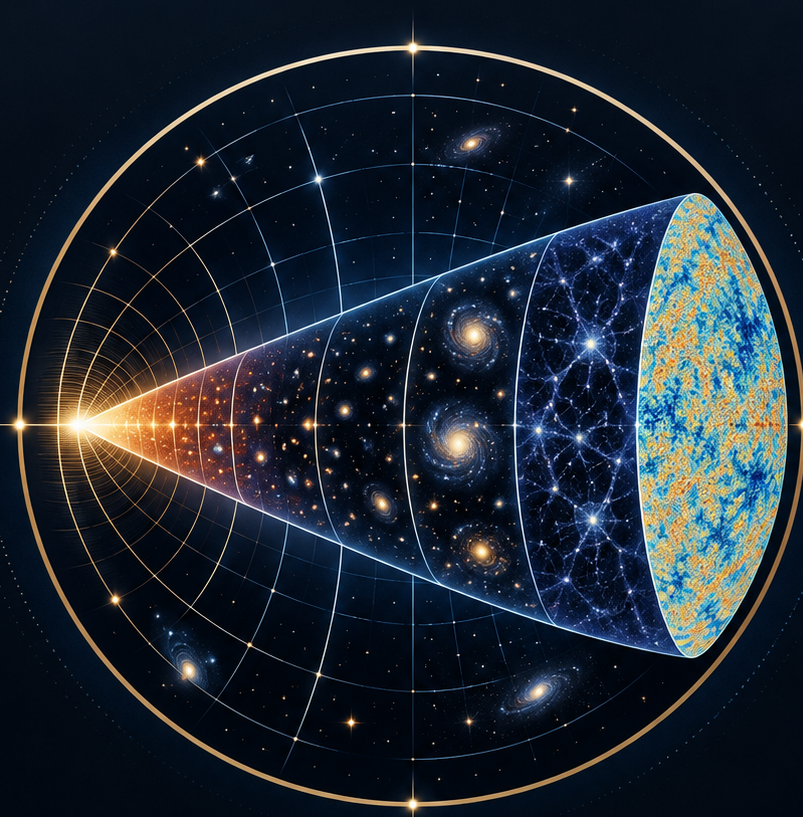
The Big Bang is the prevailing cosmological model describing the origin and evolution of the universe. It posits that the universe began as an extremely hot, dense singularity approximately 13.8 billion years ago and has been expanding and cooling ever since. Whether time itself began at that instant remains an open question in physics and philosophy. According to general relativity, the Big Bang represents a boundary to our extrapolations—a singularity where space-time curvature becomes infinite—but alternative models suggest a possible ‘before’ or a cyclic process. The standard Lambda-CDM model treats the Big Bang as the start of the observable universe’s expansion, but does not definitively address the nature of time before it.
Main Explanation
What Does ‘Beginning of Time’ Mean?
In everyday language, time is a sequence of events. But in physics, time is woven into the fabric of space-time, as described by Einstein’s general relativity. The Big Bang is not an explosion in space; it is an expansion of space itself. When we rewind the cosmic expansion, the universe becomes denser and hotter, eventually reaching a state where our physical laws break down—a singularity. As the New Scientist article notes, ‘at the big bang, space-time distorts into a point of infinite density called a singularity. We can’t say this is where time begins, only that it marks a rupture beyond which we cannot extrapolate.’
Philosophers have long debated whether time has a beginning. Immanuel Kant argued that time is a form of intuition, not a property of the world itself. Modern cosmology offers a more nuanced view: the Big Bang may be the beginning of the universe as we know it, but the question of what came before—if anything—remains speculative. Some models propose a ‘bounce’ from a previous contracting phase, while Roger Penrose’s conformal cyclic cosmology suggests a rescaling of space-time that gives rise to new universes. These are not yet part of the consensus, but they highlight the limits of our current understanding.
The Cosmic Epochs: A Timeline
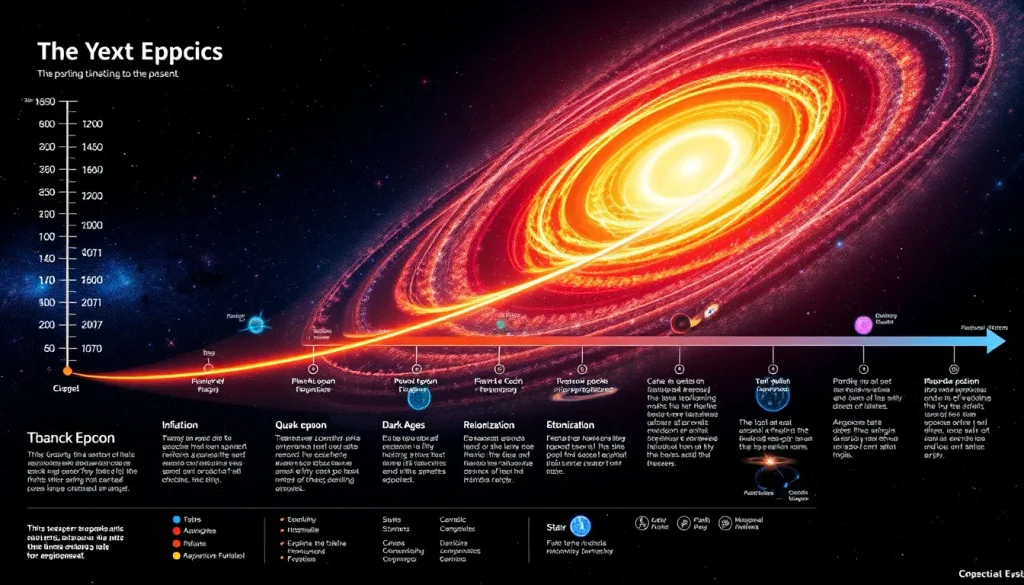
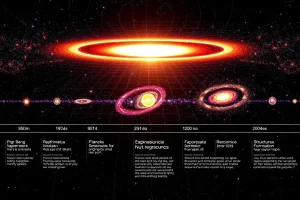
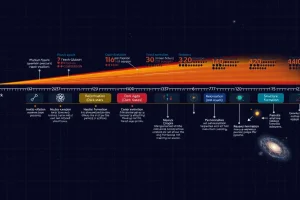
The standard model divides the universe’s history into distinct epochs, each characterized by dominant particles and physical processes. Below is a table summarizing the major epochs from the Planck epoch to the present.
| Epoch | Time After Big Bang | Temperature | Key Events |
|---|---|---|---|
| Planck Epoch | 0 to 10⁻⁴³ s | ~10³² K | Quantum gravity effects dominate; no classical space-time |
| Grand Unification Epoch | 10⁻⁴³ to 10⁻³⁶ s | ~10²⁷ K | Strong and electroweak forces unify; inflation may begin |
| Inflationary Epoch | 10⁻³⁶ to 10⁻³² s | ~10²⁷ K | Exponential expansion; quantum fluctuations seeded structure |
| Electroweak Epoch | 10⁻³² to 10⁻¹² s | ~10¹⁵ K | Electromagnetic and weak forces separate; W/Z bosons acquire mass |
| Quark Epoch | 10⁻¹² to 10⁻⁶ s | ~10¹² K | Quarks and gluons form quark-gluon plasma |
| Hadron Epoch | 10⁻⁶ to 1 s | ~10¹² to 10¹⁰ K | Protons and neutrons form; matter-antimatter annihilation |
| Lepton Epoch | 1 to 10 s | ~10¹⁰ to 10⁹ K | Leptons dominate; neutrinos decouple |
| Photon Epoch | 10 s to 380,000 yr | ~10⁹ to 3000 K | Photons dominate; nucleosynthesis of light elements |
| Recombination | ~380,000 yr | ~3000 K | Electrons combine with nuclei; CMB released |
| Dark Ages | 380,000 yr to ~150 million yr | ~3000 to 50 K | No stars yet; neutral hydrogen fills the universe |
| Reionization | ~150 million to 1 billion yr | ~50 to 10 K | First stars and galaxies ionize hydrogen |
| Structure Formation | 1 billion yr to present | ~10 K to 2.7 K | Galaxies, clusters, and large-scale structure form |
When It Happened: The Planck Epoch and Beyond
The Planck epoch is the earliest moment in the universe’s history, from t=0 to about 10⁻⁴³ seconds (the Planck time). At this scale, quantum gravitational effects are as strong as the other fundamental forces, and our current theories—general relativity and quantum mechanics—are insufficient to describe the physics. This is why the Big Bang singularity is often called a ‘boundary’ rather than a beginning: we simply cannot extrapolate beyond it with known physics.
Temperature and Redshift
As the universe expands, it cools. The temperature at each epoch is inversely related to the scale factor. For example, at recombination, the temperature was about 3000 K, and the redshift was z ≈ 1100. Today, the CMB temperature is 2.725 K, corresponding to a redshift of z = 0. The relationship between temperature and redshift is T = T₀(1+z), where T₀ is the present-day CMB temperature.
Dominant Particles and Physics
Each epoch is defined by the particles that dominate the energy density. In the quark epoch, quarks and gluons existed in a plasma. As the universe cooled, quarks combined into hadrons (protons and neutrons) during the hadron epoch. Later, leptons (electrons, neutrinos) dominated. After neutrino decoupling, photons became the dominant component until matter took over at matter-radiation equality.
What Happened: Inflation and Structure Formation
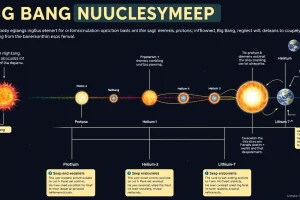
Inflation is a period of exponential expansion that occurred around 10⁻³⁶ seconds after the Big Bang. It solved several problems of the standard Big Bang model, such as the horizon and flatness problems. Quantum fluctuations during inflation were stretched to cosmic scales, providing the seeds for galaxy formation. After inflation, the universe continued to expand and cool, leading to nucleosynthesis (formation of light elements like hydrogen, helium, and lithium) during the first few minutes. The cosmic microwave background (CMB) is a relic of recombination, when the universe became transparent to radiation. The CMB has been measured with extraordinary precision by COBE, WMAP, and Planck, confirming the predictions of the Lambda-CDM model.
What Came Before and What Came Next
What came before the Planck epoch is unknown. Some theories propose a quantum gravity phase, a bounce from a previous universe, or a multiverse scenario. What came next is well understood: the universe evolved through the epochs listed above, eventually forming stars, galaxies, and large-scale structure. The first stars, known as Population III stars, formed during the Dark Ages and reionized the neutral hydrogen, leading to the transparent universe we observe today.
Evidence
The primary evidence for the Big Bang and its timeline includes: (1) the expansion of the universe (Hubble–Lemaître law), (2) the cosmic microwave background radiation, (3) the primordial abundances of light elements, and (4) the large-scale structure of the universe. The CMB is particularly powerful: its blackbody spectrum, anisotropies, and polarization patterns match the predictions of inflation and the Lambda-CDM model. Missions like COBE, WMAP, and Planck have mapped the CMB with increasing precision, providing a wealth of cosmological parameters.
Why It Matters
Understanding whether time began with the Big Bang is not just a philosophical curiosity. It touches on the fundamental nature of space, time, and causality. If time did begin, then the universe has a finite past, which has implications for the concept of a first cause. If time did not begin, then the universe may be eternal, raising questions about entropy and the second law of thermodynamics. Moreover, the cosmic timeline from the Planck epoch to the present is a testament to the power of physics to explain the universe’s evolution from the tiniest scales to the largest. It also guides future research: the James Webb Space Telescope (JWST) is now probing the era of reionization and the first galaxies, while upcoming missions like SPHEREx will map the sky in infrared to study cosmic history.
Evidence / Sources
The following sources provide authoritative information on the Big Bang and the nature of time:
- New Scientist: When did time begin? Hint: It wasn’t at the big bang
- Philosophy Now: Did Time Begin With A Bang?
- Aeon: Scientists are no longer sure the Universe began with a bang
- IOPscience: Was there time before the Big Bang? Philosophical enquiries
Related Registry Entries
Explore related topics in the cosmic timeline:
- Cosmic Microwave Background
- Inflation
- Recombination
- Reionization
- Lambda-CDM Model
FAQ
Did time exist before the Big Bang?
According to general relativity, time as we know it began at the Big Bang singularity. However, this is a boundary of our current physical theories, and some speculative models suggest a pre-Big-Bang phase. The consensus is that we cannot know with current physics.
What is the Planck epoch?
The Planck epoch is the earliest period of the universe, from t=0 to about 10⁻⁴³ seconds, when quantum gravitational effects dominated. Our understanding of physics breaks down at this scale.
How do we know the universe is expanding?
Observations of distant galaxies show a redshift proportional to their distance, known as Hubble's law. This is explained by the expansion of space itself, a key prediction of the Big Bang model.
What is the cosmic microwave background?
The CMB is the afterglow of the Big Bang, radiation emitted about 380,000 years after the start when the universe became transparent. It fills the entire sky and has a temperature of 2.725 K.
Leave a Reply