
Short Answer
Main Explanation
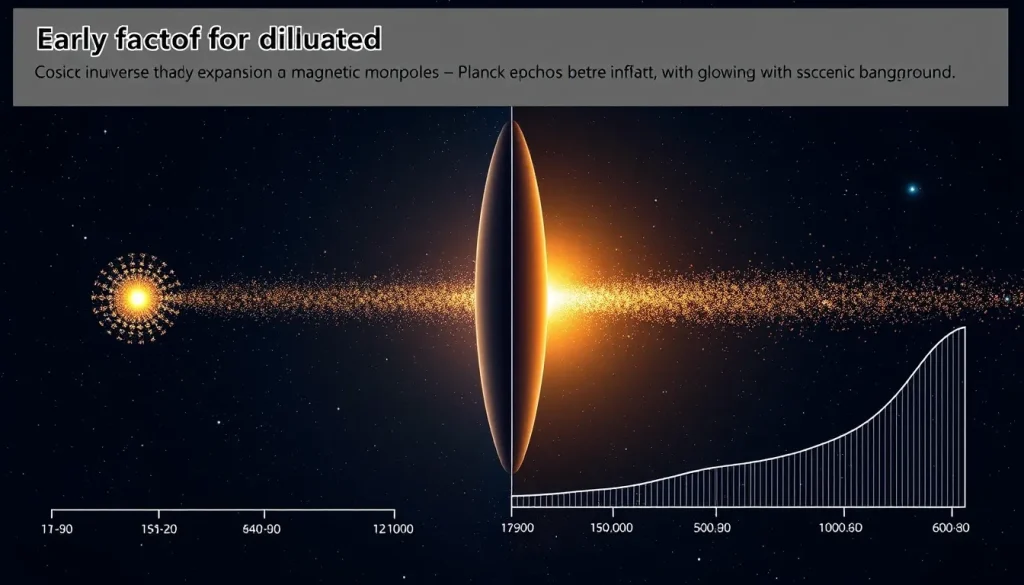
The magnetic monopole problem is one of the three classic puzzles of the hot Big Bang model that motivated the theory of cosmic inflation. It arises from the prediction of grand unified theories (GUTs) that extremely heavy, stable particles called magnetic monopoles should have been produced in abundance during the early universe. Observations show that such particles are essentially absent today, so either the theories are wrong or something diluted them. Inflation provides the dilution mechanism.
To understand the problem, we need to trace the universe’s history from the very beginning. The standard cosmological model describes a sequence of epochs, each characterized by the dominant physical processes and particle content.
Cosmic Epochs Timeline
| Epoch | Time | Temperature | Key Events |
|---|---|---|---|
| Planck epoch | <10-43 s | >1032 K | Quantum gravity effects dominate; no known physics. |
| Grand Unification epoch | 10-43 to 10-36 s | 1032 to 1028 K | GUT symmetry breaking; monopoles may form. |
| Inflationary epoch | 10-36 to 10-32 s | ~1028 K | Exponential expansion; dilutes monopoles and other relics. |
| Electroweak epoch | 10-32 to 10-12 s | 1028 to 1015 K | Electromagnetic and weak forces separate. |
| Quark epoch | 10-12 to 10-6 s | 1015 to 1012 K | Quarks and gluons form a quark-gluon plasma. |
| Hadron epoch | 10-6 to 1 s | 1012 to 1010 K | Protons and neutrons form; annihilation of baryons. |
| Lepton epoch | 1 to 10 s | 1010 to 109 K | Leptons dominate; neutrinos decouple. |
| Photon epoch | 10 s to 380,000 yr | 109 to 3000 K | Photons dominate; nucleosynthesis occurs. |
| Recombination | ~380,000 yr | ~3000 K | Electrons combine with nuclei; CMB released. |
| Dark Ages | 380,000 yr to ~150 million yr | 3000 to ~50 K | No stars; universe dark and neutral. |
| Reionization | ~150 million to 1 billion yr | ~50 to 10 K | First stars and galaxies ionize hydrogen. |
| Structure Formation | 1 billion yr to present | ~10 K to 2.7 K | Galaxies, clusters, and large-scale structure form. |
The monopole problem specifically arises during the Grand Unification epoch. As the universe cooled below the GUT energy scale (~1016 GeV), the symmetry of a unified force broke into the separate strong and electroweak forces. This phase transition, analogous to the freezing of water, can produce topological defects—magnetic monopoles. The expected density of these monopoles is very high, and because they are massive and stable, they would quickly come to dominate the energy density of the universe, contradicting observations.

Inflation solves this by stretching the universe by a factor of at least 1026. Any monopoles created before or during inflation are diluted to negligible densities. The exponential expansion also smooths out any inhomogeneities and flattens the spatial curvature, solving the horizon and flatness problems as well.
The Monopole Problem: A Closer Look
Definition
The magnetic monopole problem is the contradiction between the predicted abundance of magnetic monopoles from grand unified theories and their observed absence in the present universe. It is one of the primary motivations for cosmic inflation.
How It Works
In GUTs, the early universe undergoes a phase transition as it cools, breaking the unified force into the strong and electroweak forces. This symmetry breaking can create stable topological defects—magnetic monopoles—with masses around 1016 GeV. The expected number density is roughly one per horizon volume at the time of formation, which would lead to a present-day density far exceeding observational limits.
Equation
While no single equation defines the problem, the key relation is the dilution factor from inflation: if the scale factor grows by a factor of eN (where N is the number of e-folds, typically >60), the density of any pre-existing particles drops by e-3N. This makes the monopole density negligible.
Example
Imagine a room filled with heavy balls (monopoles). If the room expands exponentially, the balls become so spread out that you rarely encounter one. Inflation does exactly this to the universe, reducing the monopole density to less than one per observable universe.
Observable Consequences
The absence of magnetic monopoles in cosmic rays and in matter searches is consistent with inflation. Additionally, the CMB anisotropies measured by COBE, WMAP, and Planck match inflation’s predictions, providing indirect support.
Common Misconceptions
One misconception is that inflation creates monopoles; in fact, it dilutes them. Another is that the expansion alone solves the problem—but without inflation, the expansion is insufficient to reduce the density to observed limits.
Why It Matters
The monopole problem is a key motivation for inflation. It demonstrates that the hot Big Bang model is incomplete without an early phase of accelerated expansion. Inflation not only solves the monopole problem but also provides a mechanism for generating the initial density perturbations that seeded the large-scale structure of the universe. Understanding this puzzle helps us appreciate the elegance and necessity of inflation in modern cosmology.
Evidence / Sources
The sources used for this article include Liddle’s “An Introduction to Cosmological Inflation,” the Wikipedia article on the magnetic monopole problem, a Physics Stack Exchange discussion, and MIT lecture notes by Alan Guth. These provide authoritative grounding on the topic.
Related Registry Entries
Related concepts include cosmic inflation, magnetic monopoles, grand unified theories, the horizon problem, and the flatness problem. See also the cosmic microwave background and the epochs of the early universe.
Last Reviewed / Updated: September 5, 2026
FAQ
What exactly is the monopole problem?
It is the contradiction between the predicted abundance of magnetic monopoles from grand unified theories and their observed absence in the universe today.
How does inflation solve the monopole problem?
Inflation expands the universe by a huge factor, diluting the density of any pre-existing monopoles to negligible levels.
Is the monopole problem the only reason for inflation?
No, inflation also solves the horizon and flatness problems and explains the origin of cosmic structure.
Have magnetic monopoles ever been observed?
No, despite extensive searches, no magnetic monopoles have been detected, which is consistent with inflation.



Leave a Reply