Short Answer
Short Answer / Definition: The cosmic web is the large-scale structure of the universe—a network of filaments and sheets of matter (mostly dark matter) interspersed with vast voids, on scales from about 30 to 200 megaparsecs. It is the backbone along which galaxies and galaxy clusters are distributed, and its shape reflects the interplay between gravity and cosmic expansion.
| Property | Value |
|---|---|
| Composition | Dark matter (≈5/6), gas, galaxies |
| Scale | 30–200 megaparsecs (no structure beyond) |
| Key components | Filaments, sheets, nodes (clusters), voids |
| Formation | Gravitational collapse of primordial density fluctuations |
| First mapped | By galaxy surveys and CMB observations (e.g., COBE, WMAP, Planck) |
| Consensus model | ΛCDM (Lambda-Cold Dark Matter) |
Main Explanation
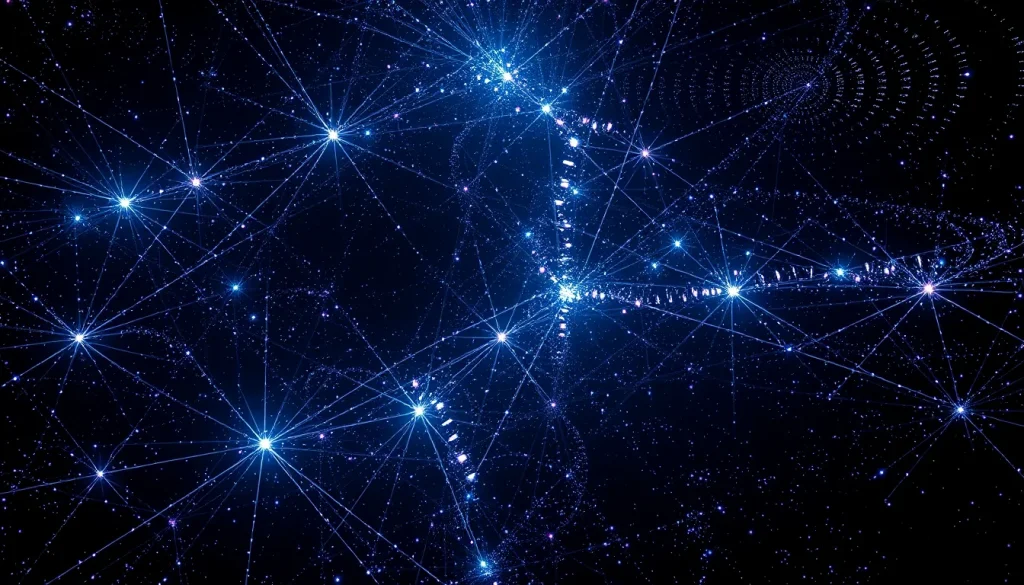
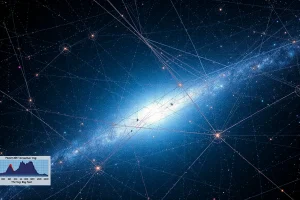
The cosmic web is the universe’s large-scale structure, a pattern of matter distribution that spans the entire observable universe. Observations from sky surveys and 21-cm emission mapping reveal that galaxies are not randomly scattered but arranged in a web-like network of filaments and sheets, with enormous empty regions called voids between them. This structure is hierarchical, with clusters and superclusters forming the densest nodes, connected by filaments of dark matter and gas. Beyond scales of about 200 megaparsecs, the universe appears roughly uniform—a phenomenon known as the “End of Greatness.”
The web is composed, in order of abundance, of dark matter, gas, and galaxies. Dark matter, which does not interact with light, provides the gravitational scaffolding that pulls normal matter into filaments and clusters. The visible galaxies and hot gas trace this invisible framework, as seen in simulations like the Illustris project.
Cosmic Epochs: From Planck to Structure Formation
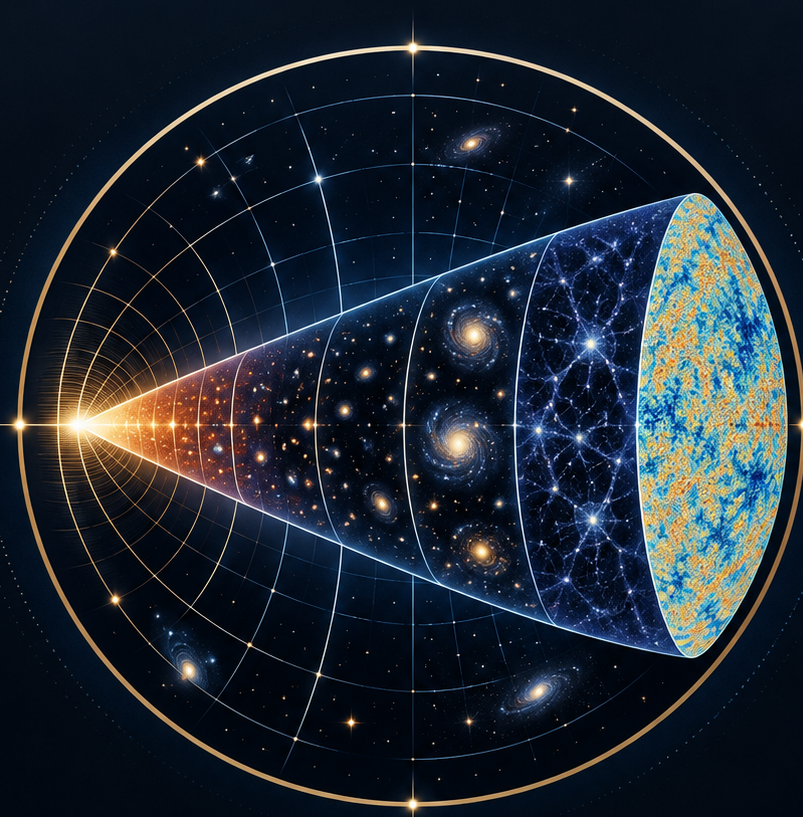
The cosmic web did not always exist. It emerged over billions of years as the universe expanded and cooled, passing through distinct epochs. The following table summarizes the major phases according to the standard ΛCDM model.
| Epoch | Time after Big Bang | Temperature | Redshift | Key Events |
|---|---|---|---|---|
| Planck epoch | 0 to 10⁻⁴³ s | ~10³² K | — | Quantum gravity effects dominate; no current theory |
| Grand Unification epoch | 10⁻⁴³ to 10⁻³⁶ s | ~10²⁷ K | — | Strong and electroweak forces unify |
| Inflationary epoch | 10⁻³⁶ to 10⁻³² s | ~10²⁷ K (cooling rapidly) | — | Exponential expansion; seeds of structure formed |
| Electroweak epoch | 10⁻³² to 10⁻¹² s | ~10¹⁵ K | — | Electromagnetic and weak forces separate |
| Quark epoch | 10⁻¹² to 10⁻⁶ s | ~10¹² K | — | Quarks and gluons exist freely |
| Hadron epoch | 10⁻⁶ to 1 s | ~10¹⁰ K | — | Protons and neutrons form |
| Lepton epoch | 1 s to 10 s | ~10⁹ K | — | Leptons dominate; neutrinos decouple |
| Photon epoch | 10 s to 380,000 yr | 10⁹ K down to 3,000 K | ~1100 | Photons coupled to matter; primordial nucleosynthesis |
| Recombination | ~380,000 yr | ~3,000 K | ~1100 | Electrons combine with protons to form neutral hydrogen; CMB released |
| Dark Ages | 380,000 yr to ~150 million yr | 3,000 K down to ~60 K | 1100 to ~20 | No stars yet; universe filled with neutral gas |
| Reionization | ~150 million yr to ~1 billion yr | ~60 K to ~20 K | ~20 to ~6 | First stars and galaxies ionize the intergalactic medium |
| Structure Formation | ~1 billion yr to present | ~20 K to 2.7 K | 6 to 0 | Galaxies, clusters, and the cosmic web assemble |
What Happened in Each Epoch: The Planck epoch is the earliest moment, where quantum gravity effects dominated and our current physics breaks down. Inflation then stretched tiny quantum fluctuations to cosmic scales, providing the seeds for future structure. As the universe cooled, quarks combined into protons and neutrons (hadron epoch), then leptons and photons dominated. During the photon epoch, light nuclei like helium were synthesized (Big Bang nucleosynthesis). At recombination, electrons joined nuclei to form neutral atoms, and the universe became transparent—releasing the cosmic microwave background (CMB). The Dark Ages followed, with no luminous sources. Then gravity amplified density variations, leading to the first stars and galaxies, which reionized the universe. Over billions of years, these structures merged into the cosmic web we observe today.
Evidence: The cosmic web is mapped through galaxy surveys (e.g., SDSS) and by measuring the faint distortion of light from background galaxies (weak lensing). The CMB, observed by COBE, WMAP, and Planck, shows tiny temperature fluctuations that correspond to the initial density seeds. The Planck satellite’s high-resolution maps confirm the ΛCDM model’s predictions for the distribution of matter and the universe’s geometry. The James Webb Space Telescope (JWST) is now probing the epoch of reionization, revealing early galaxies that shaped the web.
Why It Matters
The cosmic web is not just a curiosity; it is a record of the universe’s history and a testbed for fundamental physics. Its structure encodes the properties of dark matter, dark energy, and the initial conditions set by inflation. By comparing observed web statistics (e.g., matter power spectrum) to simulations, cosmologists can constrain parameters like the Hubble constant and the nature of dark energy. The web also influences galaxy evolution—galaxies in dense nodes evolve differently from those in voids. Understanding the web is essential to answering questions about the fate of the universe: if dark energy continues to accelerate expansion, the web may be stretched and eventually torn apart.
Evidence / Sources
- Galaxy redshift surveys: Map the three-dimensional distribution of galaxies, revealing filaments and voids.
- Cosmic Microwave Background (CMB): COBE (1989), WMAP (2001), and Planck (2009) measured temperature anisotropies that seed the web.
- Weak gravitational lensing: Hubble and ground-based telescopes map dark matter distribution by measuring light distortion.
- Simulations: Illustris, EAGLE, and other simulations reproduce the web’s formation from ΛCDM initial conditions.
- 21-cm observations: Radio telescopes (e.g., LOFAR, HERA) probe the neutral hydrogen during reionization.
Related Registry Entries
- Cosmic Microwave Background
- Inflation
- Recombination
- Dark Matter
- Large-Scale Structure
FAQ
What is the cosmic web?
The cosmic web is the universe's large-scale structure—a network of filaments and sheets of dark matter, gas, and galaxies, with vast voids between them.
How did the cosmic web form?
It formed from tiny density fluctuations amplified by gravity after the Big Bang. Dark matter collapsed into filaments, pulling gas and galaxies along, while expansion stretched voids.
What evidence supports the cosmic web?
Galaxy redshift surveys, weak lensing maps, CMB temperature anisotropies, and cosmological simulations all confirm its existence and match ΛCDM predictions.
Why is the cosmic web important?
It encodes the history of the universe, tests dark matter and dark energy models, and influences galaxy evolution. It also helps predict the ultimate fate of cosmic structure.
Leave a Reply